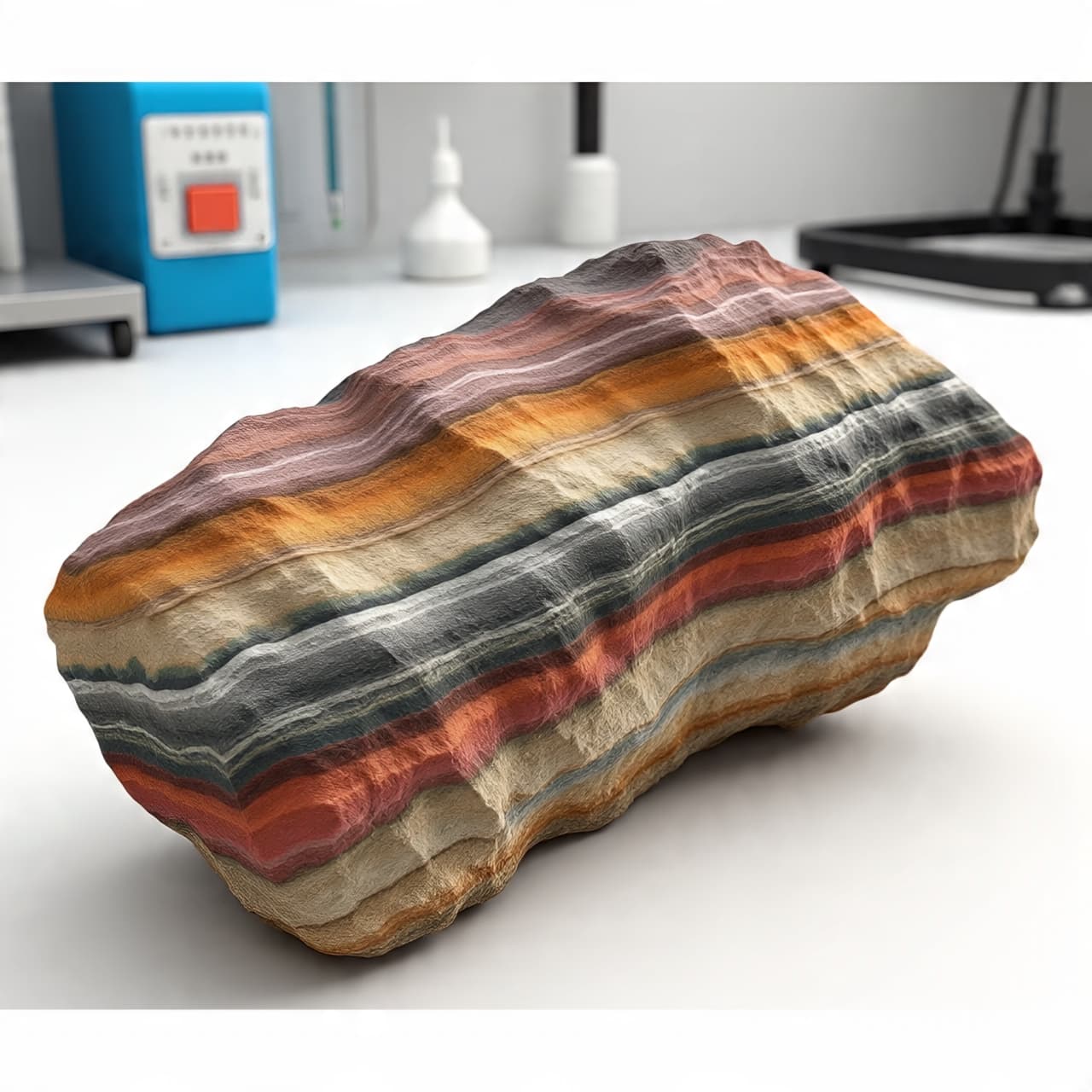
Like footprints on a deserted shore, the organic molecules found on Mars seem to echo questions we’ve carried for generations. When the Curiosity rover drilled into the ancient mudstone of Gale Crater, it uncovered long-chain carbon compounds — threads of chemistry that, here on Earth, are woven into the tapestry of life. Scientists have spent decades learning how such molecules can appear in a world without life, tracing them to dust from space or deep-seated chemistry in rocks. Yet now, a new NASA-led study has gently shifted that narrative, suggesting that some organic signatures on Mars are not easily explained by the silent forces of geology alone.
To picture this is to imagine unpicking a long-buried thread in a tapestry. After about 80 million years of radiation battering the Martian surface, the original abundance of organic molecules in the Cumberland mudstone may have been far higher than what Curiosity detects today. Researchers led by Alexander Pavlov estimate those levels could have once been between 120 and 7,700 parts per million — a richness that, when measured against the known sources of non-biological organics, seems difficult to account for without invoking processes we do not yet fully understand.
It is important to underline — as the scientists themselves carefully do — that this is not a declaration of life on Mars. Mars researchers know well the difference between tantalizing mystery and confirmed discovery. The study’s findings invite deeper inquiry rather than delivering closure: perhaps unknown abiotic chemistry is at work; perhaps there are mechanisms of organic preservation and synthesis we have not yet grasped.
Yet there is something quietly powerful in the idea that nature on Mars may have woven complexity into its ancient rocks. Organic molecules are essential building blocks — they form the membranes of cells, the energy stores of living tissue, and the cycles of carbon that sustain ecosystems. On Earth, similar molecules are deeply entangled with biology; on Mars, their presence invites us to ask again what once was possible beneath a cold, rust-colored sky.
In the interplay between curiosity and evidence, scientists continue to refine their models, to test hypotheses, to return to the raw data and the cold equations that govern planetary chemistry. Each new finding — measured with care, interpreted with humility — expands the canvas on which we paint our understanding of Mars. The quest is not simply about proof of life but about grasping what ancient worlds can tell us about how life might arise, or why it might falter. And in that quiet probing lies one of the most profound scientific journeys of our age.
AI Image Disclaimer (Rotated Wording) Illustrations were produced with AI and serve as conceptual depictions, not real photographs.
Sources
ScienceAlert (reporting on the study) Phys.org (science news syndicate) Orbital Today (space science media) SpaceDaily (science/space press) Times of India (science reporting on Mars organics)
Published by Banx Network. This article is part of the Banx decentralized media programme, powered by the BXE token on the XRP Ledger.