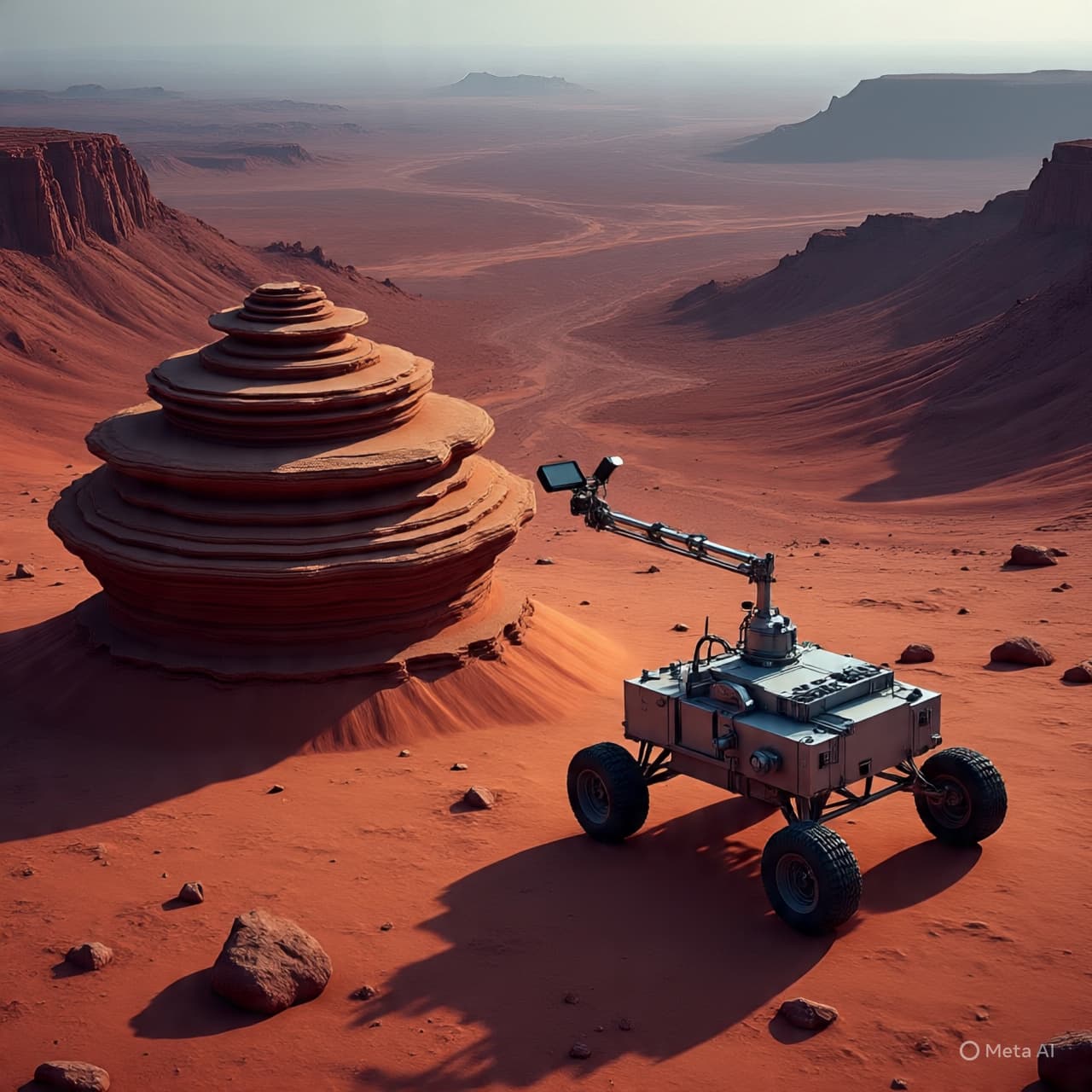
There are moments in science when silence itself seems to carry meaning. On Mars, where winds move slowly across an ancient landscape, rocks have remained undisturbed for billions of years. Through the steady work of NASA’s Perseverance rover, these stones are beginning to reveal something unexpected.
Recent findings suggest that certain Martian rocks, estimated to be around three billion years old, contain features or materials not previously observed at such scale. While the exact nature of these findings is still under investigation, early analysis points to complex chemical or structural patterns that may reshape understanding of Mars.
Perseverance, which landed in Jezero Crater in 2021, continues its mission to study signs of past habitability. The crater is believed to have once held water, making it an ideal location for preserving ancient environmental records. Layers of sediment may contain traces of processes that occurred long ago.
The newly identified features stand out because of their size and consistency. Similar patterns have been seen before in smaller forms, but not at this level. This raises new questions about the conditions that existed on Mars during its early history.
Scientists are exploring whether these structures formed through interactions with water. On Earth, comparable formations can sometimes be linked to biological processes, although researchers emphasize that no direct evidence of life has been confirmed on Mars. Distinguishing between geological and biological origins remains complex.
The rover’s instruments, including advanced cameras and spectrometers, allow scientists to study the composition and texture of the rocks in detail. Each measurement contributes to a clearer picture of how these formations developed over time.
These discoveries also support future plans to return samples to Earth. Materials collected by Perseverance may eventually be studied in laboratories, where more precise analysis can be conducted. Such efforts could provide answers that current instruments cannot fully deliver.
The findings add to a growing understanding that Mars was once more active than it appears today. Evidence suggests the presence of water and dynamic environmental conditions in the distant past.
Even so, researchers proceed carefully. Scientific interpretation requires time, and each discovery often leads to new questions rather than immediate conclusions. The process remains ongoing.
In the quiet landscape of Mars, the past is preserved with unusual clarity. Whether these rocks reveal signs of ancient life or simply deepen understanding of planetary history, their significance continues to grow.
AI Image Disclaimer Illustrations were produced with AI and serve as conceptual depictions.
Sources NASA Nature Science Magazine BBC News Reuters
Published by Banx Network. This article is part of the Banx decentralized media programme, powered by the BXE token on the XRP Ledger.