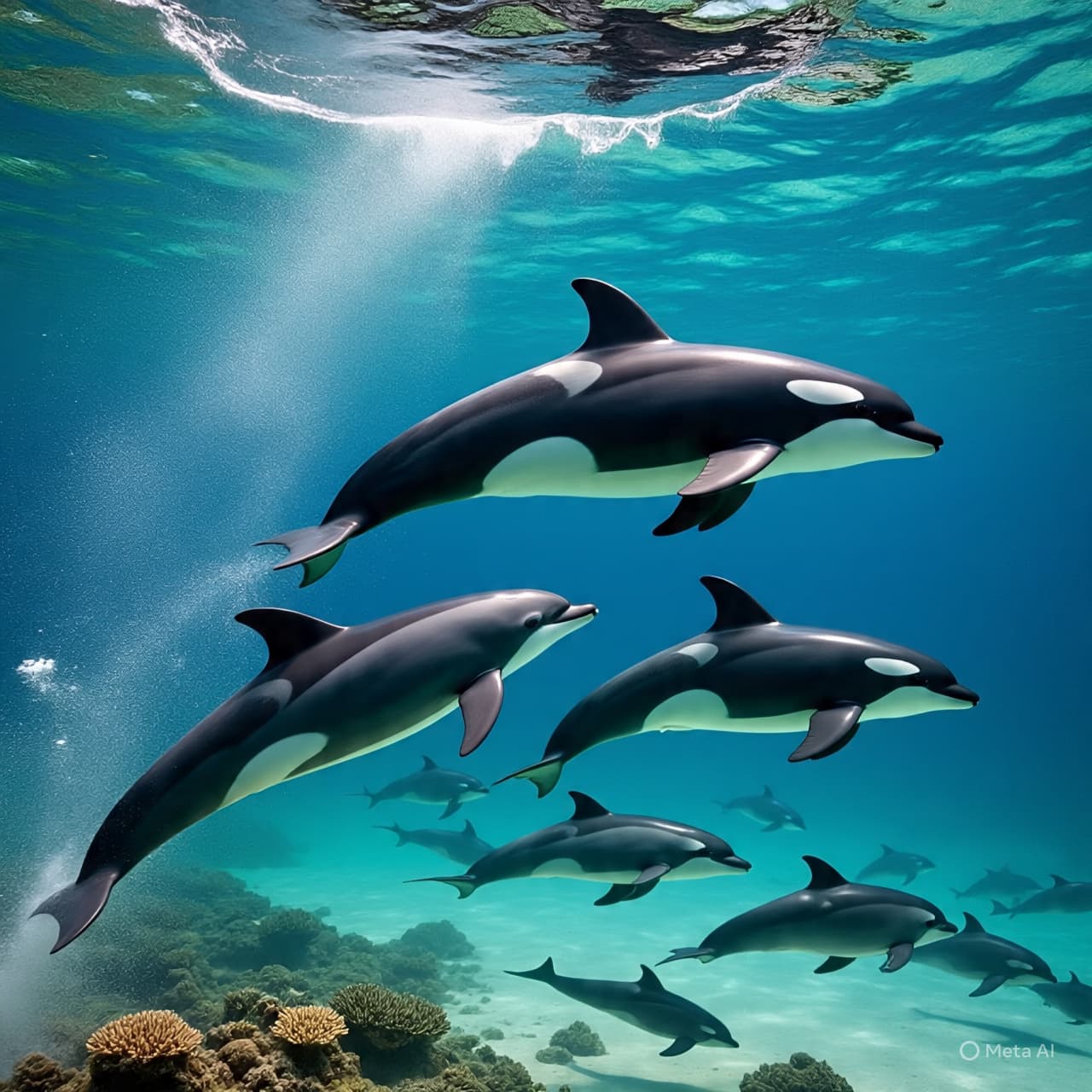
In the ever‑shifting blue tapestry of the Pacific, where currents swirl and life brims from sunlit shallows to oceanic depths, an unexpected alliance has emerged — one that challenges long‑held ideas about predator behaviour in the sea. Researchers studying marine mammals off the coast of British Columbia have documented a remarkable partnership: northern resident killer whales, commonly known as orcas, moving and hunting in concert with Pacific white‑sided dolphins — a relationship that, until now, was little more than an intriguing curiosity.
Unlike the dramatic scenes of orcas preying on seals or large whales, this interaction is one of cooperation rather than conflict. Using drones, underwater video and biologgers, scientists tracked the two species during foraging missions targeting Chinook salmon, a prized but elusive prey. What stood out wasn’t just their proximity, but the coordinated way they moved together, with dolphins leading in ways that seemed to help guide the whales to the richest fishing grounds.
The scientific study suggests several reasons behind this interspecies teamwork. Killer whales, which rely heavily on salmon, especially Chinook, may be using the dolphins’ remarkably sensitive echolocation as an acoustic guide — essentially “listening in” on the dolphins’ sonar to find fish over larger areas. The dolphins, for their part, may benefit from the orcas’ presence by scavenging scraps of salmon that are too big for them to consume whole, and potentially by gaining increased protection from other orca types that pose threats.
What makes these observations especially compelling is the lack of aggression between the species during hunts. In many interspecies encounters, one predator might chase or avoid another. Here, dolphins and orcas swim within meters of each other, matching dives and turns as if they share a common purpose. The whales often reduced their own echolocation when dolphins were present — a behaviour interpreted by scientists as “eavesdropping” on the smaller cetaceans’ sonar clicks so they can locate fish more effectively.
This remarkable behaviour wasn’t a one‑off. Over dozens of documented interactions, orcas repeatedly oriented themselves toward dolphins and followed their movements during high‑value foraging events. Once fish were located, there were instances where salmon were shared among the orcas, and dolphins opportunistically fed on the leftovers — a pattern that suggests mutual benefit rather than mere coincidence.
Scientists caution that it is still early days in understanding this alliance. Some experts note that more data is needed to conclusively determine whether this is true cooperative hunting or a form of opportunistic foraging that happens to benefit both species. Nonetheless, this first documented case of orca‑dolphin teamwork adds a fresh layer to our understanding of marine mammal social dynamics, demonstrating that even apex predators can engage in complex, interspecies relationships that transcend simple competition.
AI Image Disclaimer Visuals are created with AI tools and are not real photographs.
Sources: AOL News
• Scientific Reports study via Nature
• The Guardian
• Washington Post
• Discover Magazine reporting
Published by Banx Network. This article is part of the Banx decentralized media programme, powered by the BXE token on the XRP Ledger.