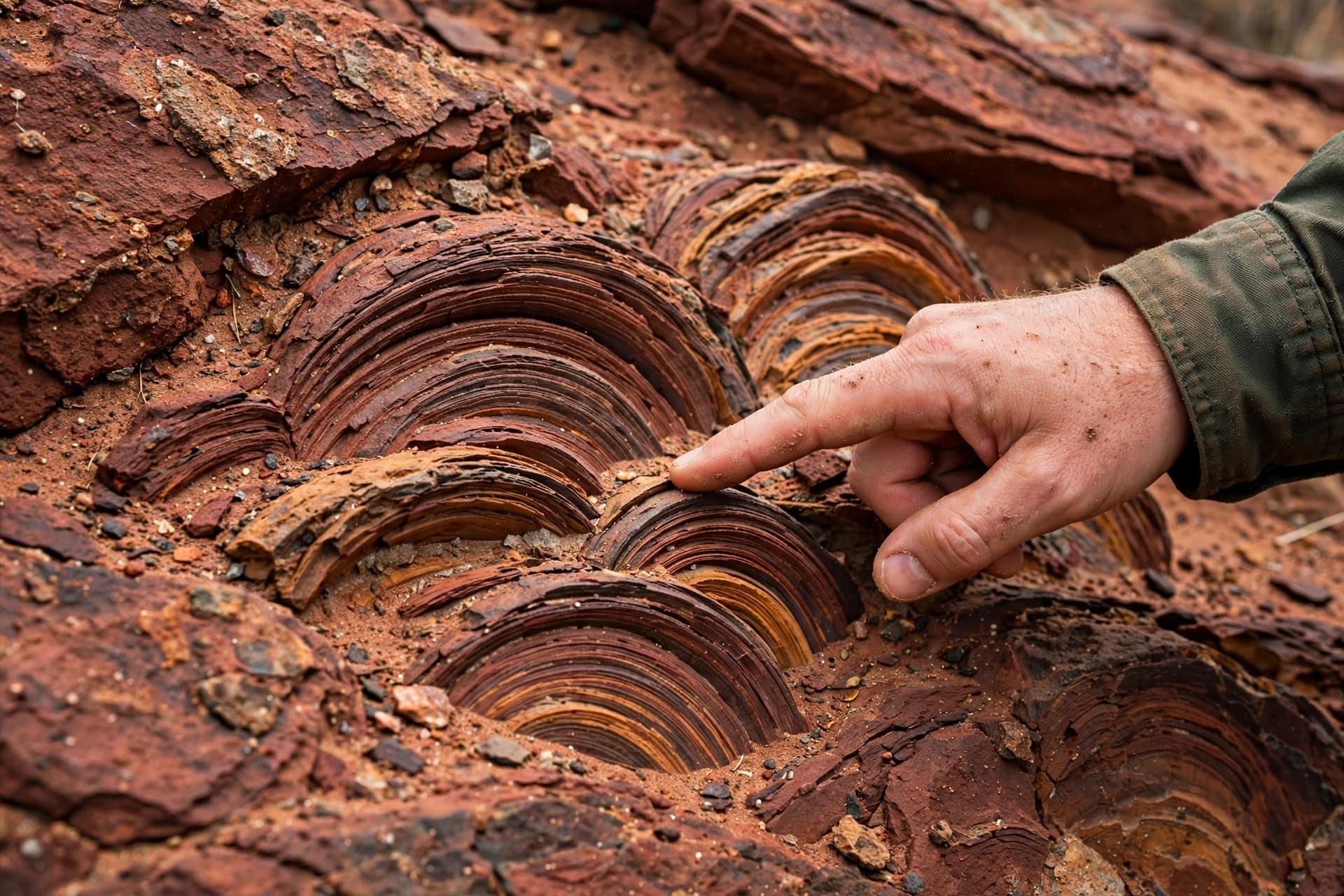
There is a particular irony in the fact that the oldest evidence of life on Earth is so easily overlooked. It does not announce itself with bones or shells or the dramatic silhouettes of dinosaurs. It sits in the rocks of Western Australia, in structures that look like ordinary mounds, formed by communities of microbes that lived nearly 3.5 billion years ago—before oxygen filled the sky, before forests reached upward, before anything that could be called an animal walked on land.
These structures are called microbialites, and they are the earliest visible evidence of life on our planet . They come in two main forms: stromatolites, with distinctive layers, and thrombolites, with a clotted texture whose origins remain one of science's unresolved questions . Western Australia holds an extraordinary record of them, from the oldest known examples preserved in the Pilbara to living microbialites in the UNESCO World Heritage area of Shark Bay—modern examples that scientists describe as a "Rosetta Stone" for understanding their ancient counterparts .
The record they preserve is not merely a curiosity. Microbialites offer clues about where the earliest life lived, how the atmosphere became oxygen-rich, and how life responded to environmental upheaval in the deep past. Western Australia's microbialite record spans at least one, and potentially two, of Earth's five major mass extinctions . Evidence suggests that sudden increases in microbialites often preceded or coincided with major ecological disruption—that they may act as early indicators of stress in the systems they inhabit .
Yet these ancient archives are surprisingly fragile. Living microbialites grow extremely slowly, meaning physical damage can take decades or centuries to repair, if it can be repaired at all . In May 2024, dozens of aurora chasers trampled 2,000-year-old thrombolites in a restricted area at Lake Clifton, causing what may be irreparable harm . Fossil sites face their own pressures: tourism, inappropriate collecting, and even scientific sampling can diminish them. Their protection falls under the category of geoheritage, which the 2021 Australian State of the Environment report concluded had a "poor" outlook due to the lack of national frameworks, focus, and resourcing .
The challenge is compounded by the fact that microbialites do not look like what we expect ancient life to look like. They are not dramatic. They do not photograph well. They sit in quiet places, doing their slow work, and they ask for nothing. It is easy to walk past them, to step on them, to chip away a piece without understanding what has been lost. The rock-like appearance makes their fragility difficult to appreciate, even for those who know better .
Scientists continue to fill the gaps in our understanding. They debate how to distinguish structures built by life from those produced by non-biological processes, what environments ancient microbialites formed in, and why thrombolites are clotted rather than layered . But the gaps are closing slowly, and the archives themselves are not guaranteed to remain intact for the scientists who might one day answer those questions.
What is at stake is not merely the past but the future of our understanding. The microbialite record offers a deep-time perspective on how ecosystems respond to environmental change—a perspective that may inform how we navigate the disruptions of the present. But that perspective depends on the evidence surviving. The oldest story of life on Earth is written in stone, and stone, it turns out, can be erased. The question is whether we will choose to read it before it is gone.
AI Image Disclaimer: This article includes AI-generated imagery created for illustrative purposes only.
Sources: The Conversation, Daily Excelsior
Published by Banx Network. This article is part of the Banx decentralized media programme, powered by the BXE token on the XRP Ledger.