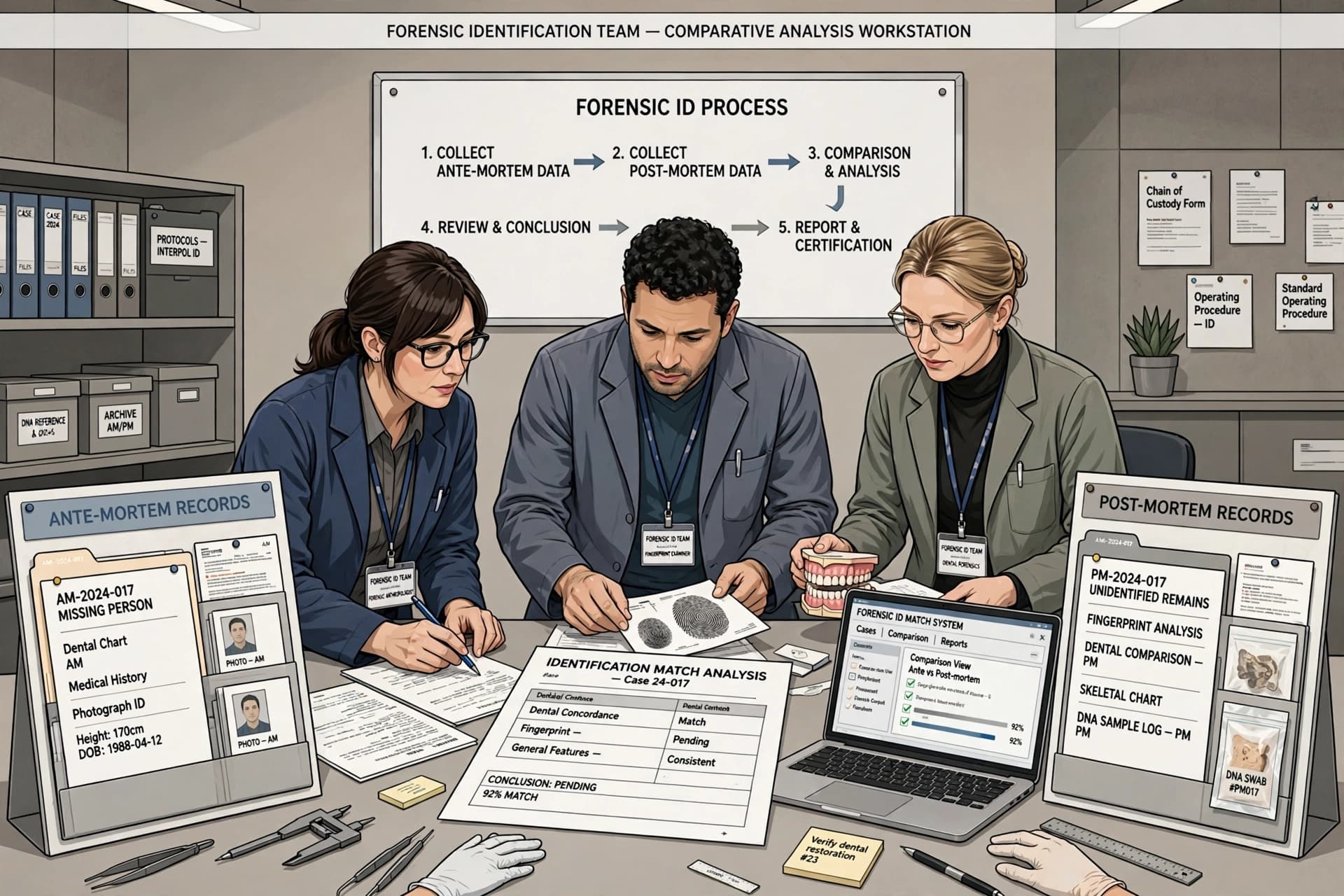
As of September 19, 2026, DVI Polri had identified nine deceased victims from KM Virgo Transport 8. All nine had been handed over to their respective families after the identification process was completed. The identification process uses two principal categories of information. Ante-mortem data are information collected before a person is found, including identifying information and comparison material obtained from family members. Post-mortem data are gathered through examination of the recovered victim. The two sets of information are then compared as part of the DVI process. The nine victims identified by September 19 came from several regions. Polri reported that four were from East Java, two from West Java, and three from South Kalimantan. Their identities were established before the remains were returned to their families. The identification effort was being strengthened as the SAR operation continued. Polri prepared 140 DVI personnel, consisting of 66 personnel from the South Kalimantan Regional Police DVI team, 56 from the East Java Regional Police DVI team, and 18 from the National Police Medical and Health Center. The personnel involved include medical professionals and other specialists supporting the identification process. Their work becomes particularly important when recovered victims cannot immediately be identified through ordinary visual recognition. Scientific comparison allows authorities to establish identity through documented evidence and information supplied by families. Family data collection has also been part of the wider effort. In Garut, West Java, authorities collected ante-mortem information and DNA samples from relatives of KM Virgo victims. On September 15, 13 family members participated in the sampling process, including relatives of people who had died and those who remained missing. Polri reported that by September 19 it had collected 153 ante-mortem records. After accounting for 18 duplicate records, 135 records remained, with nine already reconciled and 126 still awaiting reconciliation. These records serve as comparison material as authorities continue receiving and examining information from recovered victims. The identification process therefore moves alongside the search itself. As additional victims are recovered, investigators and medical personnel must establish identities before remains can be formally returned to families. For those still waiting, the work of DVI provides a structured process for turning uncertainty into verified information. The latest DVI operation is part of the broader response to the KM Virgo Transport 8 disaster. While search teams continue looking for people who remain unaccounted for, identification teams continue examining the victims who have been recovered. Each confirmed identity closes one part of the process while the wider search continues at sea.
Published by Banx Network. This article is part of the Banx decentralized media programme, powered by the BXE token on the XRP Ledger.