There are rooms where time settles gently.
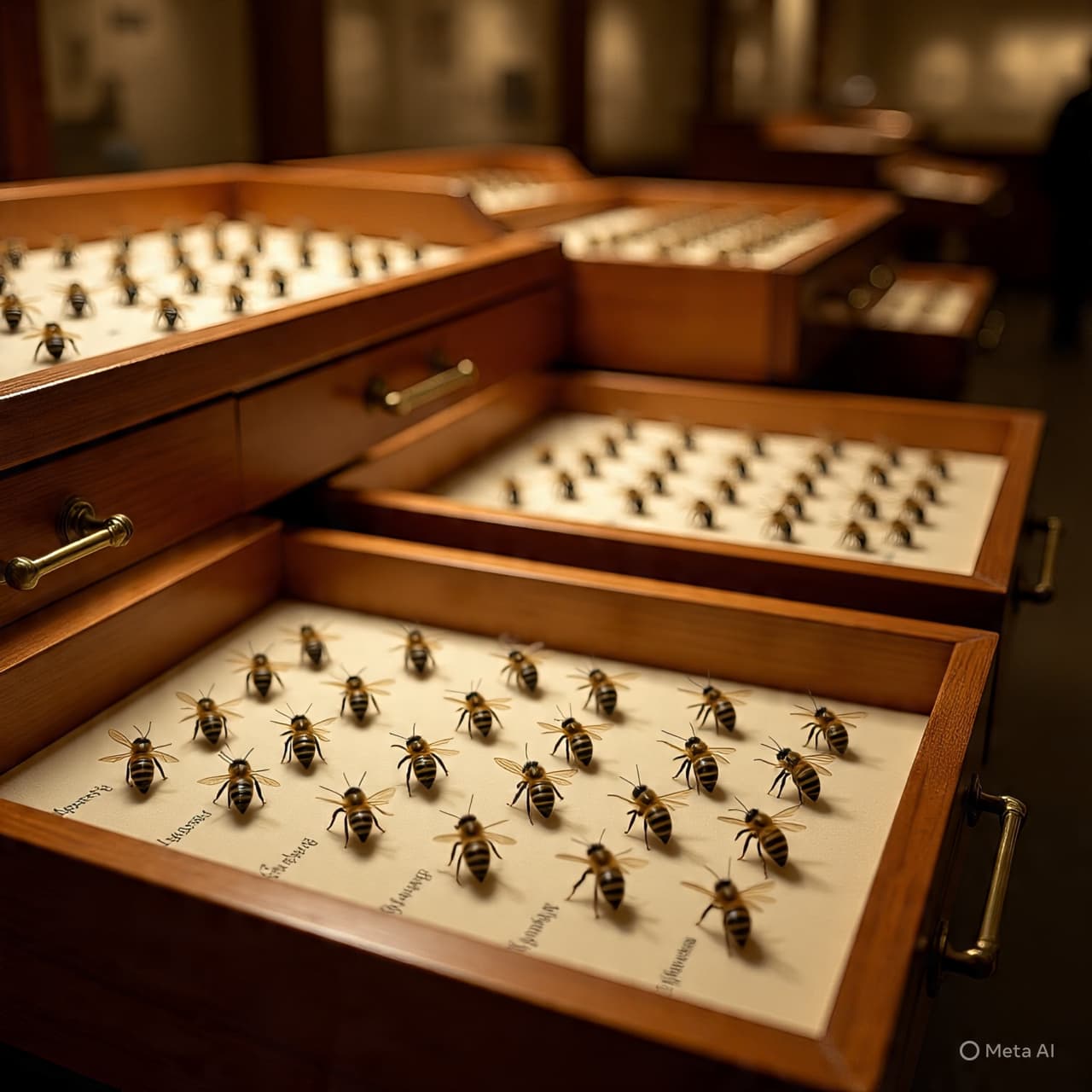
Behind closed doors, beyond the reach of daily movement, rows of cabinets hold what once moved freely through fields and air. Inside them, carefully arranged and labeled, are bees—thousands upon thousands—each one a small fragment of a larger world that has long since shifted. Their wings no longer stir, but their presence remains, preserved in stillness, waiting without urgency.
For generations, natural history collections have gathered such specimens, building quiet archives of life on Earth. Institutions like the Natural History Museum and the Smithsonian Institution have held these collections not as displays alone, but as records—evidence of where species lived, how they varied, how they changed. Yet much of this knowledge has remained, in a sense, contained. To access it required proximity, time, and careful handling.
Now, that stillness is beginning to shift.
The Big Bee Project, a collaborative effort among museums and research institutions, is working to bring these collections into a different kind of space—one not bound by drawers or glass, but by data and connection. Through large-scale digitization, the project aims to catalog and image vast numbers of bee specimens, translating physical collections into accessible, searchable records.
It is a quiet transformation, but a significant one.
Each specimen carries more than its form. There are labels, often handwritten, noting the place and date of collection, sometimes the conditions, sometimes the name of the person who found it. These details, once read individually, can now be aggregated, forming patterns across time and geography. A single bee becomes part of a larger map—of movement, of decline, of persistence.
The work itself is meticulous. Specimens are photographed with high precision, their features captured in detail. Labels are transcribed, their information structured into databases that can be shared across institutions. It is not simply preservation, but translation—from object to information, from isolation to network.
There is a certain patience in this process, an echo of the care with which the specimens were first collected.
But the implications extend outward. As concerns about pollinator decline grow, the need for historical data becomes more immediate. Understanding where species once thrived, and how their distributions have changed, offers context for the present—though not in a way that demands urgency or alarm, but rather in a way that deepens awareness.
The past, in this sense, becomes a resource.
Researchers can compare contemporary observations with records that stretch back decades, even centuries. Subtle shifts—changes in range, variations in form—begin to emerge. What once required physical access to a collection can now be explored remotely, allowing scientists, students, and the public to engage with the material in new ways.
There is also something more intangible at work.
In bringing these collections into the digital realm, the project alters their presence. The bees remain where they are, in their drawers and cases, but they are no longer confined to them. They become visible in a broader sense, their existence extended beyond the rooms that house them.
It is not a replacement of the physical, but an expansion of it.
And so, the quiet rooms remain, their order unchanged. The cabinets still open and close. The specimens rest as they always have. But alongside that stillness, another form of movement has begun—data flowing outward, connections forming, histories unfolding in new configurations.
The Big Bee Project is digitizing natural history collections to make bee specimens and their data widely accessible. By imaging and cataloging specimens from major institutions, the initiative supports research into biodiversity, pollinator trends, and environmental change.
AI Image Disclaimer
These visuals are AI-generated and intended for illustrative purposes only.
Source Check: Natural History Museum (London), Smithsonian Institution, The Guardian, Science Magazine, BBC
Published by Banx Network. This article is part of the Banx decentralized media programme, powered by the BXE token on the XRP Ledger.