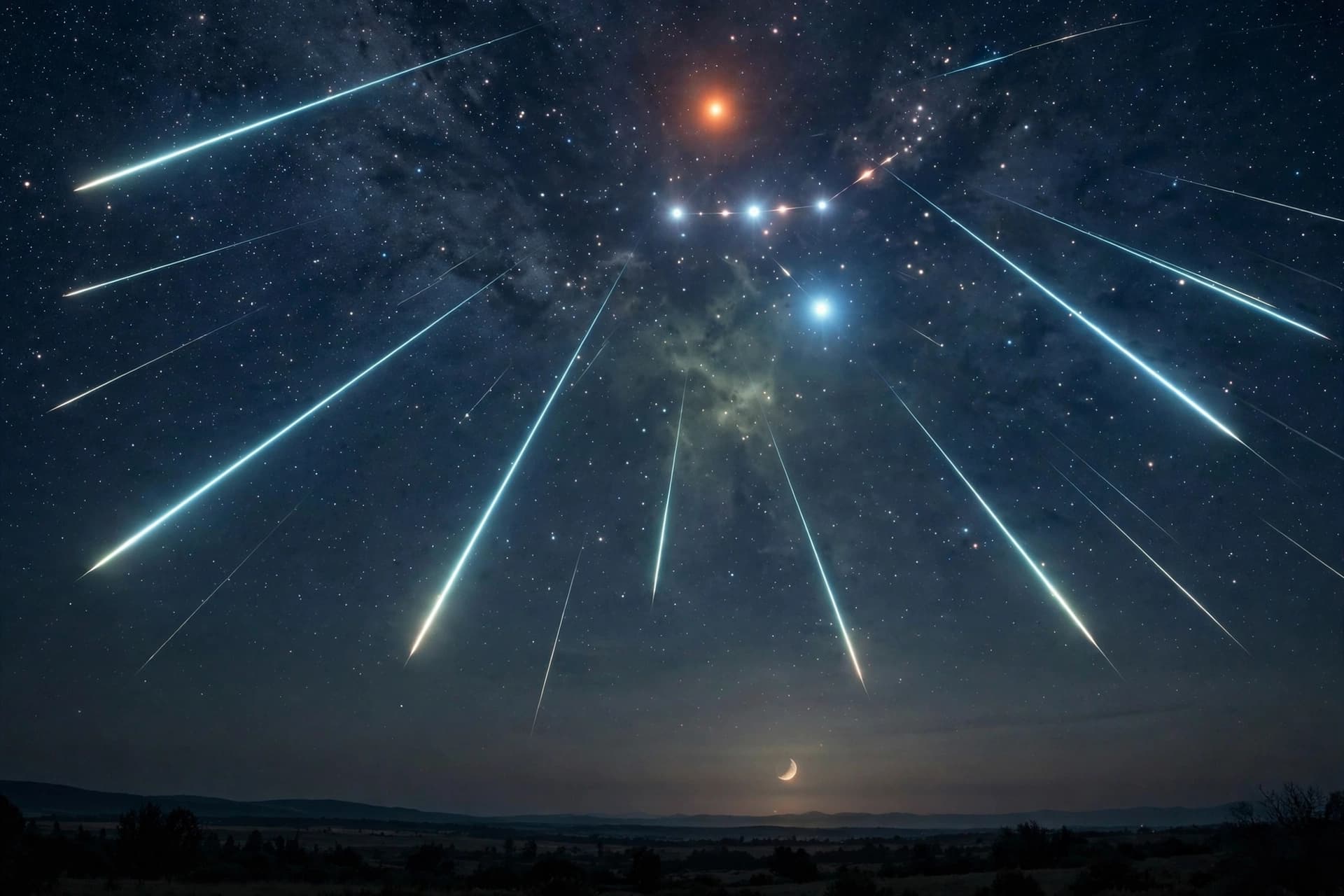
There is a particular charm in a meteor shower that does not demand the sacrifice of a night's sleep—a shower that arrives in the early evening, delivers its brief but beautiful display, and then fades into the night, leaving you free to go to bed at a reasonable hour. The Draconid meteor shower is exactly that kind of event. Unlike many showers that peak in the pre-dawn hours, the Draconids are best observed in the evening, making them an accessible and family-friendly celestial event.
The Draconids are produced by debris from Comet 21P/Giacobini-Zinner, a periodic comet that orbits the Sun every 6.6 years. When Earth passes through the stream of particles left behind by the comet, those particles burn up in the atmosphere, creating the streaks of light we call meteors. The shower is named after the constellation Draco, from which the meteors appear to radiate—though they can be seen anywhere in the sky.
This year, the shower peaks on the evening of October 8 and the early morning of October 9. The Moon, a waning crescent, will be only about 10 percent illuminated, meaning dark skies and excellent viewing conditions. The best time to look is after dusk, when Draco is high in the northern sky. Unlike the Perseids or Geminids, which produce meteors for weeks, the Draconids are a short, sharp event—most of the activity occurs over a single night. The rates are typically modest, around 5 to 10 meteors per hour, but the Draconids have produced spectacular outbursts in the past, with rates reaching hundreds or even thousands per hour when Earth passes through a particularly dense clump of debris. Those outbursts are difficult to predict, but when they occur, they are unforgettable.
The Draconids are a reminder that the night sky is not static. It is a place of constant activity, of particles from ancient comets, of light from distant stars, of events that happen on schedules we can predict but cannot control. The shower is a small thing—a few meteors, a brief display—but it is a connection to something larger: the comet that created it, the orbit that brings it back, the planet that passes through its path. The evening is the time. The sky is the place. And the Draconids are waiting.
AI Image Disclaimer: The visual elements in this article were created using AI generation tools and are intended for illustrative purposes only.
Sources: NASA, American Meteor Society, EarthSky
Published by Banx Network. This article is part of the Banx decentralized media programme, powered by the BXE token on the XRP Ledger.