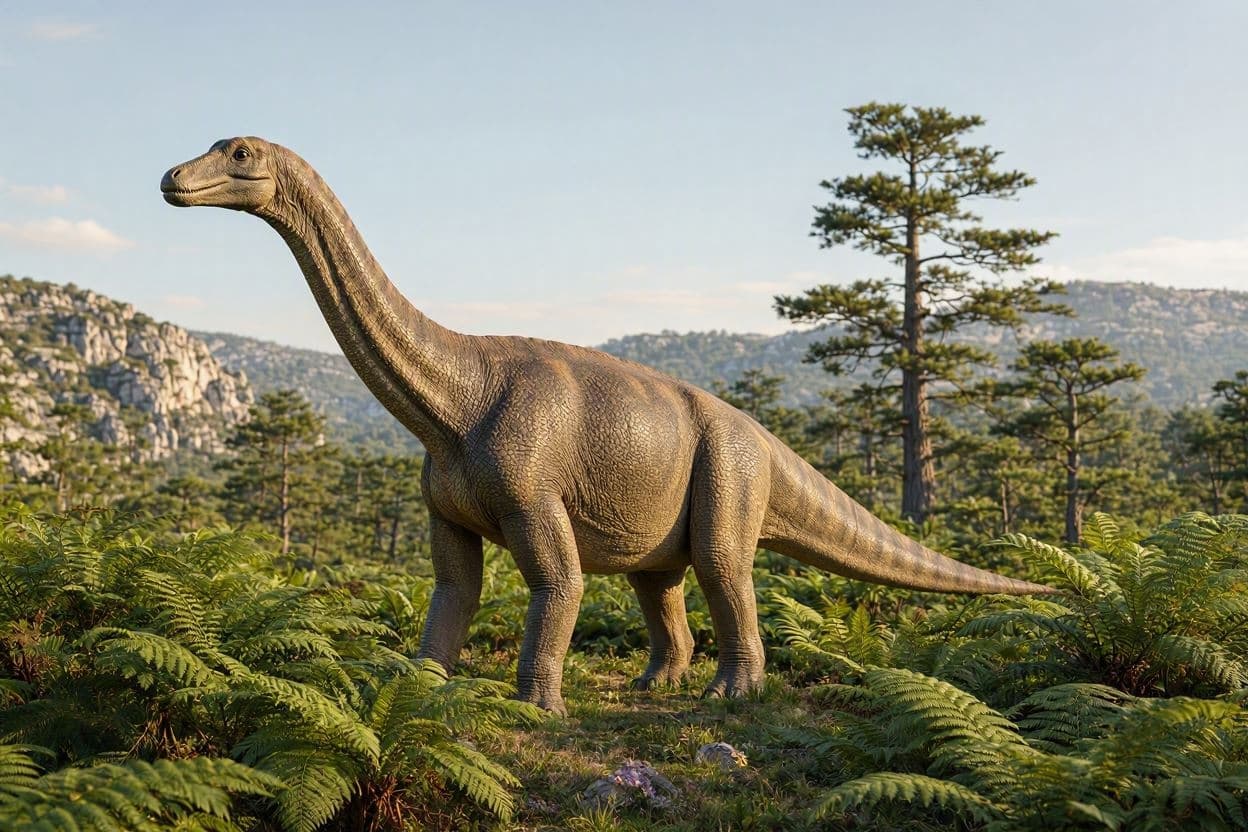
For over a century, the iconic Diplodocus has been synonymous with the prehistoric landscapes of North America, its long neck and whip-like tail dominating museum halls from New York to London. This sauropod, a symbol of the Late Jurassic period, was believed to be exclusively native to the Morrison Formation in the western United States. However, a recent discovery in Spain has rewritten this chapter of paleontological history, confirming that these gentle giants once roamed the lands of Europe as well.
Paleontologists from the Fundación Conjunto Paleontológico de Teruel-Dinópolis have identified the first confirmed fossils of the genus Diplodocus outside North America. Unearthed at the La Tejería site in El Castellar, Teruel, the specimen consists of fourteen exceptionally preserved caudal vertebrae and several chevron bones. The anatomical features, including large pneumatic cavities and distinctive forked chevrons, align closely with those of Diplodocus hallorum, a species previously known only from the American West.
This finding challenges long-held assumptions about dinosaur distribution during the Late Jurassic, approximately 150 million years ago. It suggests that land bridges may have periodically emerged across the proto-North Atlantic Ocean, allowing for faunal exchange between the two continents. The presence of Diplodocus in Iberia indicates that these massive herbivores were capable of migrating across vast distances, adapting to diverse ecosystems on both sides of the ancient ocean.
The discovery also highlights the rich biodiversity of the Spanish Jurassic, a region that has already yielded numerous other sauropod species such as Turiasaurus and Losillasaurus. The coexistence of Diplodocus with these distinct sauropods suggests that the coastal environments of eastern Iberia supported complex and varied ecosystems, capable of sustaining multiple giant herbivore species simultaneously.
Sergio Sánchez Fenollosa, the lead author of the study, described the excavation as a gradual process of piecing together a puzzle. As the team analyzed the osteological details, the similarities to North American diplodocids became undeniable. The confirmation of Diplodocus in Europe not only expands the geographic range of the genus but also provides new insights into the evolutionary history and dispersal patterns of sauropod dinosaurs.
The fossils are now on display at the Museo Aragonés de Paleontología in Dinópolis, where they serve as a testament to the interconnectedness of prehistoric life. For visitors and researchers alike, the specimen offers a tangible link to a time when continents were closer together, and dinosaurs wandered freely across what is now the Atlantic divide.
This discovery underscores the importance of continued paleontological exploration in Europe, a region that holds many untold stories of the Mesozoic era. As more fossils are unearthed and analyzed, our understanding of dinosaur biogeography continues to evolve, revealing a world far more dynamic and interconnected than previously imagined.
In reflecting on this find, one is reminded of the enduring mystery of the past. Each fossil discovered is a piece of a larger narrative, helping us reconstruct the lives of creatures that dominated the Earth millions of years ago. The Spanish Diplodocus stands as a bridge between continents and epochs, inviting us to look deeper into the history of our planet.
AI Image Disclaimer: The images accompanying this report are AI-generated artistic renderings of the dinosaur and its environment, not photographs of the actual fossils.
Sources: Taylor & Francis Newsroom Journal of Vertebrate Paleontology Fundación Dinópolis
Published by Banx Network. This article is part of the Banx decentralized media programme, powered by the BXE token on the XRP Ledger.