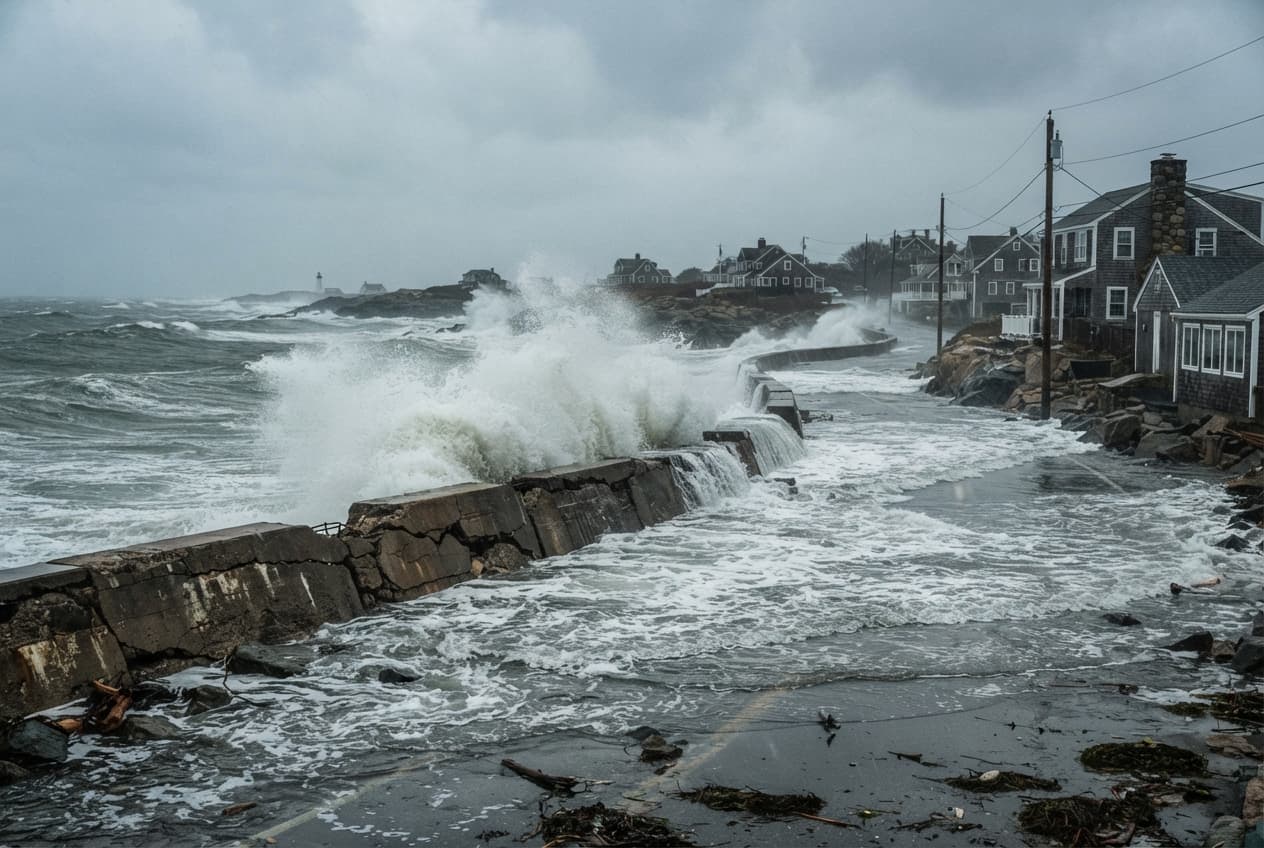
Boston, United States—A powerful autumn nor'easter battered the northeastern United States coastline on September 28, 2026, unleashing destructive tidal surges, structural collapses, and widespread utility outages that left over one hundred thousand homes in darkness. The slow-moving low-pressure system drove relentless gale-force winds and heavy downpours onshore across New Jersey, New York, and New England. Emergency management dispatchers logged thousands of calls regarding downed high-voltage power lines and flooded coastal access routes.
Municipal authorities in coastal New Jersey towns reported that consecutive high tide cycles breached sea walls and filled low-lying neighborhoods with knee-high saltwater. Emergency rescue units deployed amphibious vehicles to extract residents trapped inside homes surrounded by rapidly rising maritime surges. Local resident Marcus Vance noted that the speed of the inundation caught many property owners off guard before they could secure coastal marine equipment.
High winds packing gusts up to sixty miles per hour snapped mature oak trees and toppled utility poles onto residential structures across Long Island and coastal Massachusetts. A New York City housing authority worker suffered fatal injuries when a heavy tree branch collapsed during early morning maintenance operations. Utility repair crews faced dangerous operating conditions as continuous wind shear prevented bucket truck deployment until gusts subsided slightly.
Transportation infrastructure suffered widespread disruptions as regional airports reported hundreds of flight cancellations and significant departure delays. Ferry services connecting mainland ports to offshore barrier islands including Nantucket, Martha's Vineyard, and Fire Island remained suspended indefinitely. Department of transportation officials closed multiple low-lying highway stretches along the mid-Atlantic seaboard due to deep water accumulation.
Commercial marinas along the New England waterfront sustained heavy property damage as vessel moorings failed under pounding wave action. Boat owners rushed to secure loose rigging and pump out swamped hulls as fiberglass watercraft collided against wooden piers. Marine insurance adjusters established mobile command trailers near major harbors to process initial structural damage claims.
Public utility companies mobilized mutual aid work crews from neighboring non-affected states to accelerate power restoration efforts across densely populated sectors. Municipal emergency operation centers remained activated at elevated readiness levels as meteorologists tracked secondary coastal convergence bands. Local shelters opened their doors to accommodate families displaced by structural wind damage and electrical fires.
Coastal erosion monitoring teams noted severe sand depletion along vulnerable barrier beach ecosystems subjected to prolonged wave pounding. Structural engineers conducted rapid safety inspections on compromised seawalls and timber boardwalks facing the open Atlantic. Local mayors urged civilian populations to respect road barricades and avoid sightseeing along wave-swept jetties.
Emergency services continue patrolling vulnerable neighborhoods throughout the evening hours to monitor shifting tide levels and structural integrity. Repair technicians coordinate around the clock to restore electrical transmission feeds to critical municipal water treatment plants. Response commanders emphasize that recovery operations will extend well into the coming week as weather systems gradually exit the offshore shelf.
Published by Banx Network. This article is part of the Banx decentralized media programme, powered by the BXE token on the XRP Ledger.