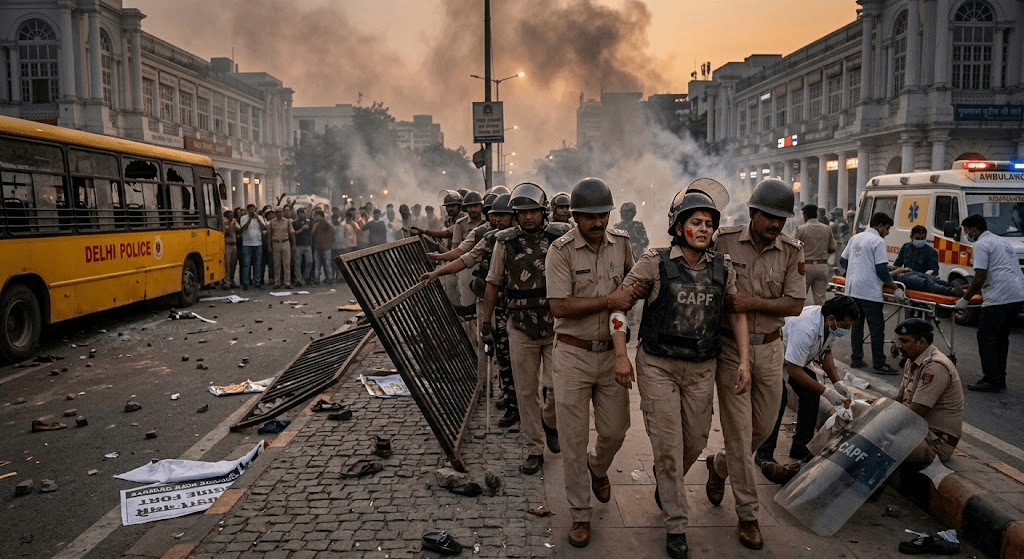
NEW DELHI — Central Delhi descended into chaos on Monday, July 20, 2026 as a massive protest march bound for Parliament erupted into one of the city's most violent street confrontations in years. According to official statements from the Delhi Police, the intense clashes left more than 118 security personnel—including local police officers and members of the Central Armed Police Forces (CAPF)—injured.
The violence broke out on the opening day of the Parliament's Monsoon Session, completely disrupting legislative proceedings and turning prime sections of the national capital into a battlefield.
The protest was organized by the youth-led "Cockroach Janta Party" (CJP), a movement that began as online satire but has swiftly grown into a massive challenge for the administration. Thousands of young demonstrators gathered at the historic Jantar Mantar protest site, demanding accountability over competitive examination paper leaks and calling for the resignation of Union Education Minister Dharmendra Pradhan.
Despite heavy rainfall, the crowds launched a 'Sansad Chalo' (March to Parliament) initiative. When security forces attempted to seal off the perimeter, groups of protesters splintered into inner lanes, walking kilometers to bypass checkpoints. The situation turned critical near Patel Chowk, Shastri Bhawan, and the RBI Building when thousands of demonstrators aggressively breached multiple layers of heavy iron barricading to reach closer to Parliament.
According to law enforcement authorities, the crowd exhibited highly aggressive behavior, ignoring repeated lawful commands to disperse. Security forces were met with a barrage of stones and blunt objects.
The intense scale of the confrontation is underscored by the extensive casualty list, which includes several top-tier Indian Police Service (IPS) officers, such as Special Commissioners, Joint Commissioners, and multiple Deputy Commissioners (DCPs). Additionally, the violent melee resulted in injuries to approximately 60 demonstrators, with youth organizers claiming that many of them required hospital treatment.
"The crowd attacked personnel with stones, deliberately violated prohibitory orders, and resorted to large-scale violence that severely endangered public order," a senior Delhi Police representative stated during a late-night brief.
To regain control of the central secretariat zone, security forces deployed batons (lathicharge) and fired multiple rounds of tear gas shells. Internet services were temporarily choked across large parts of central Delhi to prevent the mobilization of further crowds.
The aftermath left a trail of destruction. At least two Delhi Police transit buses had their windows completely smashed during stone-pelting, and multiple shops along the Janpath commercial stretch were vandalized.
By Monday night, the Delhi Police had detained over 70 individuals, noting that several of those caught in the violent vanguard were not registered students. Multiple First Information Reports (FIRs) are currently being registered as investigators scour digital CCTV feeds and mobile phone footage to establish if the sudden surge in violence was premeditated.
While the CJP leadership subsequently called off further street marches to prevent further injuries to the youth, a tight security blanket remains draped over the capital. Hundreds of paramilitary personnel continue to patrol central Delhi, using heavily fortified barricades to restrict access to government blocks.
Published by Banx Network. This article is part of the Banx decentralized media programme, powered by the BXE token on the XRP Ledger.