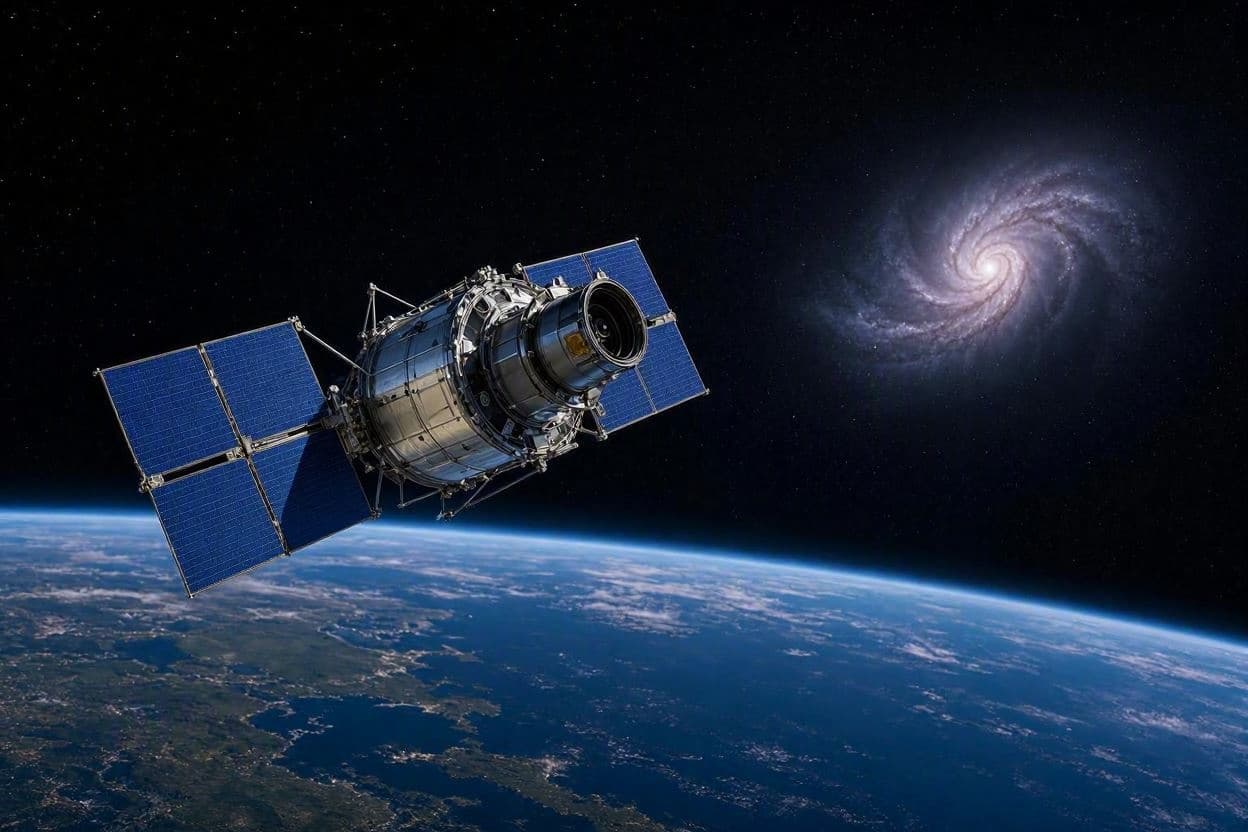
In the silent vacuum of space, machines often outlive their expected lifespans, defying the odds through robust engineering and fortunate circumstances. The Swift space telescope, launched to study the most energetic explosions in the universe, was recently thought to be nearing its end. After a critical failure threatened to silence its instruments, a rescue mission was attempted but ultimately failed. Yet, in a twist of resilience, Swift has managed to restart its science operations, offering a reprieve for astronomers who rely on its unique capabilities.
Swift has been a cornerstone of high-energy astrophysics since its launch in 2004. Designed to detect gamma-ray bursts, the fleeting flashes of light from collapsing stars and merging neutron stars, it has provided invaluable data for over two decades. Its ability to quickly pivot and observe these transient events in multiple wavelengths has made it an indispensable tool for understanding the violent dynamics of the cosmos.
The recent crisis began when the telescope entered a safe mode due to a gyroscope issue. Gyroscopes are essential for maintaining the orientation of the spacecraft, allowing it to point accurately at targets. When one failed, the backup systems struggled to compensate, leading to fears that the mission was over. Engineers worked tirelessly to diagnose the problem and devise a workaround, hoping to restore functionality without a physical repair mission.
The attempted rescue involved uploading new software commands to bypass the faulty hardware. While this effort did not fully resolve the underlying mechanical issue, it inadvertently stabilized the system enough to allow partial operations. This unexpected success highlights the adaptability of modern spacecraft, which can often be reconfigured remotely to overcome hardware limitations.
For the scientific community, the revival of Swift is a welcome surprise. Gamma-ray bursts are rare and unpredictable, and having a reliable observer in orbit is crucial for capturing these fleeting moments. The telescope’s return to service ensures that continuous monitoring of the high-energy sky can continue, preserving a dataset that spans more than twenty years.
This incident also underscores the importance of redundancy in space mission design. Swift’s multiple gyroscopes and robust software architecture allowed it to survive a failure that might have ended less resilient missions. It serves as a testament to the foresight of its engineers, who anticipated potential problems and built in safeguards to mitigate them.
Moreover, the story of Swift’s recovery is a reminder of the human element in space exploration. Behind every successful maneuver are teams of dedicated professionals who work around the clock to solve complex problems. Their ingenuity and perseverance turn potential disasters into opportunities for extended discovery, maximizing the return on investment for space agencies and taxpayers alike.
As Swift continues its work, it joins a growing list of legacy missions that have exceeded their planned lifetimes. From the Voyager probes to the Hubble Space Telescope, these enduring observatories provide a long-term perspective on the universe. They allow scientists to track changes over decades, offering insights that short-term missions cannot provide.
The future of Swift remains uncertain, as the underlying hardware issues may resurface. However, for now, it continues to send back valuable data, contributing to our understanding of black holes, supernovae, and the early universe. Its resilience is a source of inspiration, proving that even in the face of failure, there is room for recovery and continued contribution.
The unexpected restart of NASA’s Swift space telescope is a triumph of engineering and persistence. Despite a failed rescue mission, the telescope has resumed its scientific duties, extending its legacy of discovering the universe’s most energetic events. It stands as a symbol of durability and the enduring value of well-designed space infrastructure.
AI Image Disclaimer: The visuals accompanying this article are AI-generated representations designed to depict the Swift space telescope in orbit and its operational context.
Sources: NASA Goddard Space Flight Center SpaceNews The Astrophysical Journal
Published by Banx Network. This article is part of the Banx decentralized media programme, powered by the BXE token on the XRP Ledger.