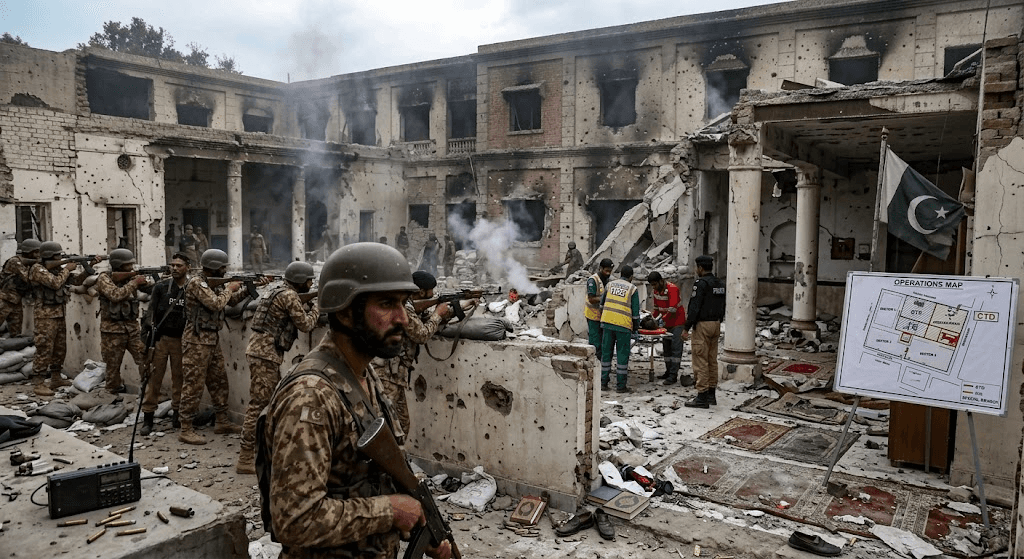
KOHAT, Pakistan — At least 31 people, including 16 police personnel, were killed and more than 100 others injured after heavily armed militants stormed the Old Police Lines complex in Kohat, triggering an explosive suicide attack and a multi-hour standoff with security forces.
The assault began during Friday afternoon prayers when attackers rammed an explosive-laden vehicle into the facility near a mosque inside the compound, causing a massive detonation that left a deep crater and collapsed nearby structural walls. The compound serves as a critical district-level headquarters housing sensitive unit, including the Counter Terrorism Department (CTD) and Special Branch.
Following the initial blast, gunmen breached the perimeter, prompting military and specialized police units to seal off the area as intense firefights broke out.
The assault resulted in significant casualties and an extended security operation. Local health officials confirmed 31 deaths, noting that over 100 victims—predominantly police officers—were rushed to nearby hospitals, with several remaining in critical condition. In response, security forces engaged the remaining militants holed up within the Special Branch section of the complex during a high-stakes clearance operation that extended through the night. Ittehad-ul-Mujahideen Pakistan (IMP), a faction linked to the Tehreek-e-Taliban Pakistan (TTP), subsequently claimed responsibility for the attack.
Prime Minister Shehbaz Sharif and President Asif Ali Zardari strongly condemned the terror attack, ordering immediate top-tier medical care for the wounded and directing law enforcement agencies to accelerate counter-terrorism efforts across Khyber Pakhtunkhwa province.
Security has been elevated to maximum alert across major police installations and government facilities nationwide as authorities conduct a thorough investigation into the security breach.
In response to the catastrophic breach, counter-terrorism analysts and military leadership have initiated a comprehensive overhaul of security protocols surrounding sensitive police and intelligence installations across the province. Federal authorities are also establishing dedicated rapid-response units along key transit corridors to intercept potential militant threats before they reach urban centers, while local community leaders have called for unified public support during the ongoing security operations.
Published by Banx Network. This article is part of the Banx decentralized media programme, powered by the BXE token on the XRP Ledger.