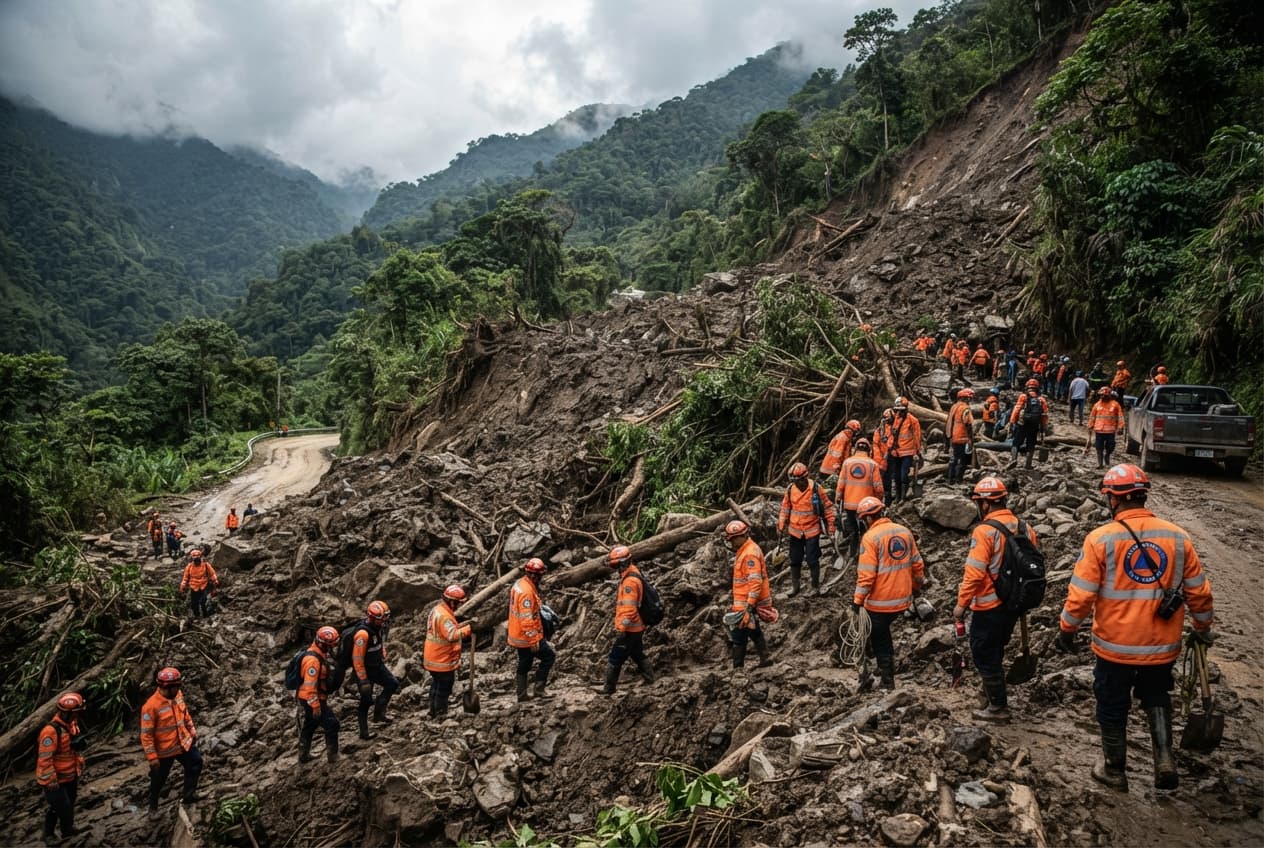
Cobán, Guatemala—A wall of mud and debris crashed down a steep mountain slope early Thursday, swallowing homes and cutting off road access to an isolated rural community in the Alta Verapaz department. Local emergency responders confirmed that rescue teams are struggling to reach the disaster zone as continuous rainfall blocks primary routes with thick layers of rock and earth. The sudden collapse struck without warning while residents were still inside their dwellings, raising immediate fears of a high casualty toll in the remote settlement.
Heavy downpours over the past forty-eight hours saturated the fragile mountain slopes beyond their natural threshold. Local authorities stated that deforestation and shifting soil composition severely compounded the vulnerability of the region. Heavy machinery dispatched from departmental headquarters remains stalled miles away due to secondary landslides blocking the narrow highway network.
Local residents near the perimeter of the disaster area attempted to clear debris using basic hand tools before professional crews arrived. Community leaders reported that telephone lines and electrical grids went dark immediately after the impact, plunging the valley into total isolation. Families living downstream have been advised to evacuate immediately as unstable earth continues to shift under persistent precipitation.
National disaster management coordinators mobilized canine units and specialized extraction squads toward the department. Officials warned that crossing the swollen rivers and unstable terrain poses severe risks to the relief personnel themselves. Search operations must rely heavily on manual excavation while aerial reconnaissance remains grounded due to zero-visibility fog shrouding the peaks.
Regional hospitals in Cobán declared a red alert to receive potential casualties transferred from the disaster zone. Doctors and trauma surgeons remain on standby, though ambulances face grueling delays navigating obstructed mountain passes. Communication relays between forward command posts and the capital continue to flicker intermittently.
Environmental monitors have repeatedly flagged Alta Verapaz as a high-risk zone for rapid mass-wasting events during extreme weather cycles. Despite past warnings, infrastructure improvements and reinforced retaining walls were never constructed along the vulnerable hillside settlement. Residents have long depended on subsistence farming on steep gradients that lack adequate drainage systems.
Makeshift shelters are currently being organized in municipal community centers to house displaced families who managed to escape the path of the slide. Relief supplies including potable water, blankets, and dry rations are being assembled at regional depots for eventual distribution. Logistics planners admit that airborne delivery may become the only viable option if ground clearing operations stall overnight.
The search and rescue perimeter remains heavily restricted as engineers assess the ongoing threat of secondary slope collapses. Heavy equipment operators continue clearing boulders and mud from the main access artery under pouring rain. Official tallies on missing persons remain fluid as local authorities cross-reference family registries with survivors gathered at temporary evacuation posts.
Published by Banx Network. This article is part of the Banx decentralized media programme, powered by the BXE token on the XRP Ledger.