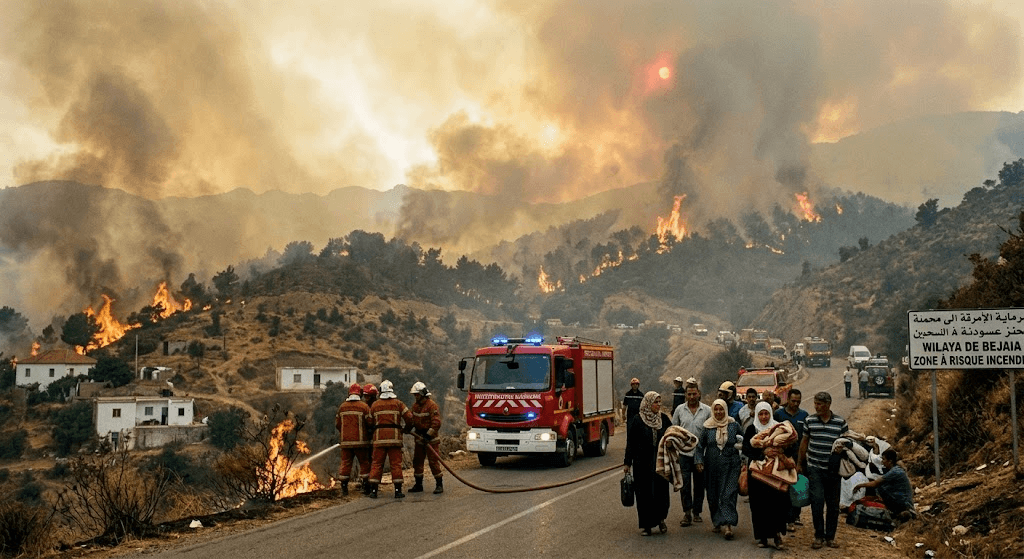
ALGIERS, ALGERIA — At least 12 people have been killed and dozens more injured after dozens of raging wildfires swept through northern and northeastern Algeria, local authorities confirmed late Wednesday. The blazes, fueled by scorching heatwave conditions and fierce winds, choked skies across several coastal provinces with thick smoke and forced emergency services into large-scale evacuations.
Algerian Interior Minister Saïd Sayoud confirmed the death toll during a visit to the hard-hit coastal province of Bejaia. Officials reported that five people were killed in Jijel province, four in Bejaia—including an eight-year-old boy and a 22-year-old woman—and three in Tizi Ouzou. At least 54 people sustained burn injuries, with six individuals remaining in critical condition in intensive care.
Civil Protection services recorded nearly 160 individual fire outbreaks across the country over a 24-hour period, with teams continuing to tackle dozens of active blazes into Thursday. Bejaia proved to be the most severely impacted region, logging over 30 separate fire outbreaks that threatened residential communities and forced the closure of major national highways connecting Bejaia, Jijel, and Sétif.
High ambient temperatures reaching nearly 49°C (120°F) combined with dry, parched vegetation turned vast stretches of mountain forests into a volatile tinderbox. Emergency response units, backed by water-bombing aircraft and military personnel, launched extensive ground and aerial operations to contain the flames and rescue trapped residents. Local government agencies have established crisis centers and deployed support services to provide shelter, medical supplies, and trauma care to hundreds of displaced families.
The government has mobilized national forestry authorities, agricultural relief agencies, and international aid coordination teams to assess the widespread structural and ecological damage. Agricultural officials reported severe losses to livestock, olive groves, and rural farming infrastructure across the coastal provinces, prompting President Abdelmadjid Tebboune to order immediate financial compensation and emergency relief packages for farmers and families whose livelihoods were destroyed by the flames.
Meteorological agencies warn that extreme heat conditions are likely to persist across the Mediterranean basin in the coming days, keeping high-risk coastal zones on elevated wildfire alerts. Environmental experts point to the recurring summer disaster as evidence of escalating climate volatility in North Africa, urging regional authorities to invest in long-term fire prevention infrastructure, expanded aerial firefighting fleets, and modernized early-warning systems to mitigate future summer blazes.
Published by Banx Network. This article is part of the Banx decentralized media programme, powered by the BXE token on the XRP Ledger.