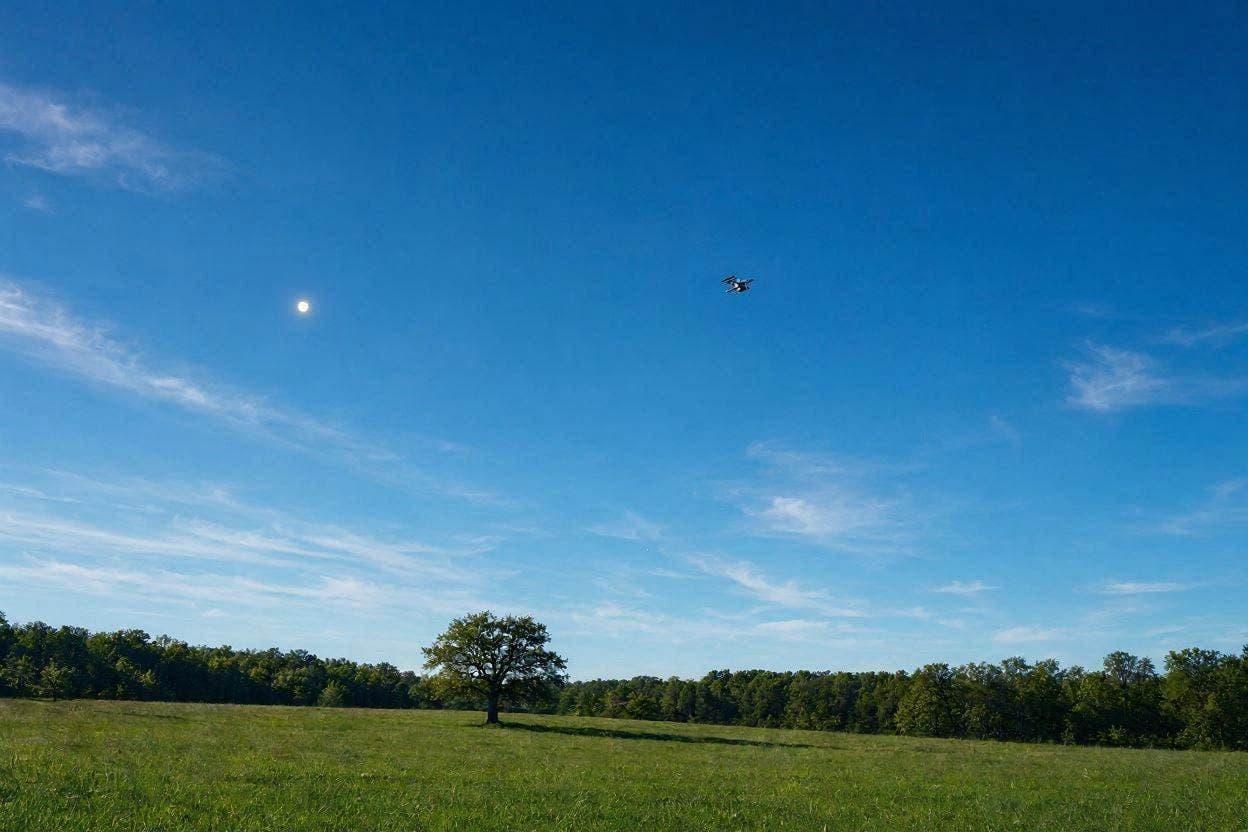
Opening: In the bright canvas of the daytime sky, where the sun’s glare usually hides all but the most persistent celestial objects, a rare alignment has been captured. The International Space Station (ISS), a beacon of human cooperation in low-Earth orbit, passed near Venus, the brilliant morning star, creating a stunning visual conjunction. Photographed on July 28, 2026, this image captures both the artificial and the natural in a single frame, reminding us of our place in the cosmos. It is a moment of beauty that transcends technical achievement, inviting wonder and reflection on the harmony of human ingenuity and planetary elegance.
The photo serves as a testament to the accessibility of space observation. It encourages people to look up, even during the day, and discover the wonders that share our sky.
Body: The conjunction occurred as the ISS orbited Earth at approximately 17,500 miles per hour. Venus, shining brightly due to its reflective cloud cover and proximity to Earth, provided a striking backdrop. Capturing such an event in daylight requires precise timing and specialized equipment, as the contrast between the bright sky and the objects is challenging. The photographer’s skill in balancing exposure and focus resulted in a clear and memorable image.
For space enthusiasts, this event was a highlight of the summer skywatching calendar. Apps and websites track the ISS’s path, allowing users to predict when it will be visible from their location. While nighttime passes are more common and easier to see, daytime sightings offer a unique perspective, showing the station against the blue rather than the black of space.
Venus, often called Earth’s sister planet, is a frequent companion in the sky. Its phases, similar to the Moon’s, change as it orbits the Sun. In this image, Venus appears as a bright point of light, its disk too small to resolve without a telescope. Yet, its presence dominates the scene, drawing the eye alongside the intricate structure of the ISS.
The ISS itself is a marvel of engineering, housing astronauts from multiple nations who conduct scientific research in microgravity. Seeing it in the same frame as a planet emphasizes the connection between our earthly endeavors and the broader universe. It symbolizes the bridge between human curiosity and the natural world.
Amateur astronomers play a vital role in documenting such events. Their contributions enrich the collective knowledge and appreciation of astronomy. Social media platforms allow these images to be shared widely, inspiring others to take up the hobby and learn more about the sky.
Educational opportunities arise from such sightings. Teachers and parents can use these moments to explain orbital mechanics, planetary motion, and the scale of the solar system. It makes abstract concepts tangible and exciting for young learners.
As light pollution increases in many areas, seeing bright objects like Venus and the ISS becomes even more important. They serve as reminders of the sky’s beauty and the need to protect dark skies for future generations. Conservation efforts aim to preserve these views for all.
The photo of the day is more than just an image; it is an invitation to pause and appreciate the universe. It reminds us that wonder is always within reach, if only we look up.
Closing: The incredible daylight photo of the ISS and Venus highlights the beauty of celestial conjunctions. It invites everyone to explore the sky and appreciate the intersection of human achievement and natural wonder.
AI Image Disclaimer: The visuals in this article are AI-generated illustrations designed to reflect the themes of astronomical photography and celestial beauty.
Sources: NASA Earth Observatory Space.com Sky & Telescope EarthSky
Published by Banx Network. This article is part of the Banx decentralized media programme, powered by the BXE token on the XRP Ledger.