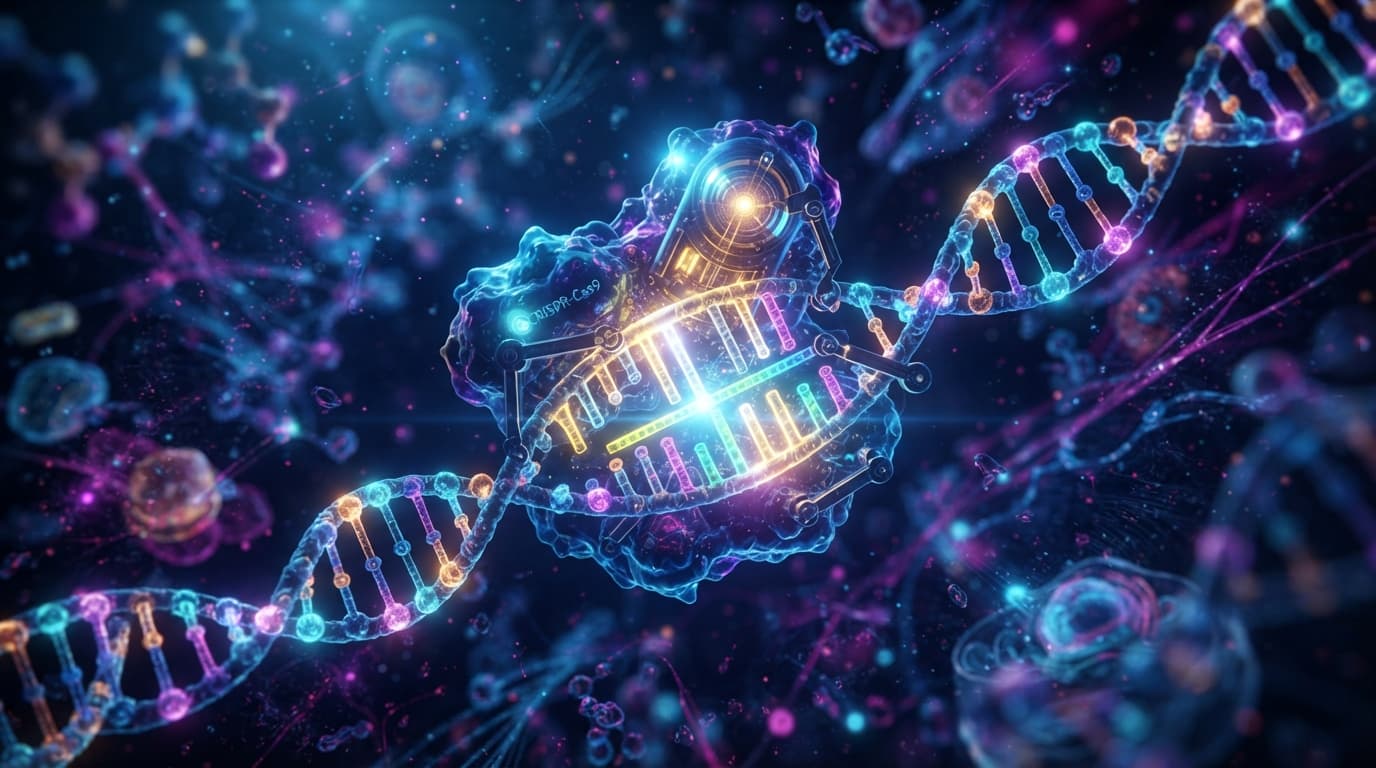
What Is CRISPR?
CRISPR is a gene-editing technology that allows scientists to make targeted changes to DNA.
The name comes from a naturally occurring system found in bacteria. Bacteria use CRISPR-associated mechanisms as part of their defence against viruses.
Scientists discovered that this biological system could be adapted into a powerful molecular tool.
The most famous version uses a guide molecule to identify a specific DNA sequence and an enzyme, such as Cas9, to cut the DNA at that location.
Once the DNA has been cut, the cell's natural repair mechanisms can be used to remove, disable or modify genetic material.
In simple terms:
Find the DNA → cut the target → allow the cell to repair it → change the genetic instructions.
That basic principle has transformed modern genetic research.
Why Is CRISPR So Important?
Before CRISPR, scientists already had methods for modifying genes.
The problem was that many techniques were difficult, expensive or relatively imprecise.
CRISPR changed the economics and accessibility of gene editing.
Researchers could design systems to target particular DNA sequences far more efficiently, allowing laboratories around the world to investigate genetic modification.
This made CRISPR more than just another laboratory technique.
It became a platform for developing potential treatments, studying disease and understanding how genes influence biological processes.
From Laboratory to Medicine
The most important development is that gene editing has moved beyond theoretical research.
In December 2023, the U.S. Food and Drug Administration approved Casgevy, the first FDA-approved therapy using CRISPR/Cas9 technology.
The treatment targets sickle cell disease by editing a patient's blood-forming stem cells outside the body before they are returned to the patient.
The UK had already authorised Casgevy in November 2023, making it the world's first regulatory approval for a CRISPR-based medicine.
This was a major milestone.
CRISPR had moved from scientific breakthrough to actual medical treatment.
Sickle Cell Disease Shows What Is Possible
Sickle cell disease is caused by mutations affecting haemoglobin, the protein responsible for carrying oxygen in red blood cells.
The resulting cells can become abnormally shaped, leading to severe pain, anaemia and other complications.
Casgevy takes a different approach from conventional medicines.
Instead of simply managing symptoms, the treatment modifies a patient's own blood stem cells.
The edited cells are then returned to the patient's body, where they can produce red blood cells with increased levels of fetal haemoglobin.
Clinical results have demonstrated substantial reductions in severe pain episodes for many treated patients.
The significance extends beyond sickle cell disease.
It demonstrates a broader principle:
Medicine may increasingly be able to treat the genetic cause of a disease rather than simply manage its consequences.
Another Blood Disorder Is Also Being Targeted
CRISPR is not limited to sickle cell disease.
Casgevy has also been approved for transfusion-dependent beta thalassemia, another inherited blood disorder.
The condition affects haemoglobin production and can leave patients dependent on regular blood transfusions.
The ability to use gene editing to address the underlying biological mechanism represents a major change in how certain inherited diseases can be approached.
Instead of developing a drug that must be taken repeatedly, researchers are exploring treatments that could potentially provide long-lasting benefits after a single intervention.
CRISPR Could Go Beyond Blood Diseases
Blood disorders are currently among the most advanced applications because blood-forming stem cells can be removed from the body, edited in a laboratory and returned to the patient.
Other diseases are considerably more difficult.
Researchers are investigating whether gene editing could eventually address conditions involving:
Cancer Cardiovascular disease Liver disorders Eye diseases Neurological disorders Rare genetic diseases Immune-system disorders
The challenge is delivering the gene-editing machinery to the correct cells without causing unwanted changes elsewhere.
This is one of the biggest problems researchers must solve before CRISPR can reach its full potential.
The Delivery Problem
Editing DNA is only part of the challenge.
Scientists must also get the editing system to the right location.
For some treatments, cells can be removed from the patient and edited outside the body.
This is known as ex vivo treatment.
But many diseases affect cells that cannot easily be removed and returned.
Researchers therefore need ways to deliver gene-editing systems directly inside the body.
Potential delivery technologies include engineered viruses, lipid nanoparticles and other biological or synthetic carriers.
Improving delivery could dramatically expand the number of diseases that CRISPR can potentially treat.
CRISPR and Cancer
Cancer presents a particularly interesting opportunity.
Cancer isn't one disease.
It is a collection of diseases caused by abnormal cell growth involving complicated genetic and biological changes.
Researchers are investigating whether gene editing can be used to modify immune cells so that they become better at identifying and destroying cancer.
One approach involves editing a patient's immune cells outside the body and then returning them to the patient.
This could potentially produce more powerful personalised cancer treatments.
CRISPR may therefore become part of a broader shift toward therapies designed around an individual's specific disease biology.
CRISPR Could Change Drug Development
CRISPR is useful even when it isn't used directly as a treatment.
Scientists can use gene editing to investigate what individual genes actually do.
Researchers can switch genes off, modify them or introduce specific changes and then observe what happens.
This provides a powerful method for understanding disease.
It can also help pharmaceutical companies identify potential drug targets.
In the future, CRISPR could therefore influence medicine in two ways:
Directly, through gene-editing treatments.
Indirectly, by helping scientists discover new medicines.
The Possibility of One-Time Treatments
One of the most exciting aspects of gene editing is the possibility of replacing long-term treatment with a single intervention.
Traditional medicine often manages chronic diseases through repeated treatment.
Patients may need medication every day, injections every few weeks or regular hospital visits.
A successful gene-editing therapy could potentially modify the underlying biological problem and produce effects lasting many years or even a lifetime.
That does not mean every CRISPR treatment will work this way.
Some diseases are too complex to solve by changing a single genetic sequence.
But where a specific mutation drives disease, the potential is enormous.
The Cost Problem
There is a major obstacle.
Advanced gene therapies can be extremely expensive.
Casgevy's U.S. list price is approximately $2.2 million per patient, according to the FDA's announcement of its approval.
That creates a difficult economic question.
A one-time treatment costing millions of dollars may still be economically attractive compared with decades of healthcare costs.
But the upfront price can make access difficult.
This creates a new challenge for healthcare systems:
How do you make revolutionary treatments financially sustainable and globally accessible?
The answer could influence how quickly gene editing spreads beyond wealthy healthcare markets.
The Accuracy Problem
CRISPR is powerful, but it isn't perfect.
One major concern is the possibility of off-target effects.
An editing system designed to target one DNA sequence could potentially interact with another similar sequence.
Researchers therefore spend enormous effort improving the accuracy of gene-editing systems and identifying unintended changes.
The goal is not simply to edit DNA.
It is to edit the correct DNA, in the correct cells, without producing dangerous unintended consequences.
As the technology improves, increasingly precise editing systems are being developed.
CRISPR Is Evolving
CRISPR is not a single technology.
Researchers have developed different approaches that go beyond the original Cas9 cutting mechanism.
Base editing can change individual DNA letters without making the same type of double-stranded DNA break associated with conventional CRISPR-Cas9.
Prime editing offers another approach that can make more precise changes to DNA.
These technologies are still being developed, but they demonstrate the direction of the field.
Scientists are moving toward increasingly controlled forms of genetic modification.
The Ethical Question
The science may be advancing faster than society's ability to agree on how it should be used.
There is an enormous difference between treating a child with a life-threatening genetic disorder and attempting to modify a healthy person's DNA to influence physical characteristics.
This creates a fundamental ethical distinction:
Therapy vs enhancement.
Treating disease is generally easier to justify.
Enhancement raises far more difficult questions.
Should parents be allowed to edit genes associated with physical characteristics?
What about intelligence?
Athletic ability?
Disease resistance?
Lifespan?
These questions are not simply scientific.
They involve philosophy, law, economics and social policy.
What About Editing Embryos?
Perhaps the most controversial possibility is germline editing.
If scientists edit an embryo, those genetic changes could potentially be inherited by future generations.
That is fundamentally different from editing cells in an adult patient.
A medical treatment given to one person affects that individual.
A germline modification could potentially affect their descendants.
This creates questions about consent because future generations cannot agree to the genetic changes being made to them.
For this reason, heritable human genome editing remains one of the most controversial areas of biotechnology.
The World Health Organization has emphasised the need for strong governance and oversight surrounding human genome editing.
Could CRISPR Extend Human Lifespans?
This is where predictions become increasingly speculative.
Scientists are investigating the genetic mechanisms involved in ageing, cellular damage and disease.
Gene editing could eventually become part of attempts to modify some of those processes.
But extending human lifespan is vastly more complicated than correcting a single mutation.
Ageing involves thousands of biological interactions across many tissues.
It is therefore unlikely that there will be a simple "longevity gene" that CRISPR can edit to make humans dramatically longer-lived.
More realistically, genetic technologies could gradually reduce the impact of specific diseases associated with ageing.
That alone could significantly increase healthy life expectancy.
The Economic Revolution
CRISPR could create an enormous biotechnology industry.
The opportunity extends beyond gene-editing treatments themselves.
It includes:
Gene-therapy companies Genetic diagnostics Drug discovery Laboratory equipment Delivery technologies Personalised medicine Bioinformatics Clinical manufacturing Genetic data analysis
As the technology becomes more sophisticated, entire industries could develop around designing, manufacturing and delivering genetic therapies.
The economic impact could therefore extend far beyond healthcare.
What Could CRISPR Look Like by 2035?
By 2035, CRISPR could be considerably more established within medicine.
The number of approved gene-editing therapies could increase.
Treatment costs could potentially fall as manufacturing improves.
Delivery systems could become more effective.
And researchers could have a better understanding of which diseases are suitable for genetic intervention.
The technology will probably remain concentrated initially in conditions where a clear genetic target exists.
Complex diseases involving hundreds or thousands of genetic and environmental factors will be much harder.
What Could Happen by 2050?
The longer-term possibilities are much harder to predict.
By 2050, gene editing could potentially become a standard treatment option for many inherited diseases.
Some cancers could potentially be treated using genetically engineered immune cells.
Genetic therapies could become more personalised.
Advanced delivery systems could allow editing to take place directly inside specific tissues.
But the biggest change may be cultural rather than technological.
Society may have to decide what kinds of genetic modification are considered acceptable.
The question may no longer be:
"Can we edit this gene?"
It could become:
"Should we?"
The Genetic Revolution
CRISPR has changed the relationship between medicine and genetics.
For much of modern medical history, doctors have treated the consequences of genetic disease.
Gene editing introduces another possibility:
change the underlying biological instructions.
That does not mean CRISPR will cure every disease.
It will not.
The human body is too complex, and many diseases have multiple causes.
But for certain genetic conditions, the technology has already demonstrated that DNA can become a direct target of medical treatment.
The next stage will be about improving precision, delivery, safety and affordability.
If researchers succeed, CRISPR could become one of the defining medical technologies of the 21st century.
And the ultimate revolution may not be that humans learned how to read their genetic code.
It may be that we learned how to rewrite it.
References
1. U.S. Food and Drug Administration — FDA Approves First Gene Therapies to Treat Patients with Sickle Cell Disease Information on the approval of Casgevy, the first FDA-approved CRISPR/Cas9 therapy.
2. UK Medicines and Healthcare products Regulatory Agency — Casgevy Authorisation Information on the UK's authorisation of Casgevy for sickle cell disease and beta thalassemia.
3. World Health Organization — Human Genome Editing Information on the scientific, ethical and governance issues surrounding human genome editing.
4. National Human Genome Research Institute — CRISPR Background on CRISPR genome-editing technology and its applications in genetic research.
5. Nobel Prize — The 2020 Nobel Prize in Chemistry Background on Emmanuelle Charpentier and Jennifer Doudna's development of CRISPR-Cas9 as a method for genome editing.
Published by Banx Network. This article is part of the Banx decentralized media programme, powered by the BXE token on the XRP Ledger.