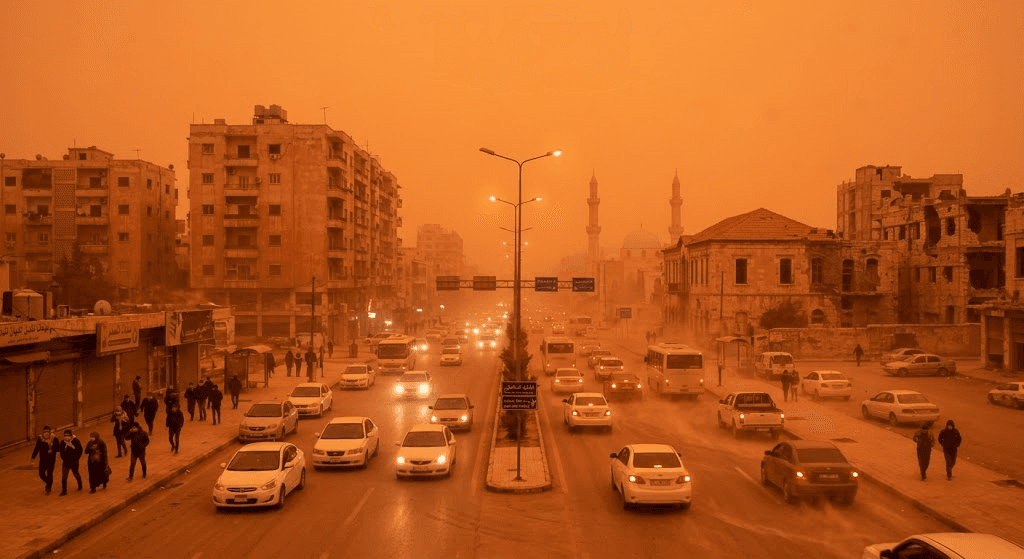
A severe dust storm swept across the governorate of Homs in central Syria on Sunday, August 30, 2026 shrouding the city and its surrounding countryside in a dense, reddish-orange haze. The dramatic atmospheric event drastically reduced visibility, bringing daily life to a near-standstill and prompting health warnings across the region.
The storm began gathering strength early in the morning, driven by strong desert winds carrying high concentrations of fine particulate matter. Within hours, the skies over Homs transformed into a vivid, apocalyptic orange, blocking out direct sunlight and casting an eerie glow over urban neighborhoods and rural farms alike.
Drivers were forced to pull off major highways or navigate at minimal speeds with hazard lights flashing due to near-zero visibility. Local authorities advised residents—particularly the elderly, children, and those with pre-existing respiratory conditions—to remain indoors and keep windows sealed tightly against the penetrating dust.
Regarding the overall impact and response, regional hospitals and medical clinics reported a swift influx of patients seeking treatment for acute asthma attacks, breathing difficulties, and severe eye irritation. On the infrastructure front, local transport networks faced widespread delays, forcing the temporary suspension of outdoor commercial activities across the province. In response to the growing hazard, municipal crews and healthcare workers were placed on high alert, working rapidly to distribute protective face masks and provide emergency medical aid to vulnerable residents.
Meteorologists attribute the severe dust event to a combination of dry soil conditions, elevated temperatures, and a strong pressure gradient pushing arid air masses from the eastern desert region toward the central plains. Weather forecasters predict that wind speeds will gradually subside over the next 24 to 36 hours, allowing the dense dust layer to settle, though atmospheric haze may linger into the early week.
Environmental experts note that recurring dust storms of this scale have grown increasingly frequent across the region due to prolonged drought cycles and expanding desertification. In response, environmental advocacy groups and local agricultural boards are calling for regional land-management initiatives, such as establishing green belts and restoring native vegetation, to stabilize topsoil and mitigate future sandstorms.
Published by Banx Network. This article is part of the Banx decentralized media programme, powered by the BXE token on the XRP Ledger.