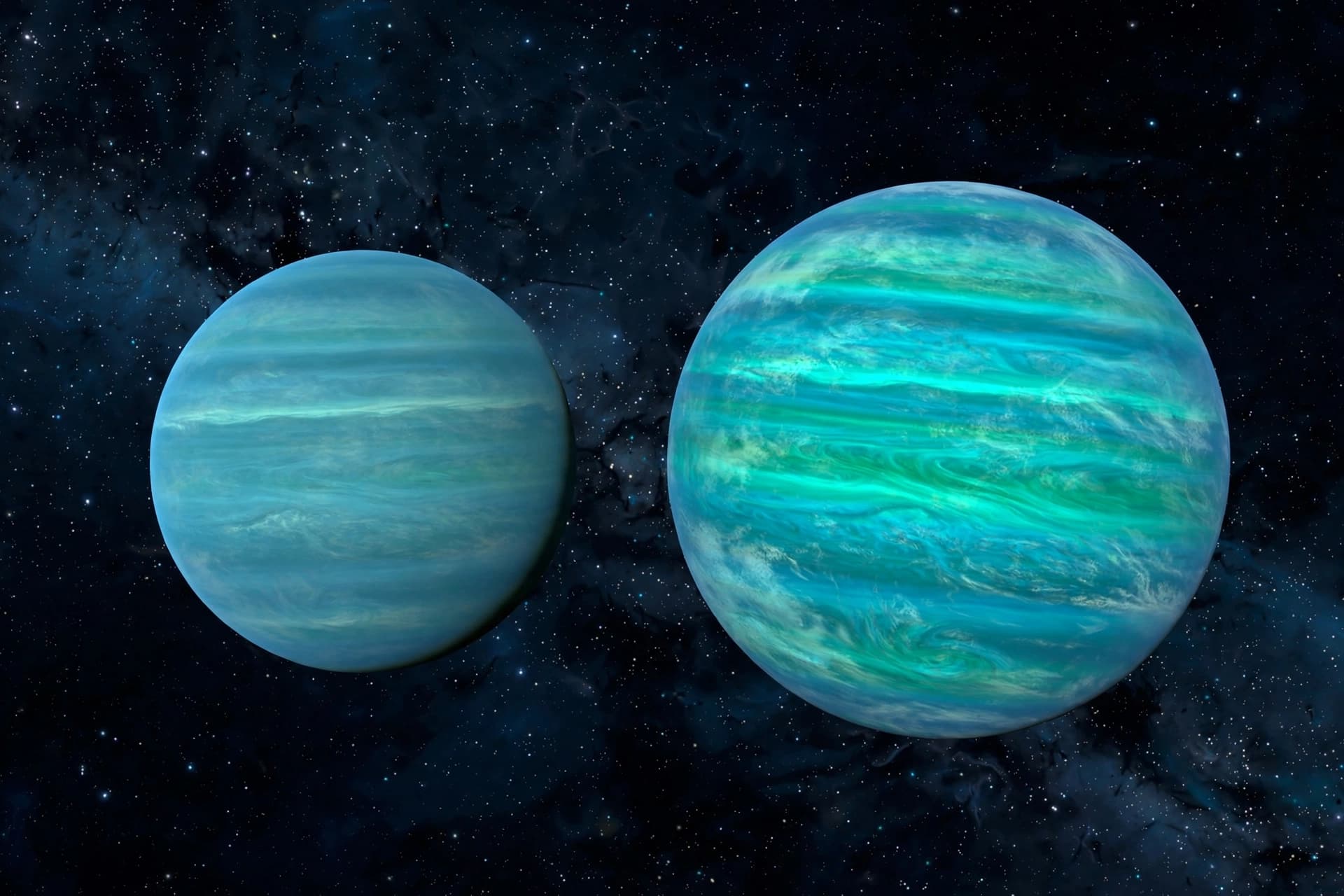
There is a particular comfort in the idea of twins, a sense that two things that look alike must share an origin, a nature, a fate. For as long as astronomers have studied Uranus and Neptune, that comfort held. The two ice giants are similar in size, mass, and the greenish-blue hue of their atmospheres. They were assumed to have formed from the same reservoir of cosmic material, in the same neighborhood of the early solar system, and to have diverged only in the ordinary ways that planets do. A new study suggests that assumption was wrong.
The research, published in Astronomy & Astrophysics, examined the chemistry of the two planets' deep atmospheres using a tracer that can be measured from afar: carbon monoxide. Recent observations, including data from the Atacama Large Millimeter/submillimeter Array, allowed scientists to compare the carbon-to-oxygen ratios of the two worlds. The finding was striking. Neptune's deep atmosphere is substantially richer in oxygen than Uranus's, a difference that is difficult to explain if the two formed from the same material .
The models that followed pointed to a different history. Neptune's building blocks, the researchers concluded, likely originated closer to the young Sun and later migrated outward to the distance where Neptune now sits. Uranus, by contrast, formed from material more local to its present position. "Uranus and Neptune may resemble twins today, but their chemistry is telling us that they are more like cousins with very different histories," said Olivier Mousis of the Southwest Research Institute, a co-author of the study .
The visual similarity, then, is a coincidence—a noteworthy one, as Mousis put it, but a coincidence nonetheless. Two superficially similar worlds reached their present locations and formations through two very distinct evolutionary paths. The blue-green color that made them seem like siblings is a surface phenomenon, a thin outer layer of lighter elements over thick blankets of heavier gases. Beneath that surface, the chemistry tells a different story .
There is a limitation that the researchers are careful to acknowledge. The study relies on remote sensing and modeling, not on direct sampling. No spacecraft has measured the deep atmospheres of Uranus or Neptune in situ. The conclusions are as strong as the models allow, but they are not the same as holding a sample in a laboratory. NASA's planned Uranus Orbiter and Probe, expected to launch in the next decade, would provide the kind of data that could confirm or complicate the picture .
The implications extend beyond our own solar system. Uranus and Neptune are the local reference points for a class of planets that appears to be common around other stars. Understanding how they formed, and how they came to be where they are, informs the study of ice giants across the galaxy. If their similarities are coincidental, then the diversity of planetary formation may be broader than the local example suggested.
For now, the twins are not twins. They are cousins, or perhaps strangers who happen to share a resemblance. The solar system, it turns out, is capable of producing the same appearance through different means, and the chemistry is where the truth is kept.
---
AI Image Disclaimer: The visuals accompanying this article are generated by artificial intelligence and are intended for illustrative purposes only.
Sources: Astronomy & Astrophysics, Southwest Research Institute, Gizmodo, EurekAlert
Published by Banx Network. This article is part of the Banx decentralized media programme, powered by the BXE token on the XRP Ledger.