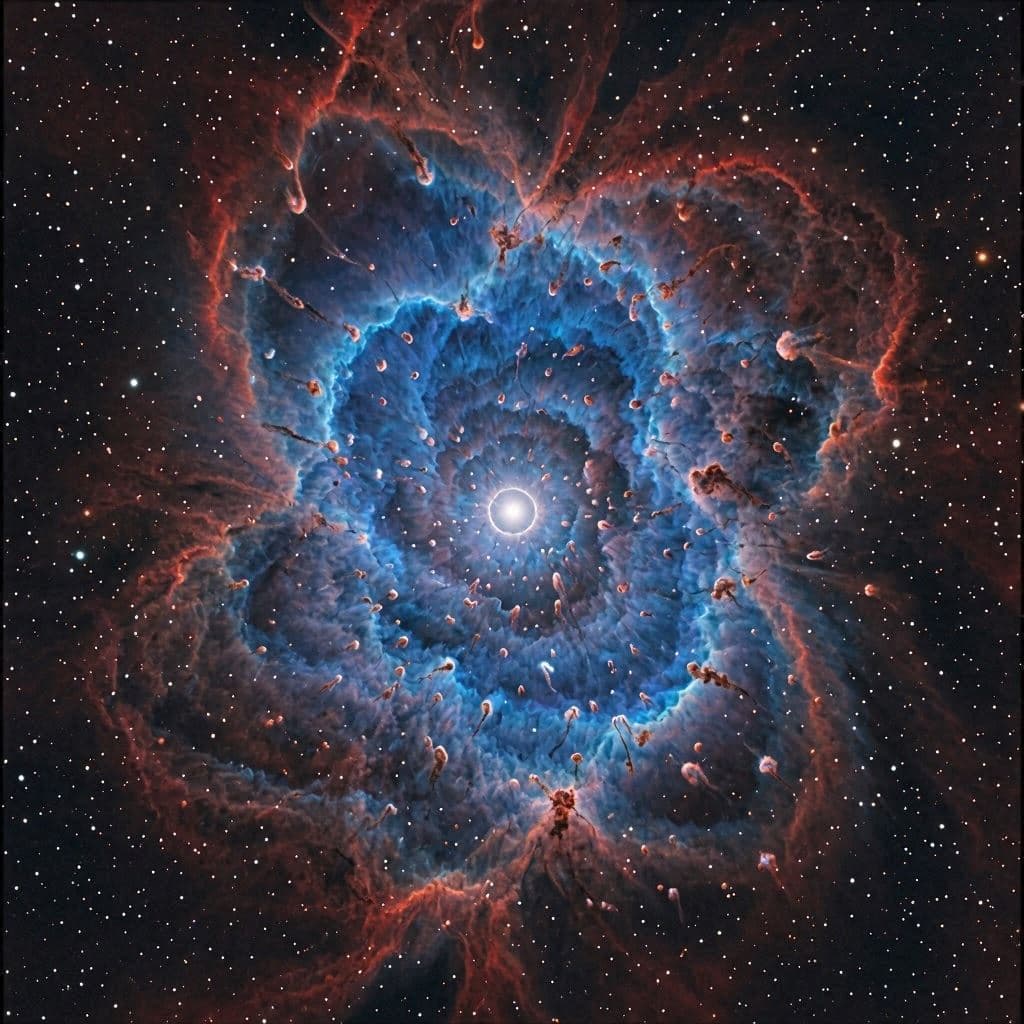
In the vast canvas of the cosmos, few sights are as hauntingly beautiful as the Helix Nebula, a glowing shell of gas expelled by a dying star. Within this ethereal structure, astronomers have identified peculiar features known as "cometary knots." These dense clumps of molecular gas, with tails streaming away from the central star, resemble comets but are vastly different in origin and scale. Their discovery adds a layer of complexity to our understanding of stellar evolution and planetary nebulae.
The Helix Nebula, located in the constellation Aquarius, is one of the closest and brightest planetary nebulae to Earth. It represents the final stages of a sun-like star’s life, where the outer layers are shed into space, leaving behind a hot white dwarf. The cometary knots, first observed in detail by the Hubble Space Telescope and later studied by ground-based observatories, are thought to be remnants of the star’s earlier red giant phase.
These knots are composed of cooler, denser gas that has resisted the intense radiation and wind from the central white dwarf. As the star’s energy pushes against these clumps, they develop long, ionized tails that point away from the source, much like a comet’s tail points away from the Sun. This interaction creates a striking visual contrast, with bright heads and faint, elongated tails stretching across the nebula.
Studying these structures helps astronomers understand the processes of mass loss in aging stars. The formation of knots suggests that the ejection of material was not uniform but occurred in bursts or with varying densities. This asymmetry challenges simple models of stellar death and indicates that magnetic fields or binary companions may play a role in shaping the nebula. Each knot serves as a fossil record of the star’s dynamic history.
The presence of cometary knots also has implications for the chemical enrichment of the interstellar medium. As these clumps eventually dissipate, they release heavier elements forged in the star’s core into space. These materials become the building blocks for new stars and planets, linking the death of one star to the birth of others. It is a cosmic cycle of renewal, driven by the forces of gravity and radiation.
Recent observations using advanced spectroscopy have allowed scientists to measure the temperature and density of the gas within the knots. This data provides insights into the physical conditions inside planetary nebulae and helps refine theoretical models. The Helix Nebula remains a key laboratory for studying these phenomena, offering a clear view of processes that are often obscured in more distant objects.
The cometary knots in the Helix Nebula are a testament to the intricate beauty of stellar evolution. They remind us that even in death, stars create structures of profound complexity and significance. As we continue to observe these celestial wonders, we gain a deeper appreciation for the forces that shape our universe.
AI Image Disclaimer: Visuals associated with this article are AI-generated to capture the astronomical and aesthetic qualities of the Helix Nebula.
Sources: NASA Hubble Site Astrophysical Journal
Published by Banx Network. This article is part of the Banx decentralized media programme, powered by the BXE token on the XRP Ledger.