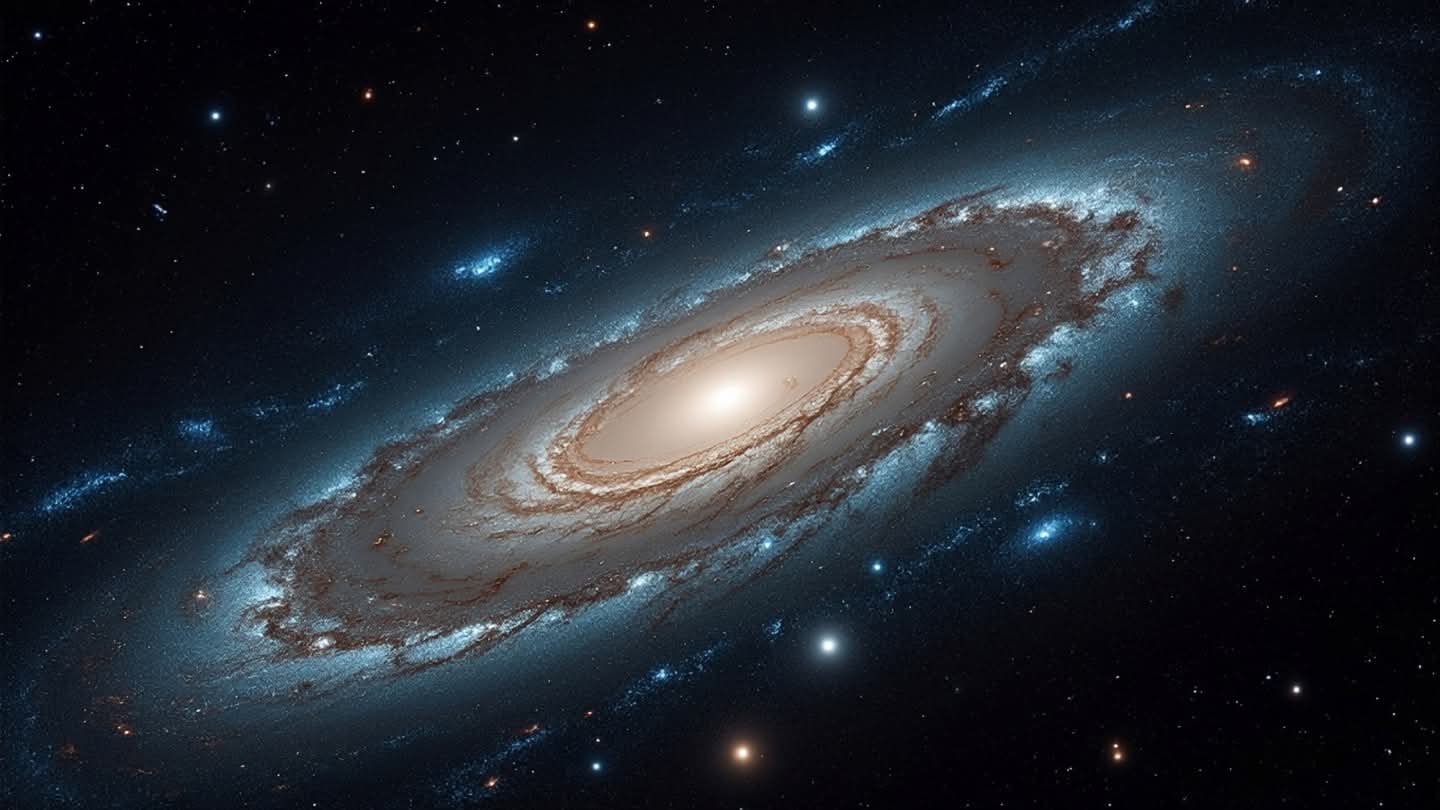
Galaxies are often seen as eternal engines of creation, birthing stars in swirling clouds of gas and dust. Yet, even our nearest major neighbor, the Andromeda Galaxy, is showing signs of winding down. Data from the Hubble Space Telescope reveals that star formation in Andromeda has been declining for the past 500 million years. This observation invites reflection on the lifecycle of galaxies and the eventual quiet that awaits even the most vibrant cosmic structures. It is a moment where the universe’s creativity begins to rest.
The decline is particularly steep in the last 40 million years, suggesting that Andromeda is entering a phase of reduced activity. While it still produces stars, the rate is significantly lower than in its youthful past. Time slows creation. Age brings calm.
Researchers attribute this slowdown to a combination of factors, including the depletion of gas reserves and possible interactions with smaller satellite galaxies like M32. These mergers may have disrupted the flow of fresh material needed for star birth. Interaction alters flow. Gas fuels fire.
For astronomers, this trend provides a preview of what may eventually happen to our own Milky Way, which is on a collision course with Andromeda. Understanding Andromeda’s evolution helps predict the future of our local galactic group. Prediction aids preparation. Future mirrors past.
Despite the decline, Andromeda remains a majestic spiral, filled with billions of stars and complex structures. Its beauty is not diminished by its slowing pace but rather enhanced by the depth of its history. Beauty endures change. History adds depth.
As we observe this gradual shift, we are reminded of the dynamic nature of the cosmos, where change is the only constant. The hope is that continued observation will reveal more about the mechanisms driving galactic evolution. Observation reveals truth. Evolution continues always.
Hubble data shows that star formation in the Andromeda Galaxy has been declining for 500 million years, with a sharp drop in recent millions. This finding offers insights into galactic aging and future interactions with the Milky Way. The hope is for continued study of our cosmic neighbors.
AI Image Disclaimer: The images provided are AI-generated to visually represent the astronomical and evolutionary aspects of the story.
Sources: NASA Universe Today Astronomy Magazine EarthSky
Published by Banx Network. This article is part of the Banx decentralized media programme, powered by the BXE token on the XRP Ledger.