Key Highlights
- Incident:A CNG-powered bus carrying 18 passengers caught fire on the Lagos-Ibadan Expressway.
- Response:Emergency services arrived promptly to manage the situation and assist passengers.
- Safety Debate:The incident raises concerns about the safety of CNG-retrofitted vehicles in Nigeria.
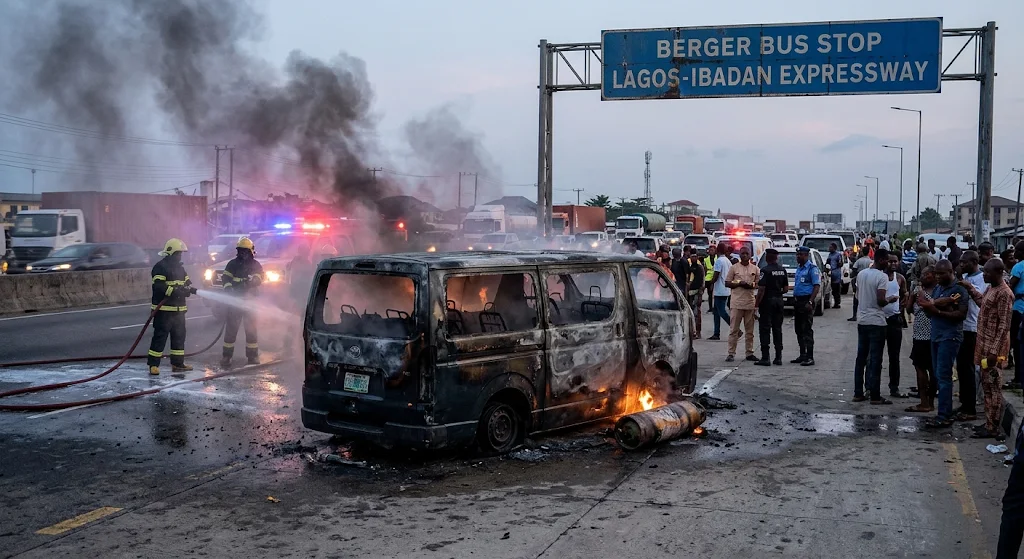
LAGOS, Nigeria — Panic and heavy gridlock gripped motorists along the busy Lagos-Ibadan Expressway earlier on Thursday after a Compressed Natural Gas (CNG)-powered commercial bus carrying 18 passengers burst into flames near the Berger Bus Stop.
The incident involved a white Toyota Hiace bus retrofitted to run on CNG. According to eyewitnesses at the scene, the vehicle was in motion along the outward-bound lane when a loud bang echoed from beneath the chassis, immediately followed by thick plumes of black smoke and intense flames that rapidly engulfed the entire vehicle.
Commuters and nearby traders scrambled for safety as the fire intensified, fueled by the pressurized gas system. Fortunately, the driver managed to bring the bus to an abrupt halt on the road shoulder, allowing all 18 passengers onboard to force open the doors and windows and evacuate just seconds before the cabin was completely consumed by the inferno.
"It happened so fast," said an eyewitness who operates a kiosk near the Berger pedestrian bridge. "We heard a sharp pop, and then fire started shooting out from under the bus. People were jumping out through the windows and doors. It is a miracle nobody was trapped inside."
Officials of the Lagos State Traffic Management Authority (LASTMA), the Federal Road Safety Corps (FRSC), and operatives of the Lagos State Fire and Rescue Service arrived at the scene shortly after distress calls were placed. Firefighters worked to douse the blaze and prevent the flames from spreading to nearby vehicles stuck in the sudden snarl-up.
While no fatalities were recorded, a few passengers sustained minor bruises and suffered from shock during the frantic escape. Paramedics on the scene attended to the affected commuters before they dispersed.
The burnt-out shell of the Toyota Hiace caused a severe traffic backlog stretching several kilometers inward toward Otedola Bridge and Ojodu-Berger, forcing traffic officials to divert motorists to alternative routes while recovery trucks cleared the wreckage.
The incident has reignited public debate surrounding the safety standards and regulatory oversight of CNG-retrofitted vehicles in Nigeria. Following the removal of fuel subsidies, federal and state authorities have aggressively championed Compressed Natural Gas as a cheaper, cleaner alternative to petrol and diesel for mass transit.
However, transport safety advocates have repeatedly warned against patronage of uncertified conversion centers and the use of substandard cylinders and piping. Authorities have yet to confirm whether the ill-fated bus was converted at a government-accredited facility, noting that a formal investigation into the mechanical failure is underway.
Published by Banx Network. This article is part of the Banx decentralized media programme, powered by the BXE token on the XRP Ledger.