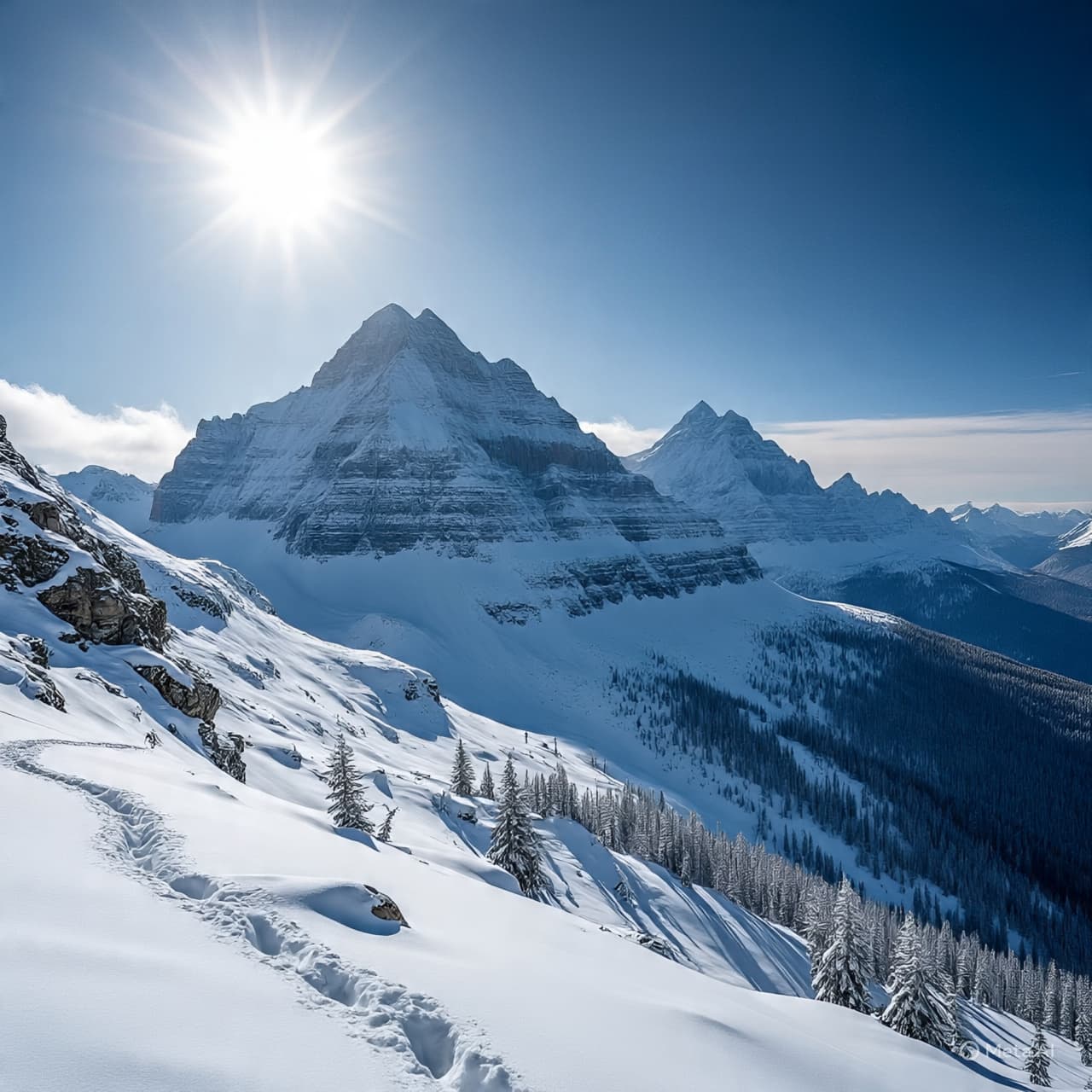
From a mountain trail, the Sun can feel almost within reach. Light arrives clean and intense, unfiltered by haze, casting sharp shadows on rock and snow. Yet with every step upward, the air grows colder. Jackets zip higher, breath turns thin, and the warmth suggested by that blazing sky never quite arrives. The paradox is familiar: closer to the Sun, but colder all the same.
The answer lies not in distance, but in how Earth warms itself. The planet is heated from the surface upward. Sunlight passes through the atmosphere with relatively little effect until it reaches the ground, where energy is absorbed and then released as heat. That warmth is shared with the air closest to the surface, making valleys and lowlands the primary reservoirs of atmospheric heat.
As altitude increases, that connection weakens. Air pressure drops, meaning fewer air molecules are packed into the same space. When air rises into these lower-pressure regions, it expands. Expansion requires energy, and that energy is drawn from the air’s internal heat, causing its temperature to fall. This process unfolds continuously, invisible but reliable, shaping the thermal structure of the atmosphere.
Meteorologists describe this as adiabatic cooling, a principle that governs clouds, storms, and mountain climates alike. On average, temperature decreases steadily with height, turning mountains into vertical gradients of climate. Forests thin, grasses give way to stone, and eventually snow persists even under direct sunlight.
The Sun’s proximity changes almost nothing. A mountain summit is only a few kilometers closer to the Sun than sea level, an insignificant difference against the vast scale of space. What matters far more is how effectively the surrounding air can trap and circulate heat. Thin air holds less warmth, releases it faster, and offers little resistance to cooling winds.
Wind and surface conditions reinforce the chill. High elevations are exposed, allowing moving air to strip heat from skin and ground alike. Snow and ice reflect much of the incoming sunlight back into the sky, preventing the surface from storing warmth. The mountain becomes a place where energy arrives but refuses to linger.
What seems like a contradiction is, in fact, a lesson in how the planet works. Warmth is not granted by nearness alone, but by density, pressure, and exchange. The mountain is cold not because it reaches toward the Sun, but because it rises away from the Earth’s heat.
Standing at the summit, wrapped in layers beneath a bright sky, the cold begins to make sense. It is the quiet logic of height, written into the air itself.
AI Image Disclaimer Visuals are AI-generated and serve as conceptual representations.
Sources NASA Earth Science National Oceanic and Atmospheric Administration American Meteorological Society Encyclopaedia Britannica World Meteorological Organization
Published by Banx Network. This article is part of the Banx decentralized media programme, powered by the BXE token on the XRP Ledger.