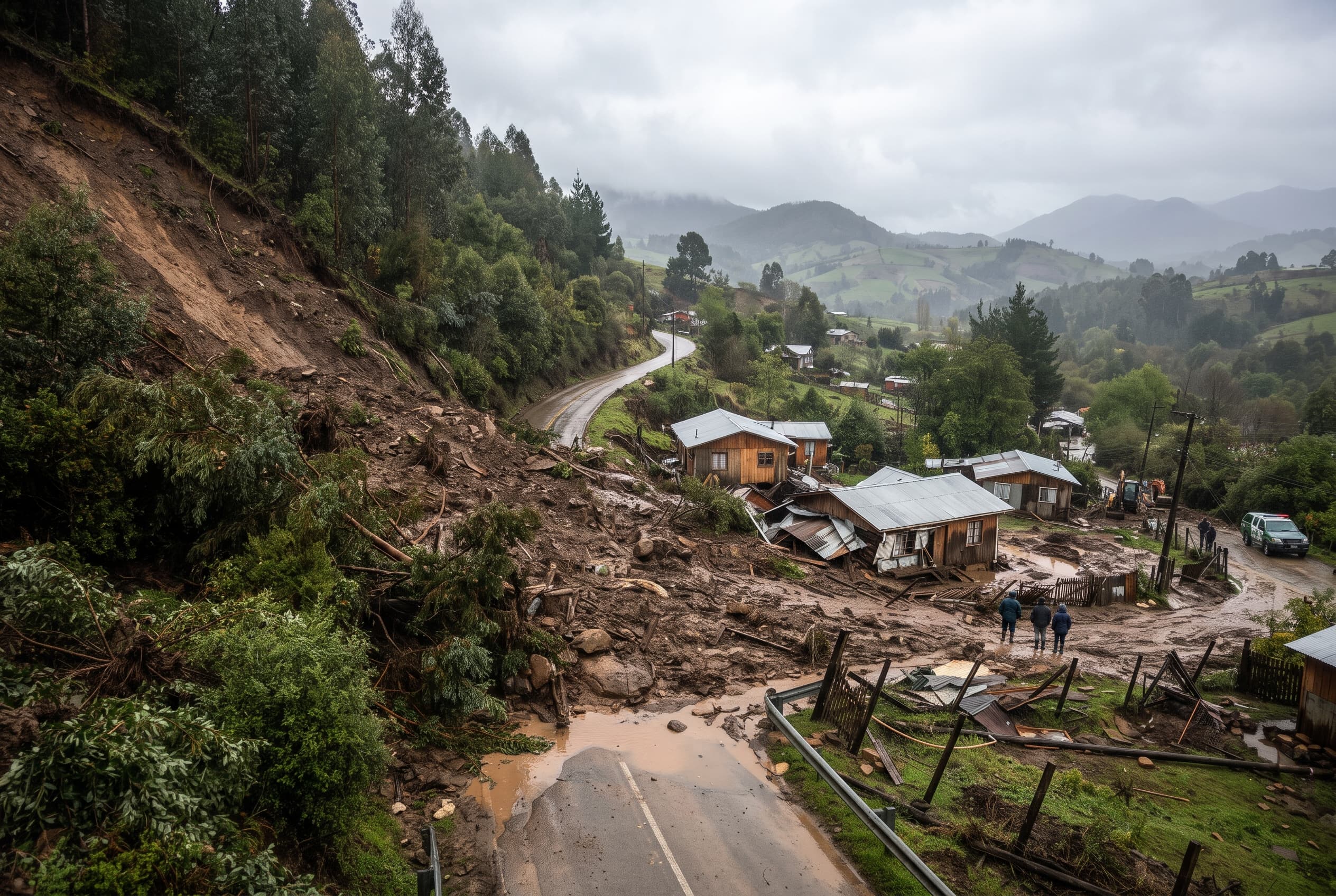
Santiago, Chile— Torrential rainfall that began before dawn on October 24, 2026 ripped through central and southern Chile, killing one person, injuring six others, and leaving more than 2,000 homes damaged or underwater as rivers broke their banks and hillsides collapsed.
The national disaster service said the hardest hit areas were Maule, Ñuble, Biobío and La Araucanía, where 12 hours of continuous downpour dumped more than 150 millimeters in some valleys. Roads vanished under brown water. Bridges buckled. In Curanilahue, a mudslide pushed straight through a row of timber houses at around 4 a.m.
One death was confirmed in the commune of Santa Juana after a retaining wall collapsed onto a residence. Six people were taken to regional hospitals with fractures and hypothermia. Two of them remain under observation. Officials said the toll could change as teams reach cut-off sectors.
More than 2,000 homes showed structural damage, infiltration or total loss, according to preliminary assessments. Local mayors described entire blocks where water reached chest height. Families dragged mattresses and refrigerators onto roofs. Power was cut for at least 18,000 customers as substations were flooded to prevent short circuits.
"We told people to leave at midnight, but the river rose faster than any forecast," a Biobío provincial emergency coordinator said. "By 3 a.m. we were pulling people out with ropes. The mud came down without noise. One moment the street was clear."
The army deployed trucks and inflatable boats to evacuate 800 people from low-lying areas near the Laja and Cautín rivers. Schools in six provinces suspended classes. The Ministry of Public Works closed Route 5 South in two stretches after landslides buried both lanes under rock and timber.
In Concepción, firefighters worked with shovels and bare hands in the Villa Cap sector after a slope gave way behind a housing complex. A resident, 42, said she woke to her bedroom wall cracking. "Water and mud just entered. We grabbed the kids and ran. Everything below is lost."
Meteorologists blamed a warm atmospheric river colliding with a low-pressure system over the Pacific. The system stalled over the coastal range, a pattern they said is becoming more frequent. Reservoirs that were half-empty a month ago are now releasing water to avoid overtopping.
Evacuation shelters were opened in municipal gyms. As of late afternoon, river levels were still rising in some tributaries, and crews were waiting for heavy equipment to clear the main mudslide sites.
Published by Banx Network. This article is part of the Banx decentralized media programme, powered by the BXE token on the XRP Ledger.