The Sun is often perceived as a steady, unchanging beacon in our sky, a constant source of light and warmth. Yet, beneath its serene surface lies a turbulent engine that constantly ejects streams of charged particles into the void. This phenomenon, known as the solar wind, flows outward in all directions, shaping the magnetic environment of our solar system. While scientists have long understood the existence of this stream, the specific origins of the "fast" solar wind—plasma that races away at speeds exceeding 400 miles per second—remain one of astrophysics’ most enduring mysteries.
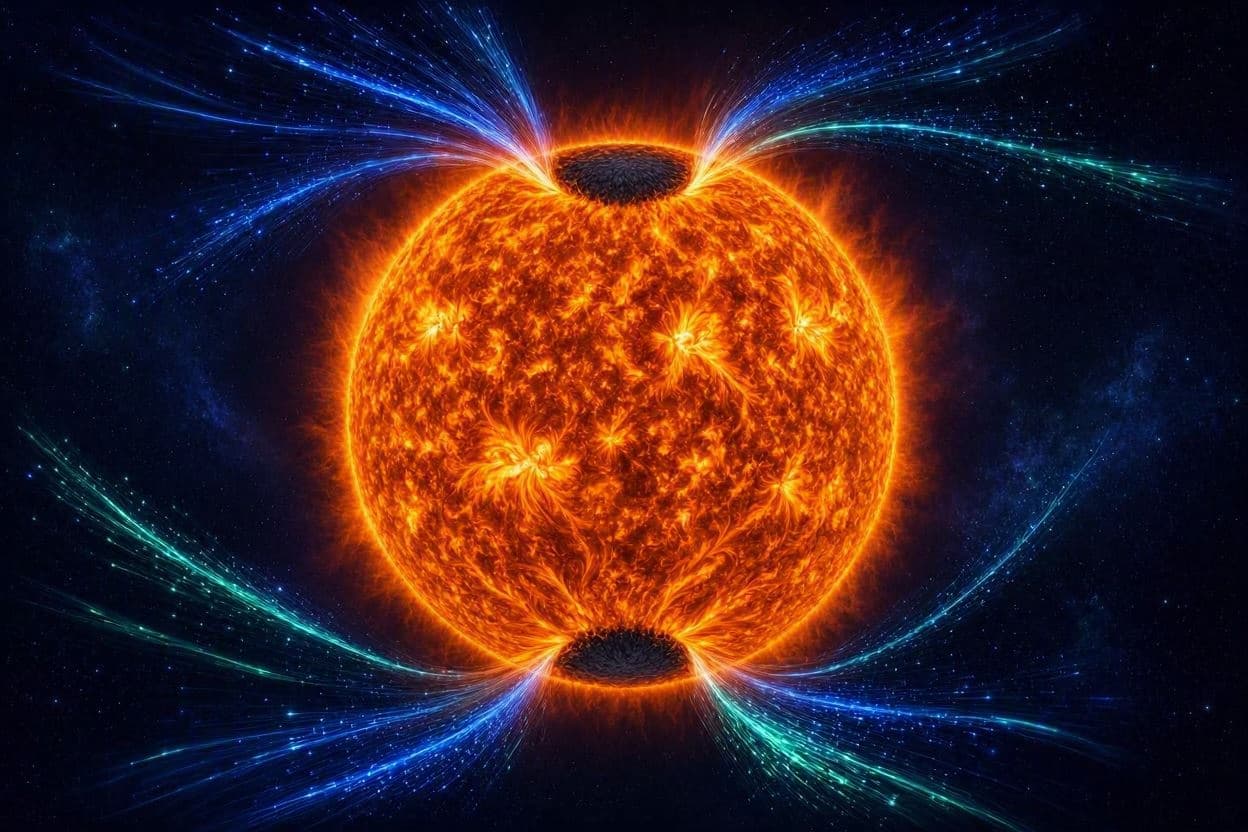
Unlike the slow solar wind, which meanders from various regions of the Sun’s corona, the fast variety appears to originate from specific areas known as coronal holes. These are regions where the Sun’s magnetic field lines open out into space rather than looping back to the surface. It is through these open channels that plasma can escape more freely, accelerating to high velocities. However, the precise mechanism that imparts such tremendous energy to these particles is not fully understood.
Recent observations from spacecraft like NASA’s Parker Solar Probe have brought us closer to the source. By dipping into the Sun’s outer atmosphere, the probe has detected intricate structures and wave patterns that may play a role in acceleration. Magnetic reconnection events, where field lines break and reconnect, releasing vast amounts of energy, are suspected to be key drivers. Yet, connecting these micro-scale events to the macro-scale flow of the wind remains a complex challenge.
The distinction between fast and slow solar wind is crucial for understanding space weather. The fast wind, being less dense but more energetic, interacts differently with Earth’s magnetosphere. It can trigger geomagnetic storms that affect satellite operations, power grids, and communication systems. Understanding its origin allows for better prediction of these events, protecting our increasingly technology-dependent society.
Scientists also look to the composition of the particles for clues. The fast solar wind has a different chemical signature compared to the slow wind, suggesting it comes from deeper or distinct layers of the solar atmosphere. Analyzing these isotopic ratios helps researchers trace the path of the plasma back to its birthplace, much like a detective following a trail of evidence.
Despite advances in instrumentation, the Sun’s corona remains a difficult environment to study. The extreme heat and dynamic magnetic fields create conditions that are hard to replicate in laboratories or simulate accurately in computers. Each new data set adds a piece to the puzzle, but the full picture of how the Sun accelerates this wind continues to evade complete explanation.
As missions continue to explore the inner heliosphere, hope remains that the secret will soon be revealed. The pursuit of this knowledge is not just about satisfying curiosity; it is about understanding the star that sustains life on Earth. The solar wind is a tangible connection between us and the Sun, a reminder of our place within its dynamic influence.
The origins of the fast solar wind remain a significant question in solar physics. Through continued observation and advanced modeling, scientists aim to uncover the mechanisms behind this high-speed plasma flow, enhancing our ability to predict and mitigate space weather effects.
AI Image Disclaimer: The visual representations accompanying this article are generated by artificial intelligence to illustrate the concept of solar wind.
Sources: NASA Goddard Space Flight Center The Astrophysical Journal Space.com
Published by Banx Network. This article is part of the Banx decentralized media programme, powered by the BXE token on the XRP Ledger.