The solar system is often pictured as a quiet neighborhood of planets and moons circling the Sun in predictable patterns. Yet from time to time, something unfamiliar passes through—an object that does not belong to this celestial family but merely visits, drifting in from the vastness between stars.
Such travelers arrive rarely and leave quickly. By the time astronomers understand what they are seeing, the visitor is often already on its way back into the darkness of interstellar space.
That fleeting nature is precisely what makes them so fascinating.
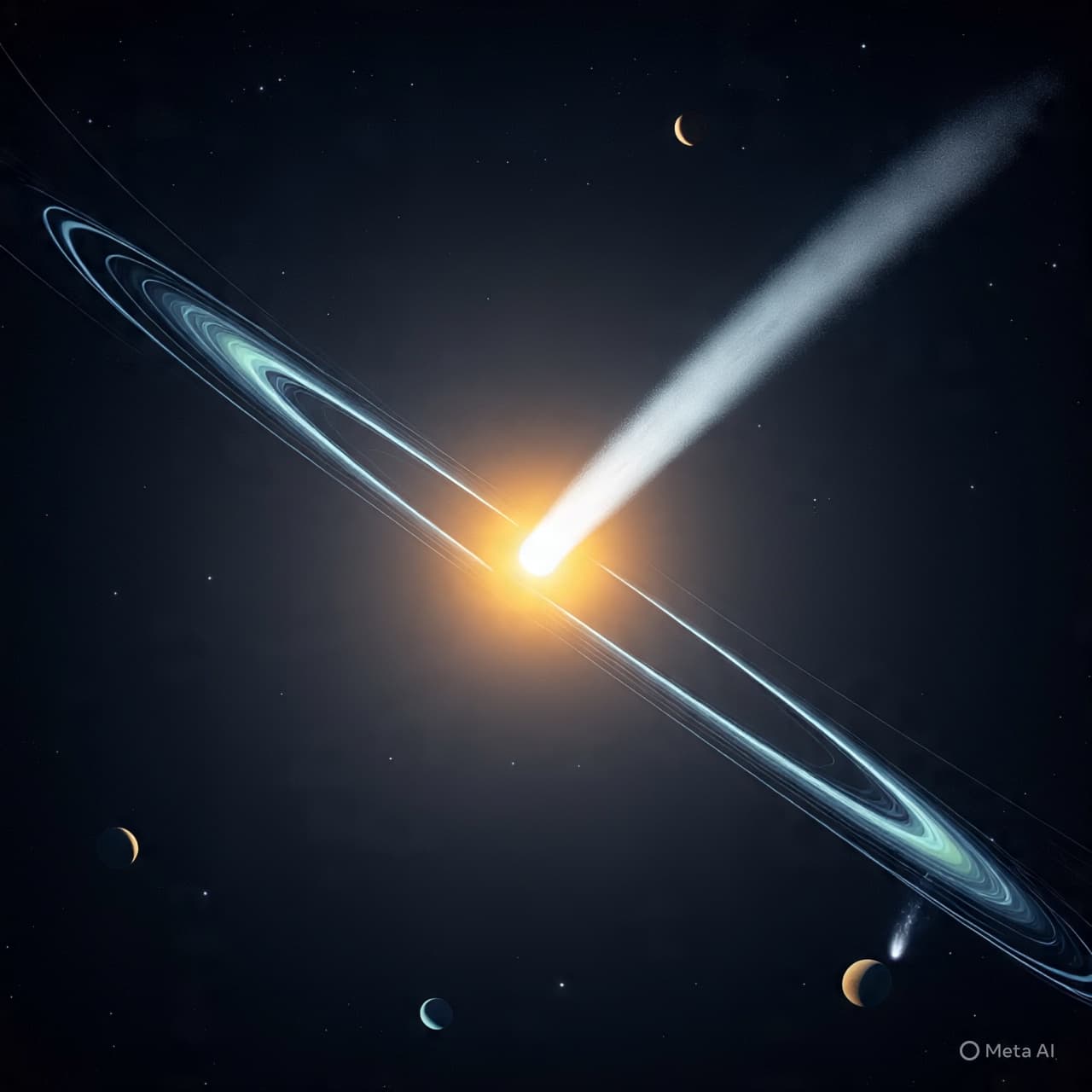
Recently, astronomers have been studying a newly detected object known as Comet 3I/ATLAS, believed to be an interstellar comet passing through the solar system on a trajectory that will eventually carry it outward again. Like previous visitors of its kind, it offers a rare opportunity to examine material formed around another star.
But time is not generous with such opportunities.
Unlike long-period comets that remain bound to the Sun’s gravity, interstellar objects travel on hyperbolic paths. They sweep through the solar system only once before continuing their journey across the galaxy. By the time they are discovered, they are often already moving at enormous speeds, making detailed study difficult.
For scientists, that fleeting visit raises an intriguing possibility: what if a spacecraft could be sent to chase the comet as it departs?
Researchers and mission planners have begun exploring the idea of a rapid-response spacecraft designed to intercept or follow Comet 3I/ATLAS as it exits the solar system. The concept would involve launching a probe capable of accelerating quickly enough to approach the comet and observe it at close range.
Such a mission would be technologically challenging but not entirely beyond reach.
Modern propulsion systems, combined with carefully calculated gravity assists from planets, could potentially allow a spacecraft to catch up with a fast-moving comet. In some proposals, a probe might perform a high-speed flyby, collecting images and measurements as it passes through the comet’s surrounding cloud of dust and gas.
Even a brief encounter could provide valuable information.
Interstellar comets are thought to contain material that formed around distant stars billions of years ago. Studying their composition could offer clues about how planetary systems form elsewhere in the galaxy. In essence, they carry chemical fingerprints from environments far beyond our own solar neighborhood.
The idea of chasing such objects has been discussed increasingly in recent years. The discoveries of earlier interstellar visitors—most famously ‘Oumuamua in 2017 and Comet 2I/Borisov in 2019—sparked growing interest in designing spacecraft capable of intercepting future arrivals.
Several research groups have proposed mission concepts that could be launched quickly after the discovery of an interstellar object. Some designs even suggest maintaining a spacecraft in a standby orbit, ready to depart once a suitable target appears.
In the case of Comet 3I/ATLAS, researchers are still analyzing its trajectory and characteristics. If confirmed as an interstellar object, it would become only the third such visitor ever observed passing through the solar system.
That rarity explains the excitement.
Each interstellar object represents a fragment of another planetary system—a messenger carrying information from places too distant for direct exploration. While telescopes can reveal some details from afar, a spacecraft encounter would provide a much closer look.
Instruments aboard a probe could analyze the comet’s gas emissions, measure the size and structure of its nucleus, and examine the composition of its dust particles. These observations could help scientists compare the chemistry of distant star systems with the materials found in our own solar system.
Yet the clock is always ticking.
Because these visitors travel so quickly, mission planners must act within narrow time windows. The spacecraft would need to launch within months or a few years of the comet’s discovery, and it would likely require innovative propulsion strategies to close the distance.
Even so, the idea captures a certain imagination.
Humanity has long sent spacecraft to explore worlds that orbit our Sun. But chasing an interstellar comet would mean reaching for something that began its journey around another star entirely.
For now, the concept remains under study, and no mission has yet been formally approved. Scientists continue to analyze Comet 3I/ATLAS while considering what might be possible with current or near-future technology.
In the coming years, researchers hope to refine these plans so that when the next visitor from the stars appears, humanity may be ready not just to watch it pass—but to follow it, if only for a brief moment along its long cosmic journey.
AI Image Disclaimer Graphics are AI-generated and intended for representation, not reality.
Sources Space.com Nature Astronomy NASA Jet Propulsion Laboratory News Scientific American Universe Today
Published by Banx Network. This article is part of the Banx decentralized media programme, powered by the BXE token on the XRP Ledger.