In the vast gallery of the cosmos, there are forms that seem almost familiar — shapes that stir the imagination before the mind can fully name them. A cloud of gas becomes a blossom, a spiral becomes a whirlpool, and sometimes, in the delicate interplay of light and dust, a nebula takes on the faint outline of a skull. The universe, in its silent artistry, mirrors us back to ourselves.
Recently, NASA’s James Webb Space Telescope turned its infrared gaze toward what astronomers informally call the “Cranium Nebula,” capturing new details that deepen both its mystery and its beauty. Officially cataloged as NGC 2467, this star-forming region lies thousands of light-years from Earth within the Milky Way, a luminous cradle where new suns are steadily taking shape.
The Webb telescope, launched in 2021 as the most powerful space observatory ever built, specializes in infrared observation. This capability allows it to peer through thick curtains of cosmic dust that obscure visible light. Where earlier telescopes saw hazy outlines, Webb reveals intricate filaments, glowing knots of gas, and newborn stars still embedded in their dusty cocoons.
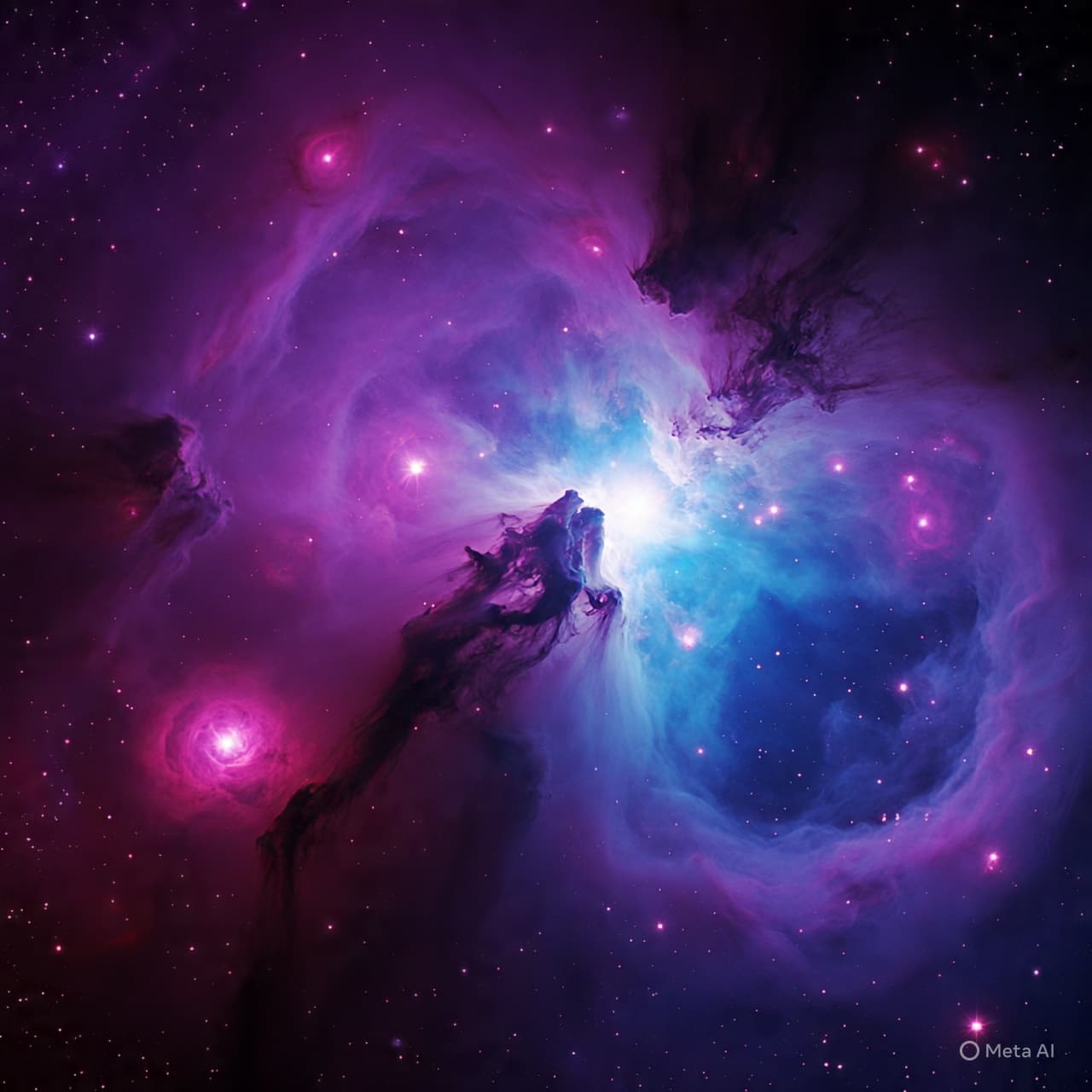
The Cranium Nebula earns its nickname from the suggestive contours of its gas clouds, which resemble the hollowed arcs and shadowed cavities of a skull. Yet beyond the playful moniker lies a dynamic environment of stellar birth. Massive young stars at the region’s center emit intense radiation and stellar winds, carving cavities into surrounding gas. These forces compress nearby material, triggering further waves of star formation — a cycle of creation unfolding over millions of years.
Webb’s latest imagery highlights the delicate textures of this process. Infrared wavelengths reveal pillars of cold molecular gas stretching like elongated fingers across the frame. Within them, gravity is quietly at work, pulling material inward to form protostars. Some of these embryonic stars are so deeply enshrouded that they are visible only in infrared light, their presence hinted at by subtle glows within darker regions.
Astronomers are particularly interested in how radiation from massive stars influences their surroundings. The balance between constructive compression and destructive dispersal shapes the eventual number and distribution of new stars. By examining regions like NGC 2467 in such clarity, scientists can refine models of how star clusters emerge and evolve.
The data gathered by Webb complement observations from earlier missions, creating a layered understanding of the nebula’s structure. Spectroscopic analysis allows researchers to identify specific chemical signatures — hydrogen, sulfur, and complex molecules — that trace temperature, density, and motion within the cloud. Each spectral line becomes a quiet measurement of physical conditions light-years away.
While the Cranium Nebula’s skull-like silhouette captures public imagination, astronomers emphasize that its significance lies in its physics rather than its shape. It is one among many stellar nurseries scattered throughout our galaxy, yet each offers a distinct laboratory for studying the interplay of gravity, radiation, and chemistry.
Public release of Webb’s imagery continues NASA’s effort to share both the scientific and aesthetic dimensions of space exploration. High-resolution images and accompanying data are made available through official channels, allowing researchers worldwide to conduct further analysis.
As the Webb telescope continues its mission, more such regions will come into focus. Each observation extends the map of our cosmic neighborhood, refining our understanding of how stars — and by extension, planetary systems — come into being.
The Cranium Nebula remains a distant and silent realm, shaped by forces far older than humanity. Yet through instruments orbiting a million miles from Earth, its light arrives here, translated into color and detail. In that exchange, the universe feels a little less remote — and a little more understood.
AI Image Disclaimer (Rewritten) Images in this article are AI-generated illustrations, meant for concept only and not actual telescope photographs.
Source Check: NASA ESA Space.com Sky & Telescope Reuters
Published by Banx Network. This article is part of the Banx decentralized media programme, powered by the BXE token on the XRP Ledger.