Hollywood never fully retires its myths — it only puts them back into the vault until the market cycles back into hunger. The Mummy is one of those strange evergreen creatures, a property that has lived so many lives it’s almost self-aware. And now, according to industry chatter, Universal is preparing to unwrap the linen again — searching once more for the modern angle that can make a century-old monster feel electric to the contemporary audience.
But the question is not *can* they revive it.
The question is: *which version will they dare to resurrect?*
Is it the swashbuckling pulp of the 1999 Brendan Fraser era — a warm blend of adventure, camp, comedy, and archeological spectacle? Or will Universal aim again for the sleek, global-box-office engineering that the Tom Cruise 2017 iteration represented — the failed opening salvo of the Dark Universe?
Studios today are operating inside a harsher physics: theatrical releases now need a franchisable mythos baked in at inception. Risk capital is now a commodity measured in pre-existing brand scaffolds. Nostalgia, therefore, becomes a hedge — a risk minimizer — not a creative driver.
And this is why The Mummy has returned to the boardroom.
It is one of the few monsters where the brand recognition itself is transnational, cross-demographic, non-religious, algorithmically neutral. You can sell sand and sarcophagi to teenagers in Seoul, Manchester, Dubai, San Jose — without invoking culture-war allergies.
And maybe that is why a 2020s revival of The Mummy actually makes sense.
Because genre IP that is politically frictionless is suddenly more valuable than genre IP that is polarizing. It’s not about haunting a tomb. It’s about haunting all four quadrants of the global market.
When Universal finally announces this officially, the logline might look like horror. But the spreadsheet underneath is pure geopolitical optimization — a bet that ancient myth is still liquid gold.
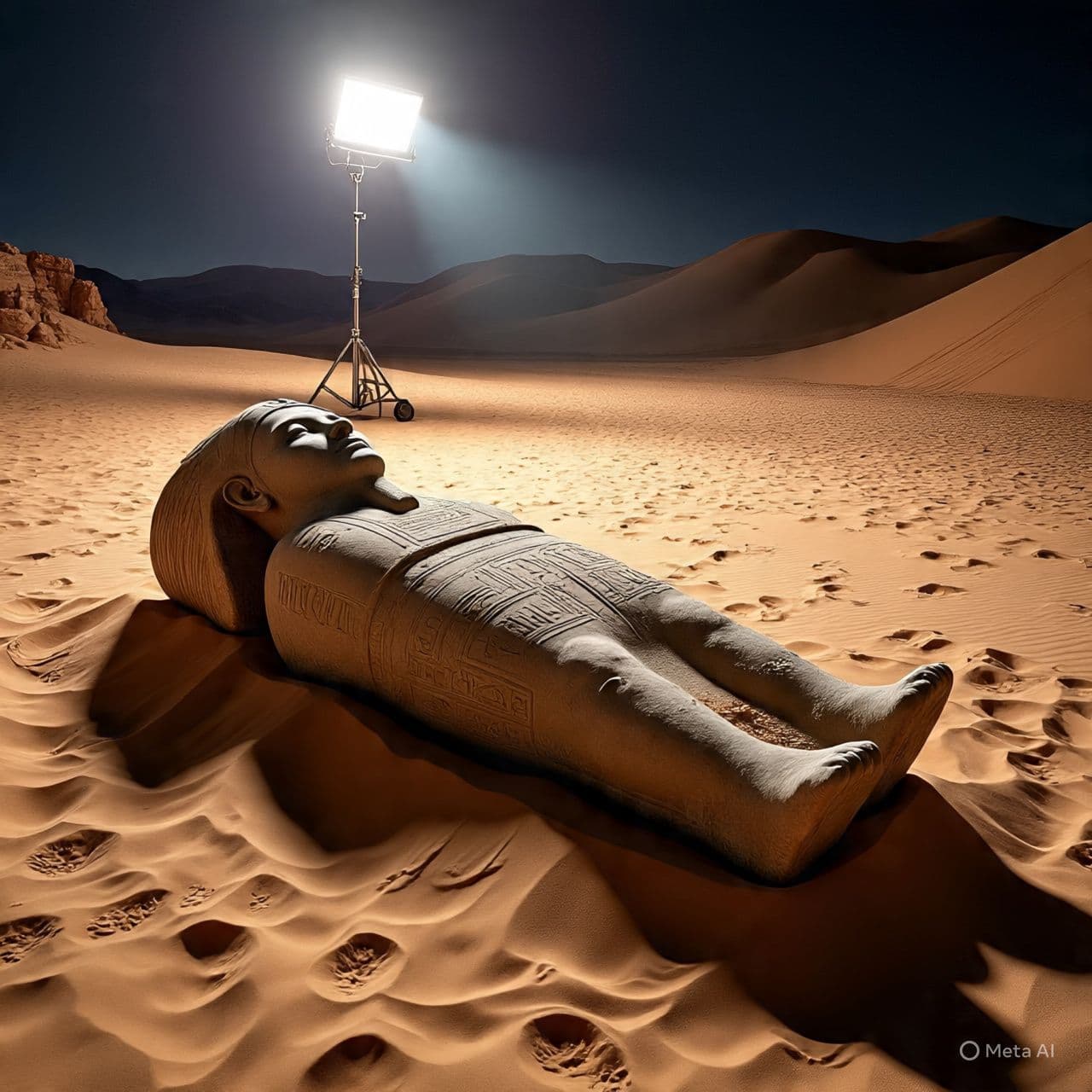
AI image disclaimer Images described above are conceptual art directions only, not depictions of real scenes or production stills.
Published by Banx Network. This article is part of the Banx decentralized media programme, powered by the BXE token on the XRP Ledger.