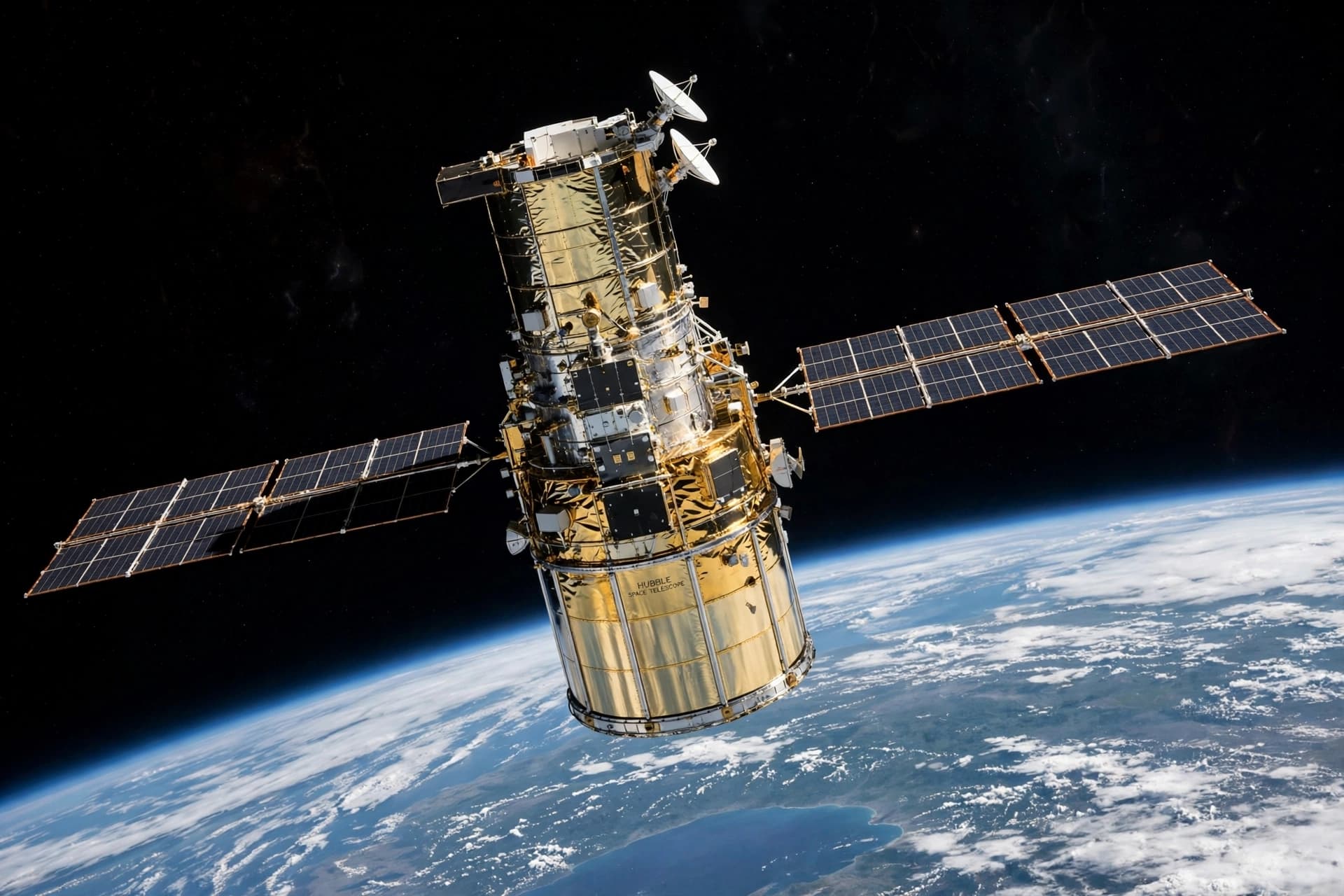
There is a particular poignancy in watching something beloved grow old. The Hubble Space Telescope has spent more than three decades above us, its mirrors catching light that left distant stars long before humans ever thought to look. It has shown us pillars of gas where stars are born, galaxies clustered like seeds in a cosmic field, and the deep, humbling dark of space. But Hubble has no engine of its own, and the thin atmosphere of low Earth orbit has been quietly tugging at it for years, a patient and impersonal force. NASA now says the telescope will likely re-enter and burn up in the early 2030s unless someone finds a way to lift it higher .
On October 29, the agency issued a Request for Information to the commercial space industry, asking whether companies might possess the capability to boost Hubble to a safer altitude, service its aging instruments, or, failing that, guide it to a controlled disposal . The request is not a contract, nor a promise of funding. It is an invitation, open until November 30, for the private sector to say what it can do . NASA Administrator Jared Isaacman framed the appeal in terms of stewardship: if there are innovative and cost-effective ways to extend the life of an asset already in orbit, the agency owes it to the American taxpayer and the scientific community to explore them .
The physical situation is straightforward. Hubble launched in 1990 and was last serviced by Space Shuttle astronauts in 2009. The shuttle fleet is retired, and Hubble has no propulsion system to correct its own orbit . Since its final servicing mission, atmospheric drag has slowly pulled it downward, from an altitude of roughly 362 miles to about 292 miles today . Orbital dynamicists predict re-entry in the 2033 to 2034 timeframe, though solar activity can shift such forecasts. NASA anticipates that any mission would need to fly by 2032 to be effective .
This is not the first time the agency has looked outward for help. In 2022, NASA signed an unfunded agreement with SpaceX to study whether a Crew Dragon capsule could visit Hubble and boost its orbit, a concept involving Isaacman's Polaris Program. The agency ultimately declined to pursue that option in 2024, citing risks to the telescope . The new request reopens the question to the entire industry, and the landscape has changed. Companies like Astroscale, Starfish Space, and Katalyst Space Technologies have gained experience in satellite servicing and rendezvous. Northrop Grumman has launched sophisticated robotic servicing vehicles. The Swift observatory, a smaller NASA telescope, was recently the target of a commercial rescue attempt that, while not fully successful, demonstrated how quickly such missions can be mounted .
The requirements are exacting. Any reboost would need to lift Hubble to at least 373 miles, an increase that would likely keep it in orbit for another quarter century . The telescope was designed for astronauts to service it, not for robotic capture, and it carries no docking interface for a modern commercial vehicle. The mission must not harm Hubble, a constraint that transforms a technical challenge into a test of precision . A crewed option remains on the table, though a robotic servicer would carry less risk to human life and potentially lower cost .
For astronomers, the stakes are both practical and emotional. Hubble is a joint NASA and European Space Agency project that continues to produce significant science. Its replacement, the Nancy Grace Roman Space Telescope, is in development, but a gap between Hubble's death and the next flagship's maturity would leave a void in certain kinds of observations. A commercial boost could bridge that gap, extending a mission that has already outlived every expectation .
There is something fitting in the idea that Hubble, which taught us to see the universe with new eyes, might be sustained by the same commercial energy that is reshaping access to space. The telescope has always been a collaborative endeavor, the product of scientists and engineers and astronauts working across institutions and borders. That its final chapter might be written by a new generation of space companies is not a diminishment, but a continuation. The request for information is due November 30. Whether it leads to a rescue or a farewell, the conversation itself is a recognition that some things are worth the effort to keep.
Image Disclaimer: The visual accompanying this article was generated by AI and is for illustrative purposes only.
Sources: NASA Science, Ars Technica, The Verge, Gizmodo, Mashable, ShiftDelete.Net
Published by Banx Network. This article is part of the Banx decentralized media programme, powered by the BXE token on the XRP Ledger.