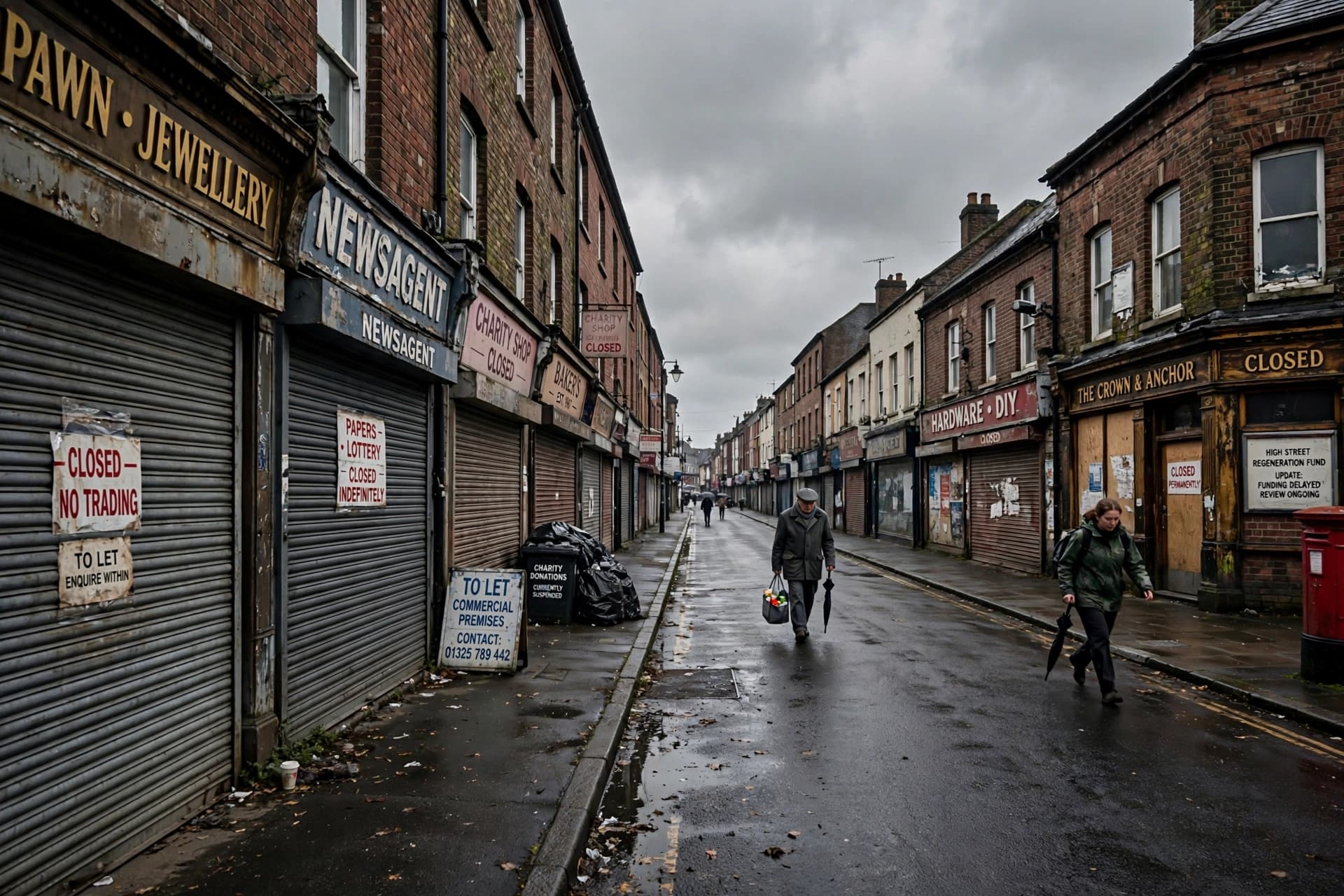
There is a particular weariness that settles into a nation when its people begin to describe it as broken—a weariness that is not about any single failure but about the accumulation of them, the sense that the systems meant to hold things together have stopped working and no one knows how to repair them. In Britain, that phrase—"broken Britain"—has become a shorthand for a mood that has settled over the country: a sense of decline, of dysfunction, of things that used to work and no longer do. Alastair Campbell, the former Labour communications chief and architect of Tony Blair's media strategy, has been thinking about that mood. And he is, by his own account, "moderately hopeful" that it can be shaken.
Campbell's assessment comes from a position of long experience with the mechanics of political change. He was part of a government that, for a time, convinced the country that things could get better—that public services could be improved, that poverty could be reduced, that Britain could be a place of possibility rather than resignation. The subsequent years have eroded that confidence. Austerity, Brexit, the pandemic, the cost-of-living crisis, and the revolving door of prime ministers have left a public that is skeptical of promises and weary of politics. Campbell argues that the "broken Britain" mentality is not inevitable—that it is a product of political choices, and that different choices could produce a different mood.
The question of how to shake that mentality is one that occupies political strategists across the spectrum. Campbell's view, broadly, is that it requires both a narrative and a demonstration—a story about what Britain could be, and concrete evidence that change is possible. The Labour government elected in 2024 has attempted to provide both, with mixed results. Its early months have been marked by difficult decisions, fiscal constraints, and the inevitable disillusionment that follows any transition from opposition to power. But Campbell's optimism, however moderate, rests on the belief that public mood is not fixed, that it responds to leadership and to outcomes, and that the sense of decline is not a permanent condition.
What makes Campbell's perspective worth considering is that he has seen both the possibility and the limits of political communication. He knows that a message alone is not enough, that voters are not persuaded by words that are not backed by action. He also knows that the absence of a message—the failure to articulate a vision—creates a vacuum that is filled by cynicism. The challenge for any government is to demonstrate, over time, that the country is not broken, that its institutions can be made to work, that the sense of decline is not a prophecy but a condition that can be treated. Whether that is possible in the current political climate is the question that Campbell's moderate hope leaves open.
AI Image Disclaimer: The images accompanying this article were generated by artificial intelligence and are for illustrative purposes only.
Sources: The Guardian, LBC, Alastair Campbell, Reuters
Published by Banx Network. This article is part of the Banx decentralized media programme, powered by the BXE token on the XRP Ledger.