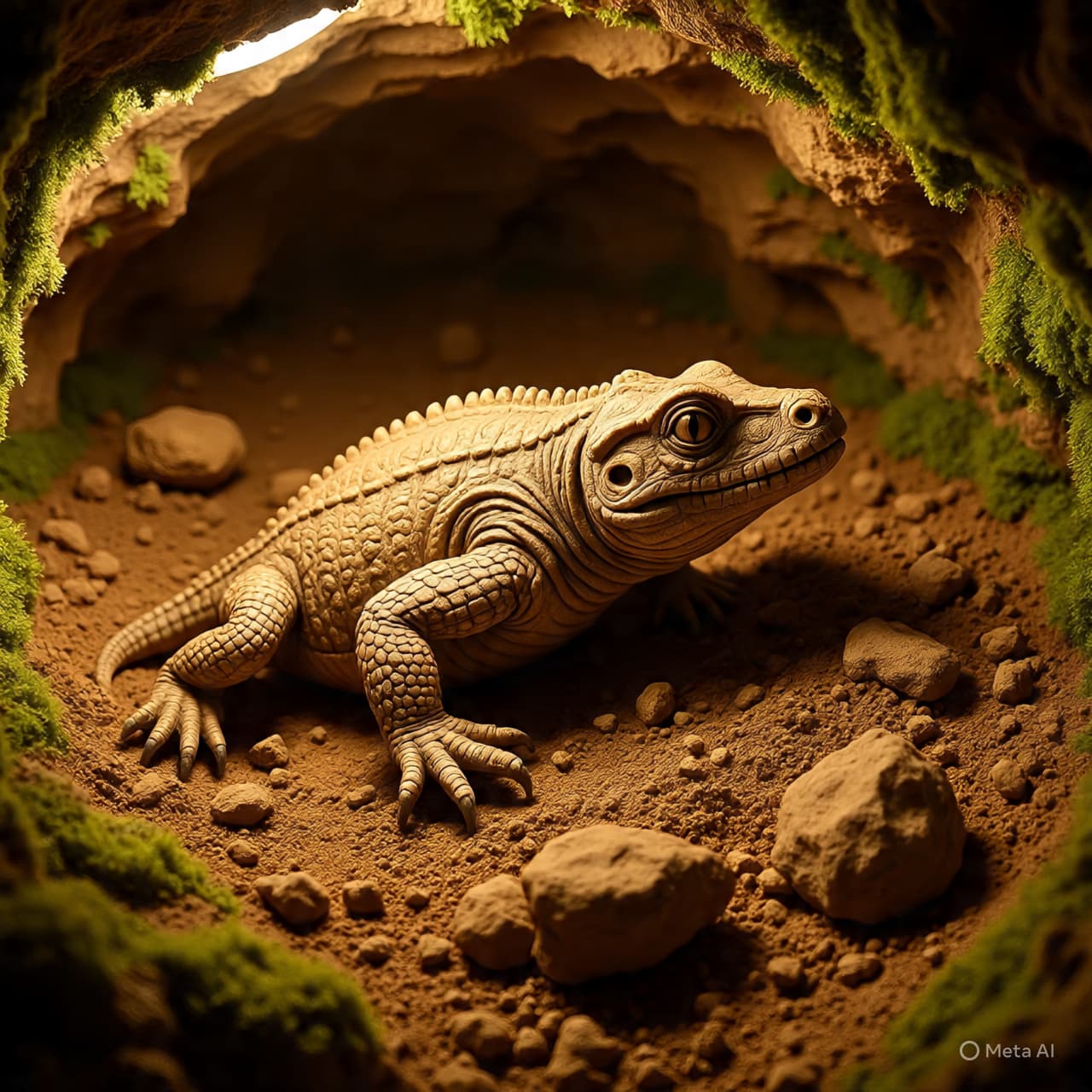
In the quiet stillness of deep time, where dust settles over stories older than memory itself, a small reptile has found its voice again. Preserved within the ancient silence of an Oklahoma cave, its body—fragile yet enduring—offers a whisper from nearly 289 million years ago. It is not merely a fossil; it is a message carried across epochs, one that speaks to something as intimate and constant as the breath we take without thinking.
The discovery of this mummified reptile has drawn the attention of scientists not because of its size or ferocity, but because of what lies beneath its preserved form. Unlike most fossils that reveal only bone, this specimen holds traces of soft tissue—an exceedingly rare condition that allows researchers to reconstruct aspects of ancient physiology. In this case, the focus turns to the mechanics of breathing, a function so fundamental that its evolutionary journey often escapes notice.
Researchers examining the specimen have identified structural clues that suggest how early reptiles—and eventually mammals—developed more efficient respiratory systems. The positioning of ribs, the inferred musculature, and the configuration of the torso all point toward a gradual transition from primitive breathing methods to more advanced mechanisms. These findings challenge long-standing assumptions that complex breathing evolved much later in the evolutionary timeline.
In modern animals, breathing is a coordinated dance between muscles and lungs, a seamless process that delivers oxygen while expelling carbon dioxide. Yet, in ancient species, this process was far less refined. The Oklahoma reptile appears to represent an intermediate stage, where structural adaptations were beginning to support more active lifestyles. This suggests that evolutionary pressure toward efficient respiration may have been driven by environmental demands much earlier than previously believed.
The cave environment where the reptile was found played a crucial role in its preservation. Low oxygen levels, stable temperatures, and mineral-rich conditions combined to slow decomposition and protect delicate tissues. Such natural preservation is rare, making this specimen an invaluable resource for scientists seeking to bridge gaps in the fossil record.
Beyond its anatomical insights, the discovery also offers a broader reflection on evolution itself. It reminds us that the features we take for granted—such as the simple act of breathing—are the result of countless incremental changes over millions of years. Each rib, each muscle, each adaptation is part of a long narrative written not in words, but in survival.
The research team continues to analyze the specimen using advanced imaging technologies, including CT scanning and digital modeling. These tools allow scientists to explore internal structures without damaging the fossil, revealing details that would have been inaccessible just decades ago. As analysis progresses, further revelations about early respiratory systems may emerge.
While the reptile itself lived in a world vastly different from ours, its legacy is deeply connected to modern life. The evolutionary innovations it represents are part of the biological heritage shared by all air-breathing animals. In this way, the fossil is not just a relic of the past, but a mirror reflecting the origins of our own existence.
In the end, the Oklahoma reptile does not shout its significance. It simply exists, quietly bridging the gap between ancient life and modern understanding. And in doing so, it invites us to consider the profound continuity of life—how even the smallest breath carries echoes of a distant past.
AI Image Disclaimer Visuals are created with AI tools and are not real photographs.
Source Check National Geographic Smithsonian Magazine ScienceDaily Nature BBC Science Focus
Published by Banx Network. This article is part of the Banx decentralized media programme, powered by the BXE token on the XRP Ledger.