
Space travel has often been described as a journey of distance, but increasingly it is also a matter of timing—of catching invisible currents that move through the solar system. In tracking a near-Earth asteroid, one astronomer has uncovered a possibility that feels almost like finding a hidden path across a vast and shifting sea.
Asteroid 2001 CA21, a near-Earth object that periodically passes within relatively close proximity to our planet, has become the focus of new research exploring orbital dynamics. By studying its trajectory, scientists have identified a potential pathway that could shorten travel time to Mars.
The concept centers on gravitational interactions and orbital alignment. Objects in the solar system follow predictable paths, but under certain conditions, these paths can intersect or align in ways that reduce the energy required for spacecraft travel.
This idea is not entirely new. Space agencies have long used gravitational assists—leveraging the pull of planets—to conserve fuel and extend mission capabilities. What distinguishes this finding is the possibility of using asteroid-related trajectories as part of mission planning.
The asteroid’s orbit appears to create a window in which spacecraft could adjust their course more efficiently, potentially reducing both travel time and fuel consumption. Such opportunities are rare and depend on precise timing and alignment.
While still in early stages of analysis, the findings could inform future mission designs, particularly as interest in crewed missions to Mars continues to grow. Any method that reduces travel duration is of significant interest, given the challenges of long-duration spaceflight.
However, researchers emphasize that practical application will require extensive validation. Factors such as safety, orbital stability, and mission complexity must be carefully assessed before such a route could be considered viable.
The study also highlights the broader value of tracking near-Earth objects. Beyond planetary defense, these observations contribute to a deeper understanding of orbital mechanics and the dynamic nature of our solar system.
In this way, a single asteroid becomes more than a passing object—it becomes part of a larger conversation about how humanity might move through space more efficiently.
The possibility of a shortcut to Mars, drawn from the motion of a distant asteroid, reflects both the precision and imagination of modern astronomy, where even small discoveries may open new paths forward.
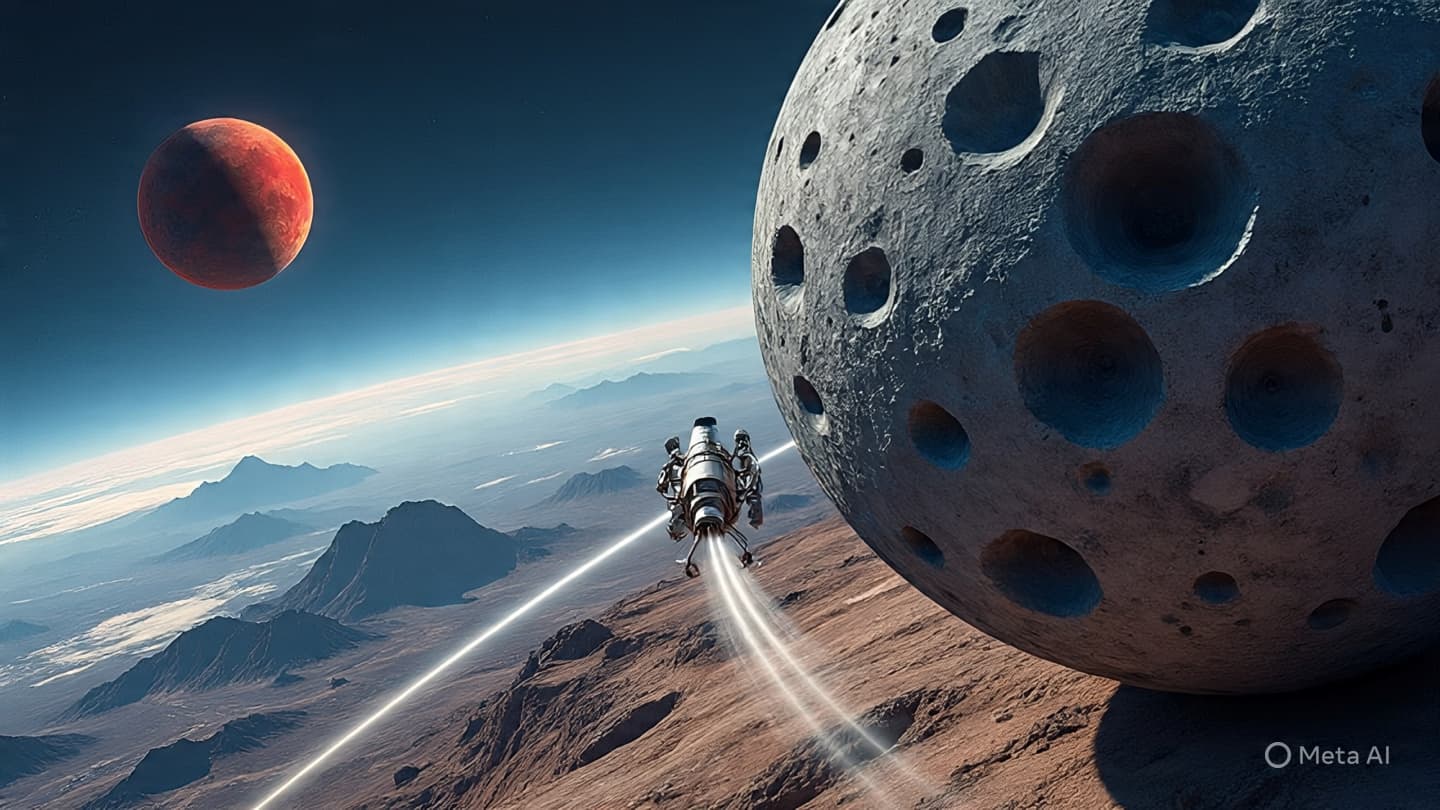
AI Image Disclaimer: Some visuals in this article are AI-generated to illustrate asteroid trajectories and space travel concepts.
Sources: NASA Jet Propulsion Laboratory (JPL) The Planetary Society
Published by Banx Network. This article is part of the Banx decentralized media programme, powered by the BXE token on the XRP Ledger.



