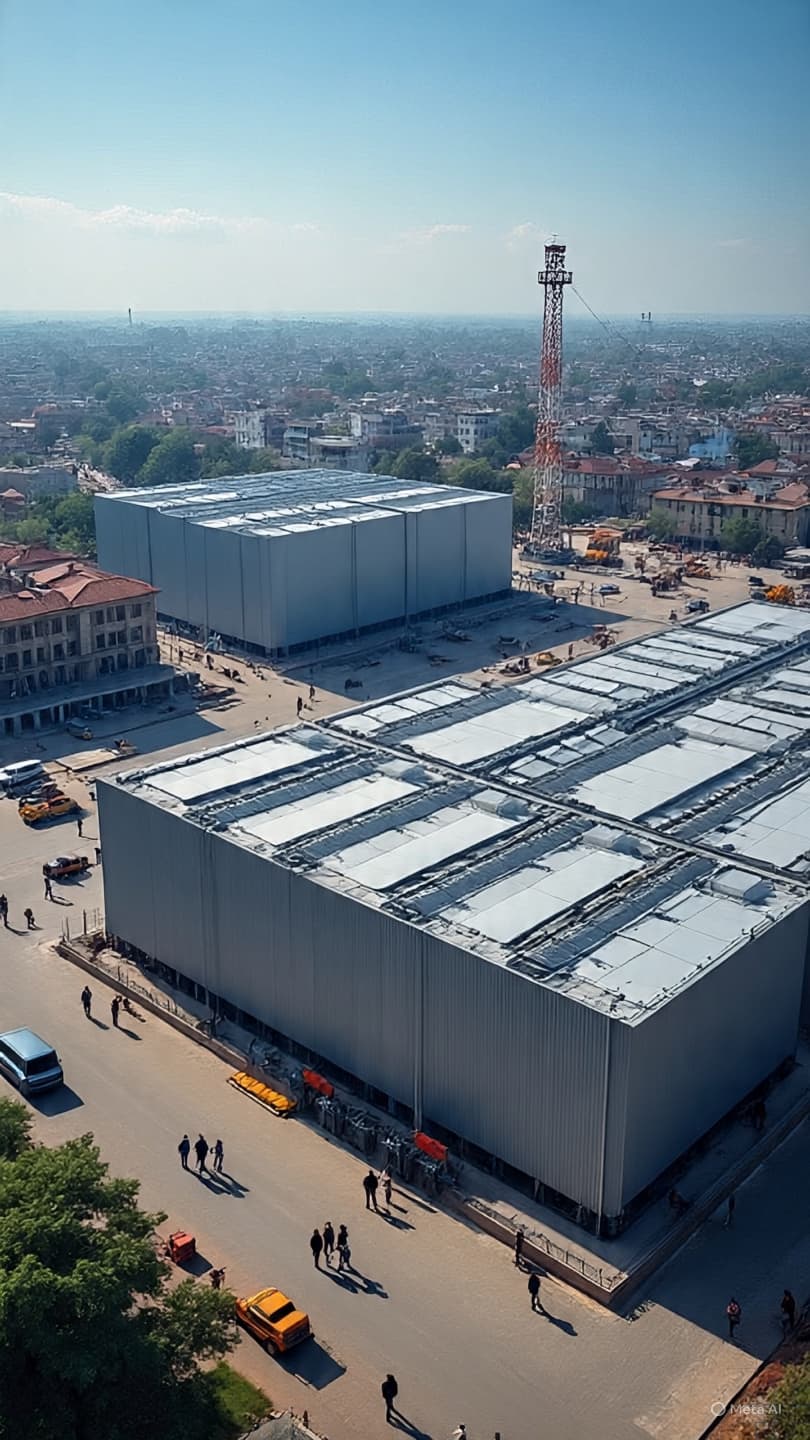
There are moments when ambition quietly redraws the map of possibility. Not with fanfare, but with blueprints — steel frames rising where once there was open land, cables laid beneath the soil like unseen arteries of a digital age. In India, a new chapter in that unfolding story is taking shape, as global and domestic forces converge around a shared belief: that artificial intelligence requires not only ideas, but infrastructure.
This week, OpenAI announced a partnership with India’s Tata Group to build out AI-focused data center capacity across the country. The collaboration signals more than a commercial agreement; it reflects the growing recognition that AI’s future will be powered as much by physical networks as by code.
At the center of the initiative is Tata Consultancy Services (TCS), the technology arm of Tata Group. Under the agreement, OpenAI will secure an initial 100 megawatts (MW) of data center capacity in India, with ambitions to scale that figure significantly in the coming years. In a field where computing power defines competitive edge, such capacity represents substantial infrastructure dedicated to training and running advanced AI systems.
India’s role in the global technology ecosystem has long been defined by software talent and IT services. This partnership suggests a further evolution — toward becoming a hub not only for engineering expertise but also for large-scale AI compute. By hosting infrastructure locally, the collaboration may help address data residency considerations, reduce latency for regional users, and support enterprises seeking AI integration within regulatory frameworks.
The agreement also extends beyond hardware. Tata Group companies are expected to deploy enterprise-grade AI tools internally, integrating OpenAI technologies into workflows across business lines. For TCS, access to advanced AI systems could enhance software development, automation, and client solutions — reflecting how AI is steadily embedding itself into traditional corporate operations.
The timing is notable. Nations around the world are racing to expand AI infrastructure, recognizing that data centers — with their vast energy needs and specialized hardware — form the backbone of innovation in machine learning. India, with its expanding digital economy and policy interest in technology leadership, stands at a crossroads where demand for AI services continues to accelerate.
For OpenAI, the move underscores a broader strategy of geographic diversification. As AI adoption widens, proximity to users and enterprises becomes increasingly significant. Building compute capacity closer to fast-growing markets offers both operational advantages and symbolic weight — signaling long-term commitment.
For Tata Group, one of India’s most established conglomerates, the partnership aligns with its historic pattern of adapting to new industrial eras — from steel and automobiles to software and now artificial intelligence. In this sense, the data center buildout may be viewed not as a sudden pivot, but as another step in a continuum of modernization.
Much remains to unfold: timelines, expansion scales, and the broader economic impact will become clearer as projects move from announcement to execution. Yet the contours are visible. The quiet hum of servers, the glow of cooling systems, the steady pulse of electricity — these are becoming as integral to the 21st century as factories once were to the 20th.
In the measured language of corporate statements, the partnership is framed as strategic and forward-looking. In practical terms, it reflects a simple truth: artificial intelligence, for all its abstraction, rests upon tangible foundations. And in India, those foundations are beginning to rise.
AI Image Disclaimer: Graphics are AI-generated and intended for representation, not reality.
Source Check (Credible Media Outlets Covering the Topic):
1. Reuters 2. Bloomberg 3. The Wall Street Journal 4. TechCrunch 5. Financial Times
Published by Banx Network. This article is part of the Banx decentralized media programme, powered by the BXE token on the XRP Ledger.