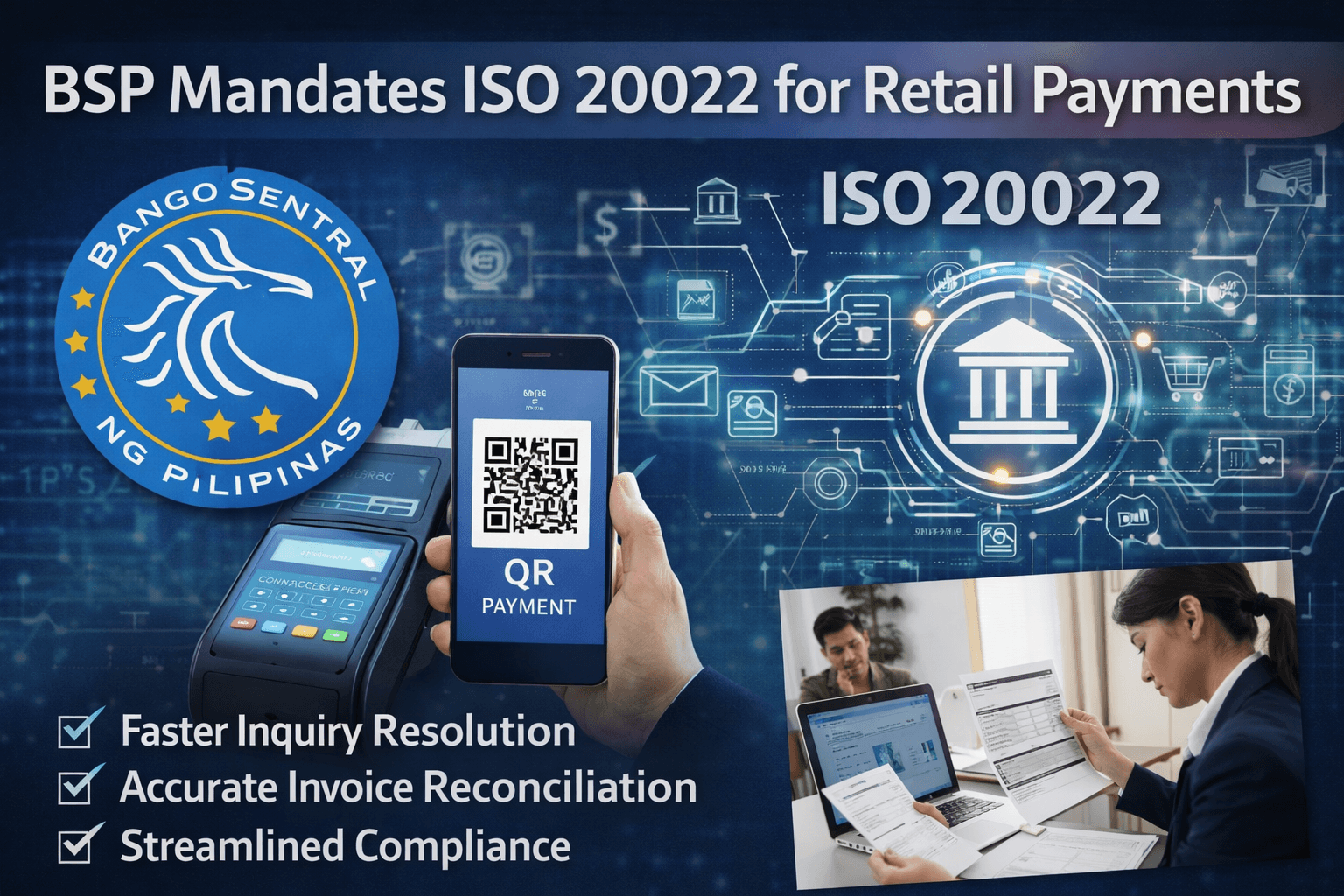
MANILA, Philippines — The Bangko Sentral ng Pilipinas (BSP) has issued a significant directive requiring all retail payment systems in the Philippines to adopt the internationally recognized ISO 20022 messaging standard to modernize and harmonize domestic and cross-border payment flows.
Under Circular No. 1223, approved by the BSP’s Monetary Board, financial institutions and payment service providers are now mandated to consistently implement ISO 20022 across all retail payment operations, addressing inconsistencies in prior adoption among systems.
What ISO 20022 Means
ISO 20022 is a global standard for electronic data interchange in financial messaging that supports richer, more structured data compared to legacy formats. It enhances the clarity, consistency, and completeness of payment information exchanged between banks and payment platforms, enabling more efficient processing, better compliance monitoring, and improved customer service.
While major retail payment channels such as InstaPay and PESONet have already implemented parts of ISO 20022, the BSP noted that execution has been uneven across the industry. The new mandate seeks to ensure uniform application of the standard across all participants.
Benefits for the Payments Ecosystem
According to the BSP, the adoption of ISO 20022 is expected to deliver a range of benefits:
• Consumers will experience faster resolution of inquiries and more transparent payment details.
• Businesses will benefit from more accurate invoice reconciliation and reduced reliance on manual processing.
• Financial institutions will gain from streamlined compliance, enhanced transaction monitoring, improved risk management, and greater interoperability with global payment networks.
• The move also aligns with G20 objectives to make remittances and retail payments more affordable, transparent, and efficient — a priority for economies with significant overseas worker remittance inflows.
Implementation Timeline and Industry Support
To facilitate the transition, the BSP has provided a two-year phased implementation period for full compliance, giving industry participants sufficient time to upgrade systems and processes.
The central bank also announced the formation of an ISO 20022 Harmonization Industry Project Team tasked with coordinating readiness efforts among banks, non-bank payment providers, regulators, and other stakeholders. The BSP pledged close collaboration with the payments industry to ensure a smooth and timely rollout of the new standard.
Broader Digital Payments Strategy
This latest directive forms part of the BSP’s wider digital payments strategy, which includes earlier initiatives like the adoption of a National QR Code Standard and modernization of both retail and high-value payment infrastructures.
As digital transactions increasingly account for a majority of retail payment activity in the Philippines, the BSP’s ISO 20022 mandate represents a crucial step toward a more efficient, secure, and globally interoperable financial system.
Published by Banx Network. This article is part of the Banx decentralized media programme, powered by the BXE token on the XRP Ledger.