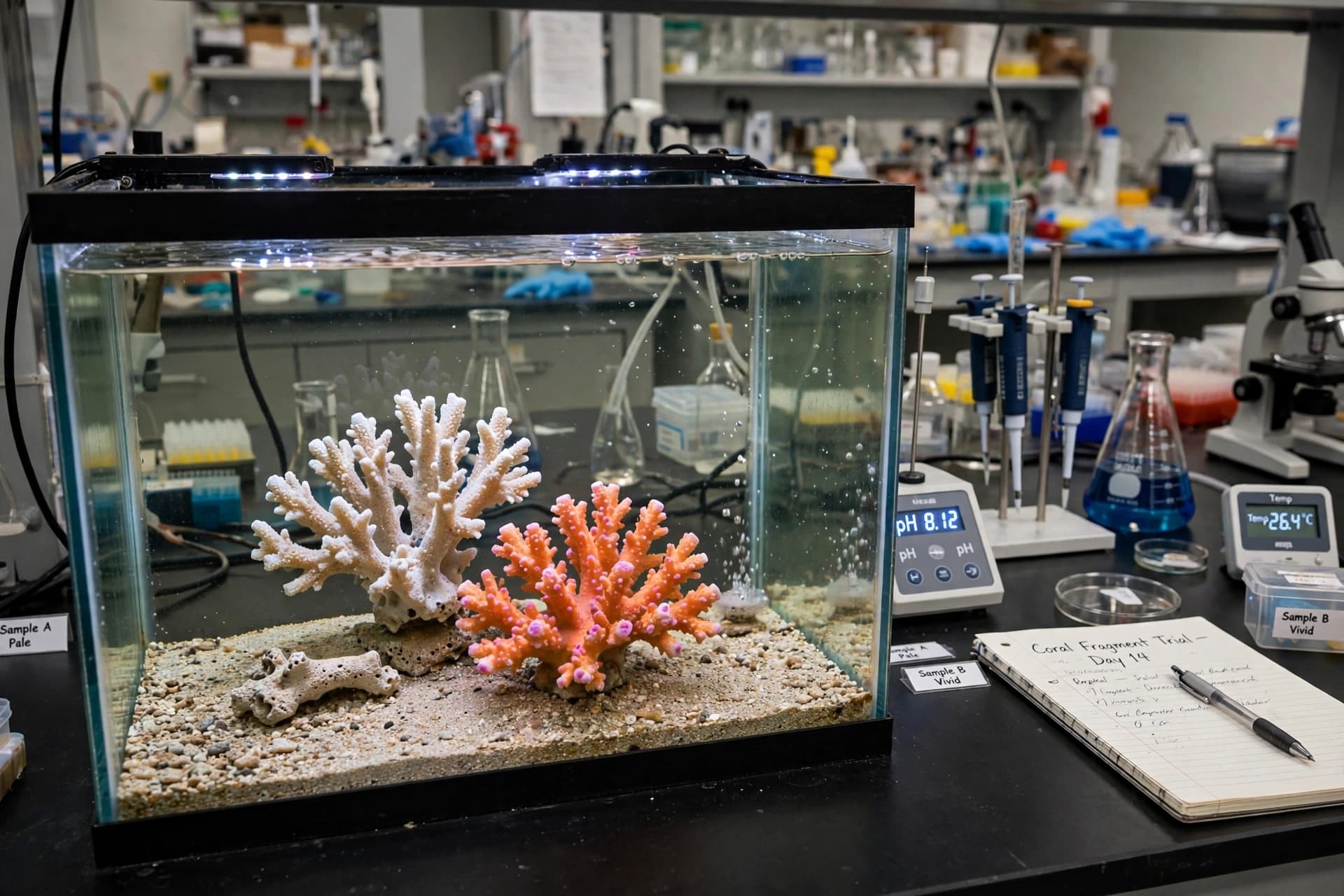
There is a particular kind of hope that arrives not from grand intervention but from a simple, almost accidental observation—two pieces of coral touching in a laboratory tank, one pale as bone, the other still holding its color, and at the point where they met, a faint flush of life returning. Science often proceeds this way: not with a declaration but with a second glance at something no one expected to see.
Researchers at Stanford University have demonstrated that bleached coral can fully recover within seven weeks through brief physical contact with a healthy, genetically identical fragment . The finding, published in Science Advances, represents the fastest documented recovery of bleached coral and opens a new avenue of inquiry for reefs under mounting thermal stress . The mechanism is not magic but biology: when two corals from the same genetic individual touch, their tissues can fuse, creating a bridge through which beneficial algae travel from the healthy partner to the starving one .
The discovery began with an accident. In early 2025, marine scientist Stephen Palumbi noticed two coral fragments in a laboratory tank had tipped over and were touching. Where the healthy and bleached fragments met, color had begun to seep into the ghostly branch . Danny Collins, then a PhD student studying how disease spreads through coral contact, wondered whether the same principle could work in reverse—whether contact could transmit something beneficial rather than harmful . He set up an experiment with ten pairs of coral fragments from the same animal, each pair containing one bleached and one healthy piece. Five pairs were arranged to touch; five were separated by a few millimeters .
The results were stark. In the touching pairs, the bleached coral recovered within eight weeks. In the separated pairs, the bleached fragments died after twenty weeks, overcome by harmful algae . Under high-powered microscopy, the researchers observed the two fragments fusing together by creating a tissue bridge, allowing symbiotic algae to transfer from the healthy coral to the bleached one within three days . After a week of contact, a bleached branch could fully recover on its own, even if separated from its healthy counterpart. The algae, once inside, simply replicated—doubling every four days at the peak of recovery .
The finding carries a significant caveat. The tissue fusion only occurred between fragments from the same genetic individual, known as a genet. Fragments from different species, or even different animals of the same species, did not fuse and did not nurse the bleached piece back to health . "Genetically identical corals recognize one another when they come into contact," Palumbi explained. "Their tissues fuse if they are from the same clone" . This specificity means the technique cannot be directly applied to wild reefs, where bleached corals do not conveniently have healthy clones nearby.
Yet the implications are not limited to what can be done tomorrow. The study demonstrates that bleaching is not necessarily a death sentence—that the coral animal, even after expelling nearly all its symbiotic algae, retains the capacity to accept new ones and recover rapidly if the conditions allow . The researchers are now investigating alternatives that do not require physical contact, such as harvesting algae from healthy corals before a heat wave and delivering them to bleached colonies in a scalable way . The question, as Collins framed it, is not whether bleached corals are dying but whether they are dead yet—and what can be done in the interval .
The reef is not saved by this discovery. The forces driving coral decline remain as powerful as ever. But a door has been opened, and through it comes a quieter kind of possibility: that the mechanisms of life, when understood closely enough, may offer tools that fear alone could not imagine.
AI Image Disclaimer: The visuals in this article were created using artificial intelligence and are intended for illustrative purposes only.
Sources: Nature, Science Advances, Stanford Doerr School of Sustainability
Published by Banx Network. This article is part of the Banx decentralized media programme, powered by the BXE token on the XRP Ledger.