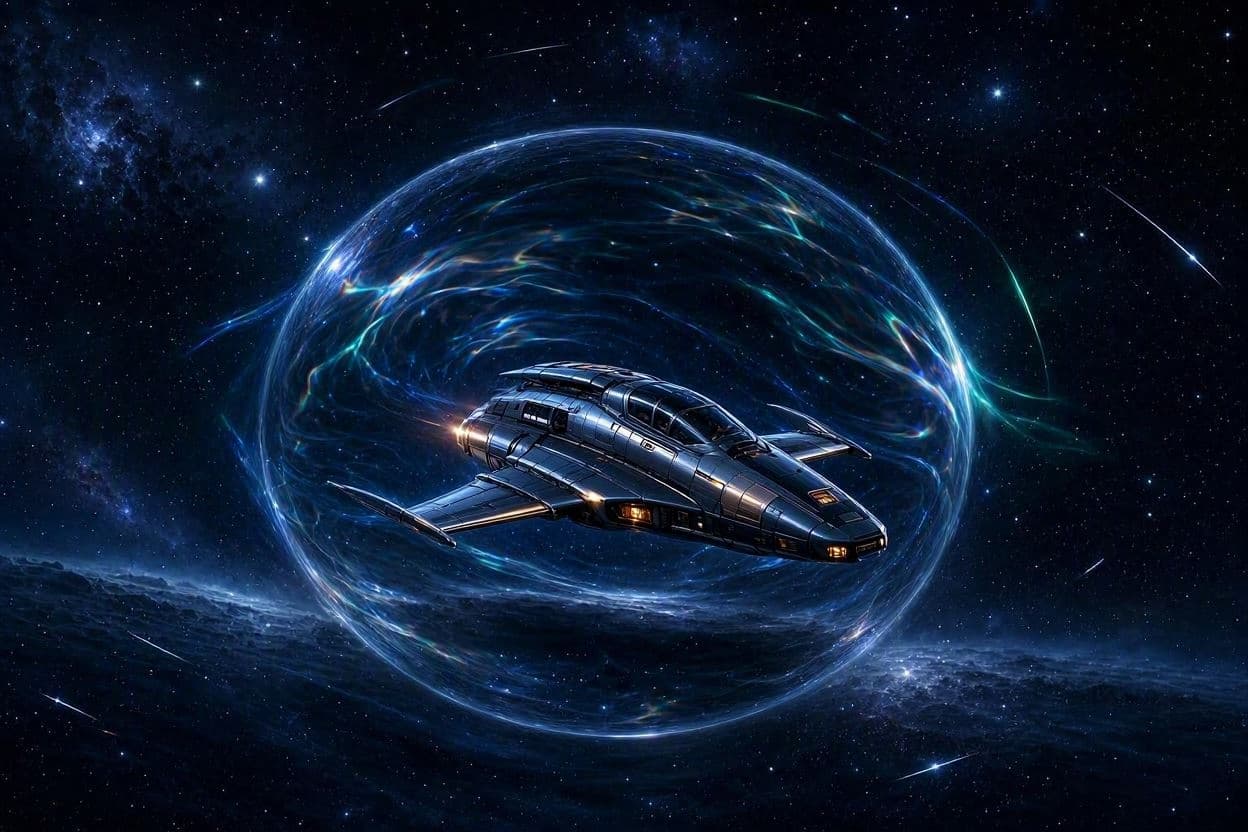
The stars have always beckoned, distant points of light that inspire wonder and longing. For centuries, they remained out of reach, separated by vast expanses of empty space that defy conventional travel. Yet, in the quiet corners of theoretical physics, ideas are emerging that challenge the limits of possibility. Concepts such as warp drives, wormholes, and halo drives offer speculative pathways across the cosmic divide, inviting us to imagine a future where the distance between worlds is no longer an insurmountable barrier.
Warp drives, popularized by science fiction, are grounded in serious mathematical models involving the manipulation of spacetime. Theoretically, a warp drive would contract space in front of a spacecraft and expand it behind, allowing the vessel to move faster than light without locally violating the laws of physics. While the energy requirements are currently beyond our capabilities, the concept remains a valid area of study in general relativity.
Wormholes, or Einstein-Rosen bridges, propose a different solution: a shortcut through spacetime. Imagine folding a piece of paper so that two distant points touch; a wormhole would be the tunnel connecting them. While stable, traversable wormholes have not been observed, their existence is permitted by the equations of gravity. They represent a tantalizing possibility for instantaneous travel, though keeping them open would require exotic matter with negative energy density.
Halo drives, a more recent theoretical proposition, offer a unique approach by leveraging the gravitational fields of black holes. By directing high-energy beams around a black hole, a spacecraft could potentially use the resulting gravitational feedback for propulsion. This method avoids the need for onboard fuel, relying instead on the immense power of cosmic giants. It is a concept that turns the most dangerous objects in the universe into potential engines of exploration.
These ideas, while highly speculative, serve an important purpose in scientific discourse. They push the boundaries of our understanding of physics, forcing researchers to confront the limitations of current theories. Even if these technologies remain out of reach for centuries, the process of exploring them yields insights into the nature of space, time, and energy.
Critics rightly point out the immense engineering challenges and potential paradoxes associated with these concepts. Time dilation, causality violations, and stability issues are significant hurdles that must be addressed. However, history shows that today’s impossibilities often become tomorrow’s innovations. The journey from theory to practice is long, but it begins with the courage to imagine.
Moreover, the study of interstellar travel concepts inspires technological spin-offs. Research into exotic materials, energy generation, and propulsion systems has practical applications here on Earth. It drives innovation in fields ranging from materials science to computer modeling, demonstrating that even the most abstract ideas can have tangible benefits.
The cultural impact of these concepts is also profound. They keep the dream of space exploration alive, motivating new generations of scientists and engineers. By engaging with the possibilities of warp drives and wormholes, we maintain a sense of curiosity and ambition that is essential for human progress. It reminds us that the universe is not just a place to observe but a place to explore.
As we stand on the threshold of a new era in space science, these theoretical frameworks provide a roadmap for the future. They encourage us to think big, to question assumptions, and to seek solutions that transcend current limitations. Whether or not we ever build a warp drive, the pursuit of such knowledge enriches our understanding of the cosmos.
The exploration of warp drives, wormholes, and halo drives represents the frontier of theoretical physics. While practical application remains distant, these concepts expand our intellectual horizon and inspire continued innovation. They remind us that the quest for interstellar travel is not just about reaching other stars but about deepening our comprehension of the universe itself.
AI Image Disclaimer: The images included in this article are AI-generated visualizations intended to illustrate the theoretical concepts of advanced spacetime propulsion.
Sources: Classical and Quantum Gravity Acta Astronautica Scientific American
Published by Banx Network. This article is part of the Banx decentralized media programme, powered by the BXE token on the XRP Ledger.