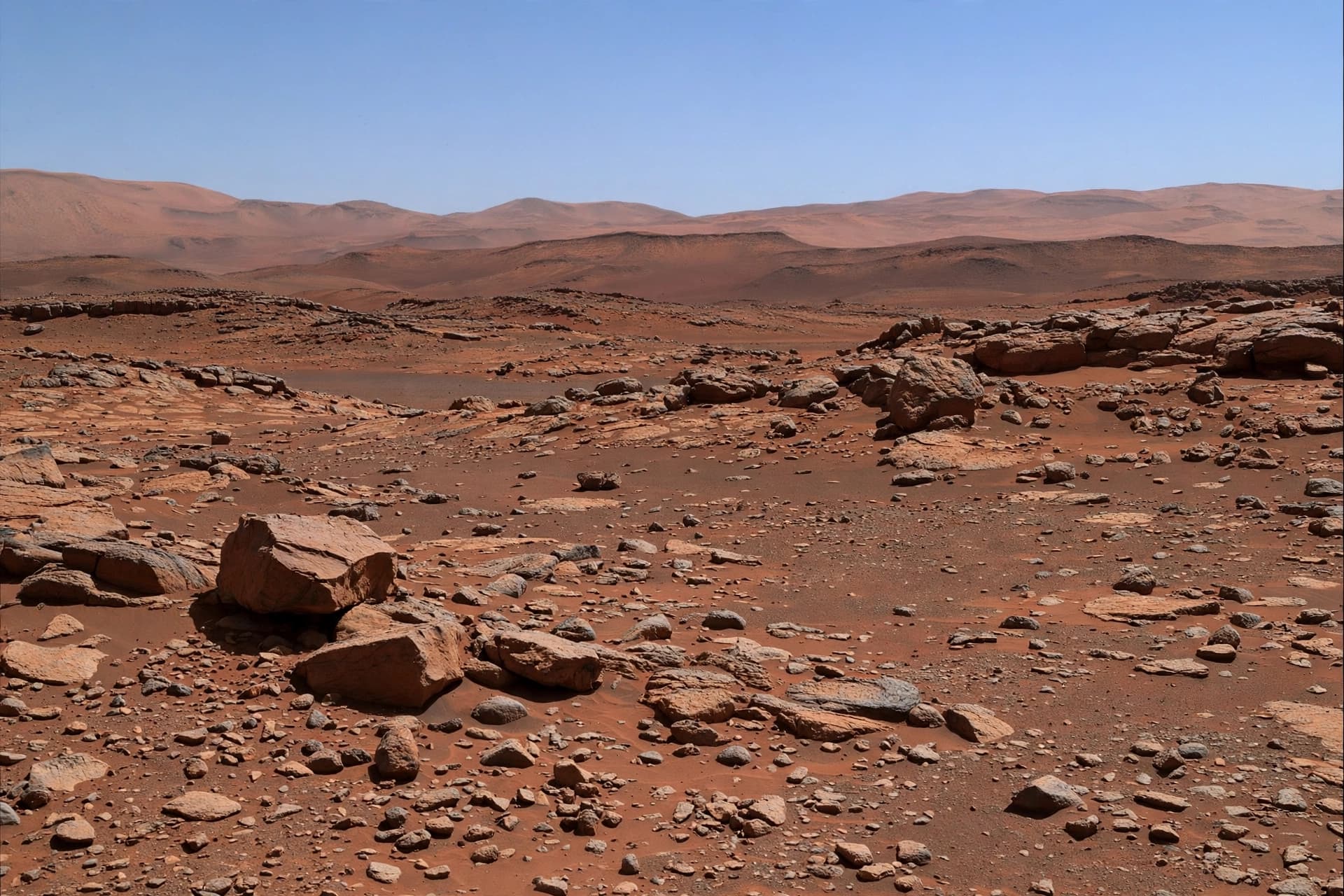
There is a particular kind of honesty in seeing a thing without its adornment. Mars, the red planet, has worn its color like a name for as long as humans have looked upward. The rusted dust, the ochre plains, the butterscotch sky—these are the signatures of a world that has been painted by time and iron. Yet when the makeup is set aside, when the filters and contrast adjustments are peeled away, Mars can surprise us. Sometimes, it looks a little blue.
In August 2025, NASA released a panoramic image captured by the Perseverance rover's Mastcam-Z camera system, stitched together from ninety-six individual photographs . The image showed a strikingly clear, bright blue sky above the Martian landscape. It was, by any measure, a beautiful picture. It was also not quite what it seemed. The blue was the result of deliberate color processing, an enhancement of contrast designed to help scientists distinguish subtle differences in terrain and sky .
Jim Bell, the principal investigator for Mastcam-Z at Arizona State University, explained the reasoning with characteristic clarity. The skies that day were relatively free of dust, providing an unusually clear view of the surrounding terrain. In this particular mosaic, the team enhanced the color contrast, which accentuated the differences between the rocks, the soil, and the sky . The result was a Martian scene that looked, fleetingly, like a desert on Earth.
This is not deception. It is interpretation, a tool that scientists use to extract information from images that the human eye alone might miss. The natural-color version of the same scene shows a reddish sky, closer to what an astronaut standing on the surface would actually see . The enhanced version is a translation, rendering visible what is otherwise subtle. The blue sky is a kind of scientific notation, a way of making the invisible legible.
Yet there is a genuine blue on Mars, and it appears at the edges of the day. During Martian sunsets, the sky can glow a cool, strange blue around the setting sun. This is not an artifact of processing but a real optical phenomenon, and its explanation lies in the peculiar nature of the Martian atmosphere . The red planet's air is thin, barely one percent of Earth's, and it is filled with fine, iron-rich dust particles. These particles interact with sunlight in ways that differ profoundly from the nitrogen and oxygen of our own sky.
During the day on Mars, the dust scatters red light across the sky, giving the planet its characteristic hue. But at twilight, when sunlight travels a longer path through the atmosphere, the red light is scattered away, and the blue light—which penetrates the dusty haze more efficiently—remains, lingering close to the sun . The result is a blue glow that seems almost terrestrial, a fleeting moment of familiarity on an alien world.
Atmospheric scientist Mark Lemmon of Texas A&M University has described the mechanism in plain terms. The colors come from the fact that the very fine dust is the right size so that blue light penetrates the atmosphere slightly more efficiently. When the blue light scatters off the dust, it stays closer to the direction of the sun than light of other colors does. The rest of the sky is yellow to orange, as yellow and red light scatter all over the sky .
So Mars is not blue, and it is not merely red. It is a world of shifting appearances, where the truth depends on the light and the angle and the instrument through which we look. The blue sky in the enhanced image is a useful fiction, and the blue sunset is a genuine wonder. Both tell us something about how we see, and what we choose to make visible.
AI Image Disclaimer: The images associated with this article are AI-generated and intended for illustrative purposes only.
Sources: NASA Jet Propulsion Laboratory, ScienceAlert, Iraqi News Agency, Daily Express, CNN Chile
Published by Banx Network. This article is part of the Banx decentralized media programme, powered by the BXE token on the XRP Ledger.