Water, the most familiar substance on Earth, is often taken for granted in its liquid, solid, and gaseous forms. However, under extreme conditions, it transforms into something entirely alien. Recent experiments have successfully forced water into a superionic state, a bizarre phase of matter that behaves like both a solid and a liquid simultaneously. This discovery may hold the key to understanding the mysterious magnetic fields of the ice giants, Uranus and Neptune.
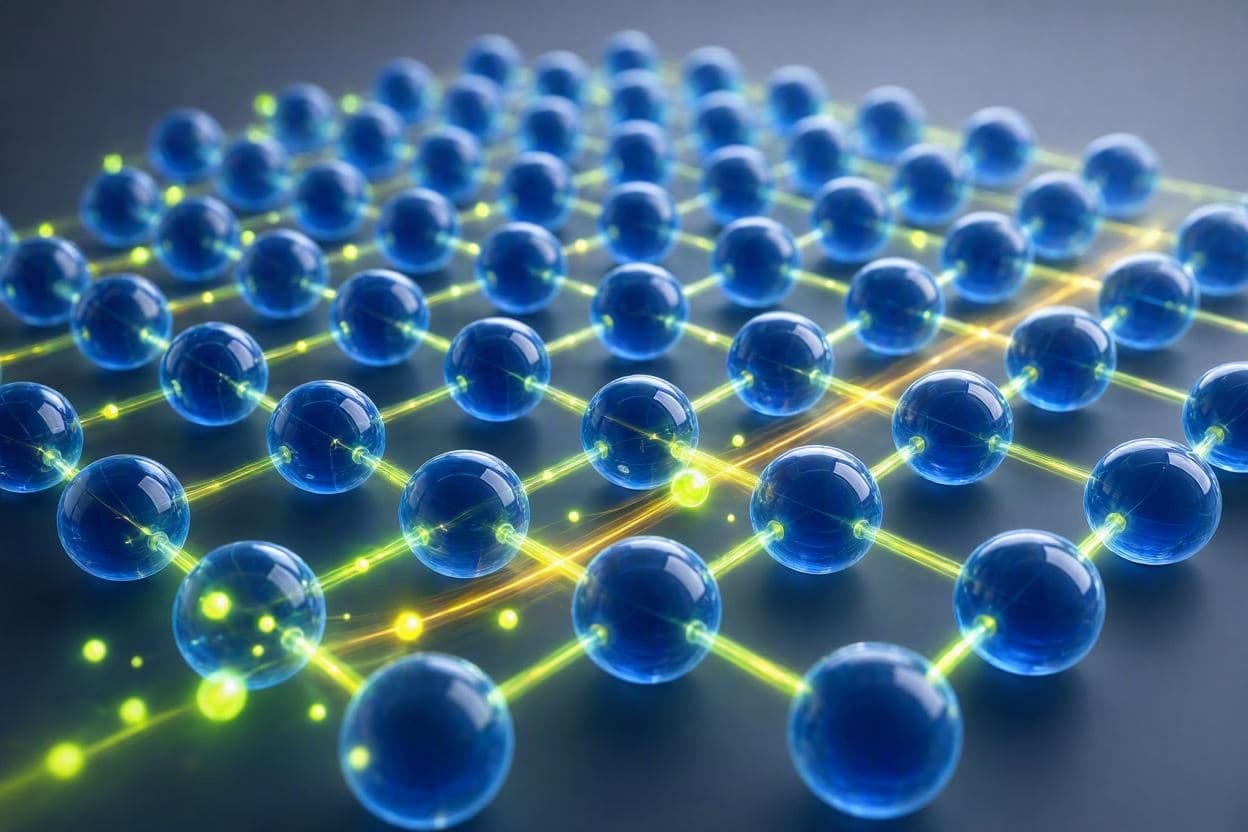
In this superionic state, water molecules break apart. The oxygen atoms form a rigid crystalline lattice, acting like a solid framework, while the hydrogen ions flow freely through this structure like a liquid metal. This unique combination gives the material high electrical conductivity, a property that is rare for water under normal conditions. Creating this state requires immense pressure and heat, conditions that are difficult to replicate in a laboratory but common in the interiors of distant planets.
Researchers used advanced laser shock compression techniques to subject water samples to pressures millions of times greater than Earth’s atmosphere. By heating the water to thousands of degrees while maintaining this pressure, they were able to observe the transition into the superionic phase. The data collected from these fleeting moments provides a glimpse into the physical properties of matter under extreme stress, validating theoretical predictions made decades ago.
The relevance to Uranus and Neptune is profound. These planets, often called "ice giants," are composed largely of water, ammonia, and methane. Their magnetic fields are unlike those of Earth or Jupiter; they are tilted at strange angles and offset from the planets’ centers. Scientists have long suspected that a layer of superionic water deep within these planets could generate such unusual magnetic dynamics through its conductive flow.
This experimental confirmation bridges the gap between planetary modeling and physical reality. It suggests that the interiors of Uranus and Neptune are not just slushy mixtures but contain distinct layers of exotic matter. The movement of hydrogen ions through the oxygen lattice could create the complex electrical currents responsible for the off-kilter magnetic fields observed by spacecraft like Voyager 2.
Understanding these processes helps astronomers interpret data from future missions. As we plan to send probes back to the outer solar system, knowing what lies beneath the clouds of these giants is crucial for instrument design and mission goals. The superionic state of water is no longer just a theoretical curiosity but a tangible component of planetary science.
Beyond the solar system, this research has implications for exoplanets. Many discovered worlds are "super-Earths" or "mini-Neptunes" that may also harbor superionic water in their interiors. By studying how water behaves under extreme conditions, we gain insights into the potential habitability and geological activity of worlds far beyond our own. It is a reminder that even the simplest molecules can hide complex secrets.
AI Image Disclaimer: The visual content in this report is AI-generated to represent molecular structures and high-pressure scientific concepts.
Sources: Nature Physics, ScienceDaily, Lawrence Livermore National Laboratory
Published by Banx Network. This article is part of the Banx decentralized media programme, powered by the BXE token on the XRP Ledger.