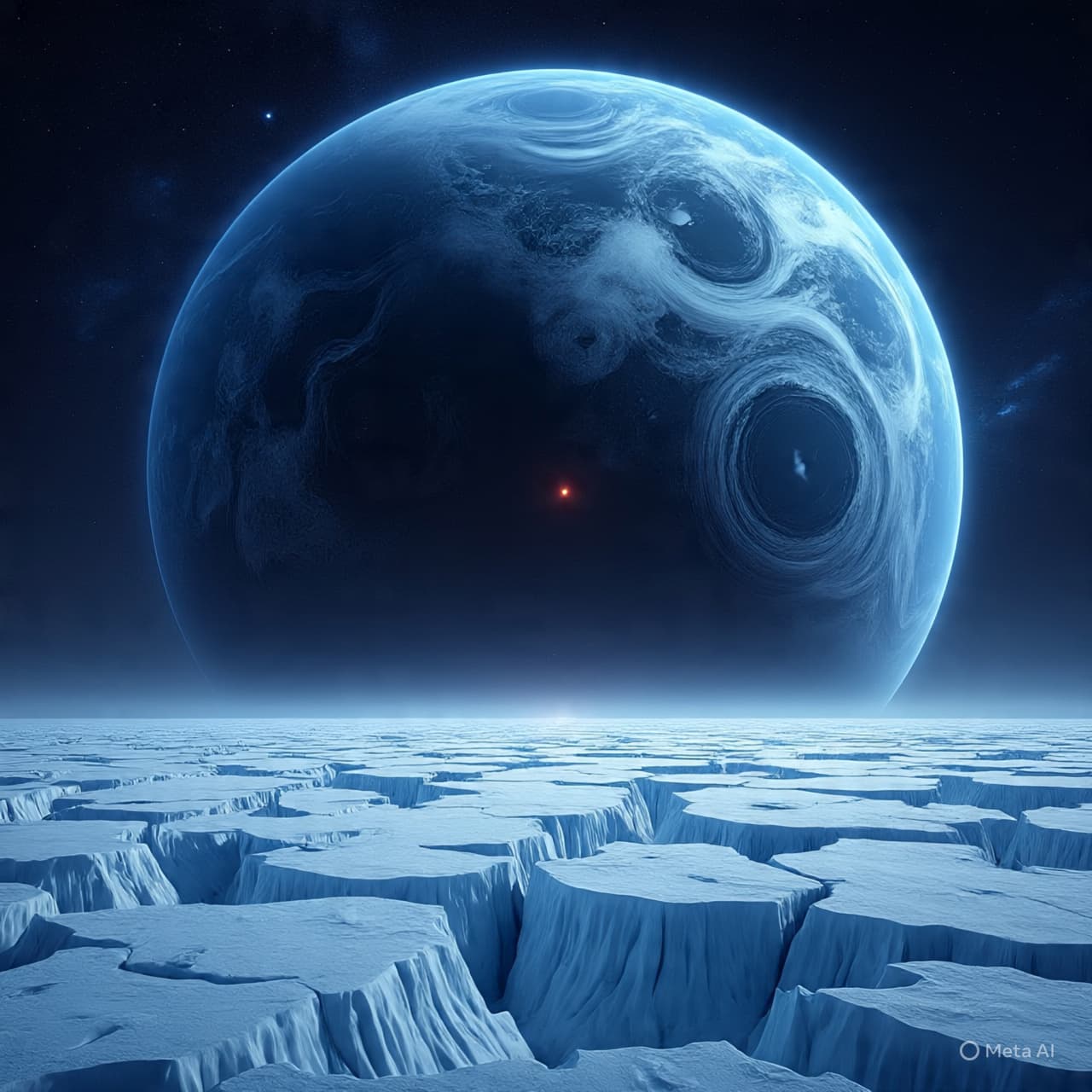
In the vast expanse of the cosmos, where stars are born and die, where galaxies spiral in silent ballet, the search for a new world—one where life could possibly exist—has captivated humanity for centuries. Every discovery is a new note in the symphony of our collective curiosity, each planet found adding depth to our understanding of the universe. But sometimes, the most exciting revelations come with a curious paradox. Such is the case with a newly discovered exoplanet, potentially habitable yet steeped in a deep freeze of -70°C. Situated 146 light-years away, it presents both a promise of possibility and a challenge to the limits of our imagination. Could this distant world harbor life, or is it a frozen relic of the cosmos, too distant and too cold to offer hope? Perhaps, the real question lies not in its temperature, but in the possibilities it ignites within us.
The discovery of a potentially habitable planet, located 146 light-years away, has sent ripples through the scientific community and reignited the debate over what truly makes a planet suitable for life. The planet, identified by astronomers using advanced telescopes and data models, falls within the so-called "habitable zone"—the region around a star where conditions might allow liquid water to exist. This zone is considered one of the most critical criteria in the search for life beyond Earth. However, there is a stark twist to the narrative: this planet, which could be a prime candidate for habitability, is engulfed in extreme cold.
At a chilling -70°C, it is well below freezing and poses significant challenges for the possibility of sustaining life as we know it. The planet’s proximity to its star, the type of star it orbits, and its atmospheric conditions will be crucial in determining whether this frozen world could support any form of life—or whether it remains as barren as the ice-covered surfaces of the outer solar system.
Despite the formidable temperatures, the discovery holds promise. While Earth-like life, as we know it, thrives under relatively temperate conditions, life itself can be remarkably adaptable. The study of extremophiles—organisms that thrive in environments once thought inhospitable, like deep-sea vents or acidic lakes—has shown us that life can take root in places we once deemed too hostile. Could the same be true for this distant planet? Could alien life exist in an ecosystem where survival is contingent on adapting to extreme cold and perhaps unique biochemical pathways?
But even if life as we don’t know it could survive in such freezing conditions, there’s the issue of its long-term sustainability. What are the odds that this planet, so distant and seemingly inhospitable, holds the key to life in a way we’ve never anticipated? Could it offer a glimpse into the broader patterns of life across the universe, where extremes are simply another part of nature’s vast diversity?
Furthermore, the planet’s frigid temperature is likely a result of its star’s characteristics. The star it orbits could be a red dwarf—small, dim, and cool. These stars, though common in our galaxy, emit far less heat than our Sun, which would leave a planet orbiting within its habitable zone struggling to warm up. Yet, despite its chill, the very existence of this world suggests that habitable zones are more complex than we ever realized, expanding the boundaries of what we define as potentially life-sustaining.
Astronomers are now focused on unraveling the mysteries of the planet’s atmosphere, which will be key to determining its true potential for harboring life. Could it have a thick enough atmosphere to trap heat, allowing for pockets of warmth in its surface or sub-surface regions? Or is its atmosphere too thin to provide the necessary conditions for life? These questions lie at the heart of ongoing research and exploration, as we seek to understand not just this planet, but the nature of habitability itself.
As humanity continues its search for life beyond Earth, this new discovery, with its paradoxical promise of habitability alongside its extreme cold, invites us to reconsider what it means to live in the universe. The journey ahead may reveal that life is not constrained to the temperate, Earth-like conditions we once thought essential, but rather, it is the adaptability of life, and perhaps the sheer persistence of the human spirit, that will continue to shape the boundaries of exploration. While this frozen world might remain too distant and cold for us to ever reach, it serves as a reminder that the universe is far more complex and mysterious than we can possibly imagine—and that, perhaps, the true discovery lies not just in finding other planets, but in finding the infinite possibilities that could await us there.
AI Image Disclaimer “Graphics are AI-generated and intended for representation, not reality.”
Sources NASA BBC News The Guardian Space.com Scientific American
Published by Banx Network. This article is part of the Banx decentralized media programme, powered by the BXE token on the XRP Ledger.