Far from the roads and cities of Earth, another journey is unfolding against a darker horizon. The destination is Mercury, the smallest planet in the Solar System and one of the most difficult worlds to reach with a spacecraft. After years of travel, the BepiColombo mission has entered another important stage as its spacecraft separates into two scientific probes.
BepiColombo is a joint European-Japanese mission designed to study Mercury. The spacecraft consists of components operated by the European Space Agency and the Japan Aerospace Exploration Agency, which will eventually conduct complementary observations of the planet.
The separation marks an important transition in the mission. Instead of continuing as a single spacecraft, the two scientific elements will proceed toward their respective operational roles around Mercury.
Reaching Mercury is particularly challenging because the planet orbits close to the Sun. A spacecraft traveling there must carefully manage its trajectory and energy while dealing with intense solar conditions.
BepiColombo has therefore spent years following a complex route through the inner Solar System. The journey has involved carefully planned maneuvers and gravity-assist operations designed to reduce the energy required to reach Mercury.
Once the mission reaches its destination, its instruments will study the planet from different perspectives. Scientists hope to learn more about Mercury’s surface, magnetic environment, interior and interaction with the solar wind.
The separation phase comes before the mission’s planned arrival and marks the beginning of a more specialized stage of operations. Each spacecraft will eventually contribute its own instruments and observations to the wider scientific picture.
Mercury remains one of the least explored planets in the Solar System. Despite being relatively close to Earth compared with the outer planets, its proximity to the Sun makes long-duration missions particularly demanding.
The scientific questions surrounding Mercury are equally compelling. Researchers want to understand how such a small planet developed, why it has such a large metallic core and how its magnetic field interacts with the solar environment.
The mission’s progress therefore carries significance beyond a single spacecraft maneuver. Each stage brings scientists closer to observing Mercury in greater detail and adding another piece to the history of planetary formation.
As BepiColombo continues its final approach, the spacecraft’s journey moves into a new rhythm. After years of traveling together, its scientific components are preparing to work separately around a distant world, carrying with them instruments designed to look more closely at one of the Solar System’s most enigmatic planets.
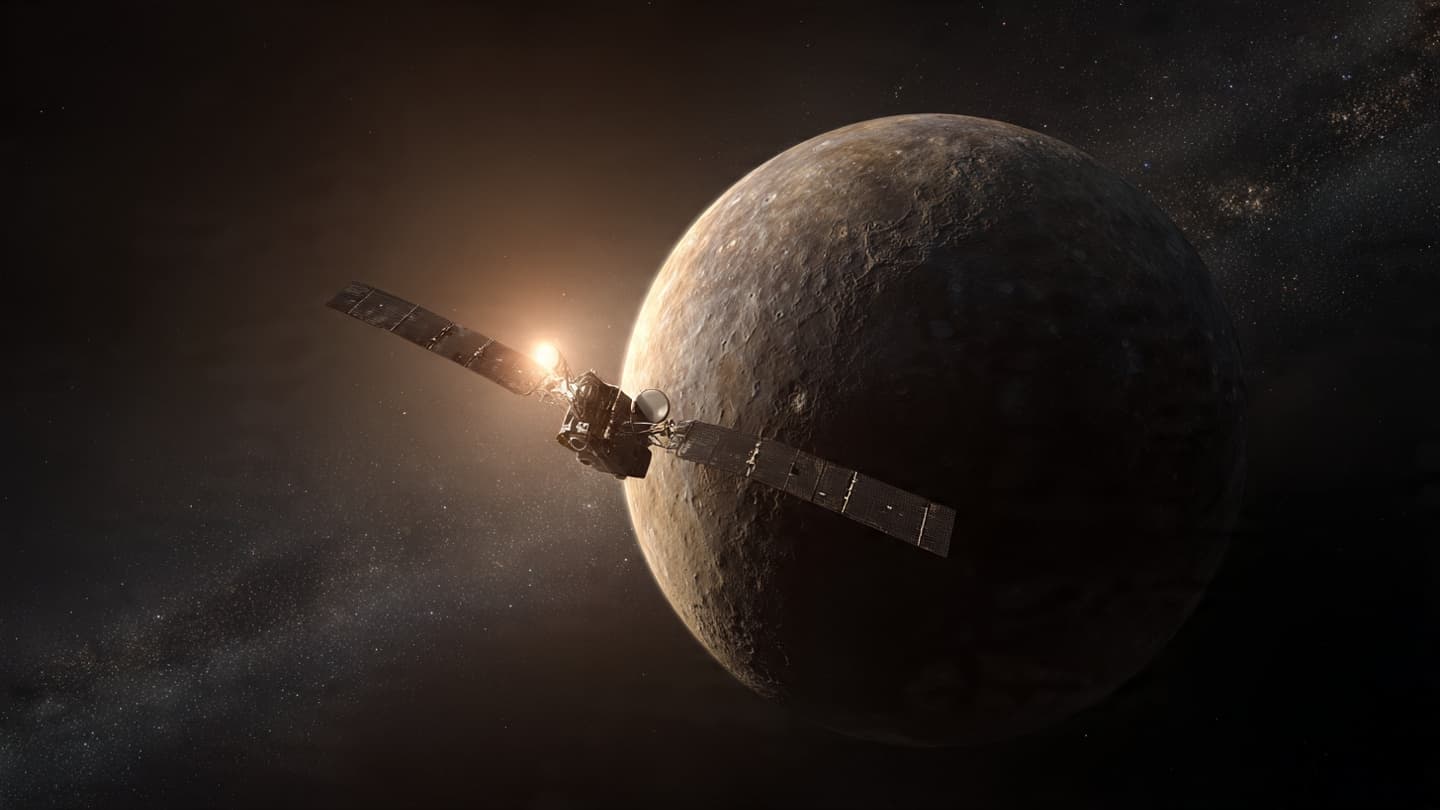
AI Image Disclaimer The accompanying space illustration was generated using AI for visualization purposes and does not represent an actual photograph of the BepiColombo spacecraft or Mercury.
Sources Le Monde Agence France-Presse
Published by Banx Network. This article is part of the Banx decentralized media programme, powered by the BXE token on the XRP Ledger.