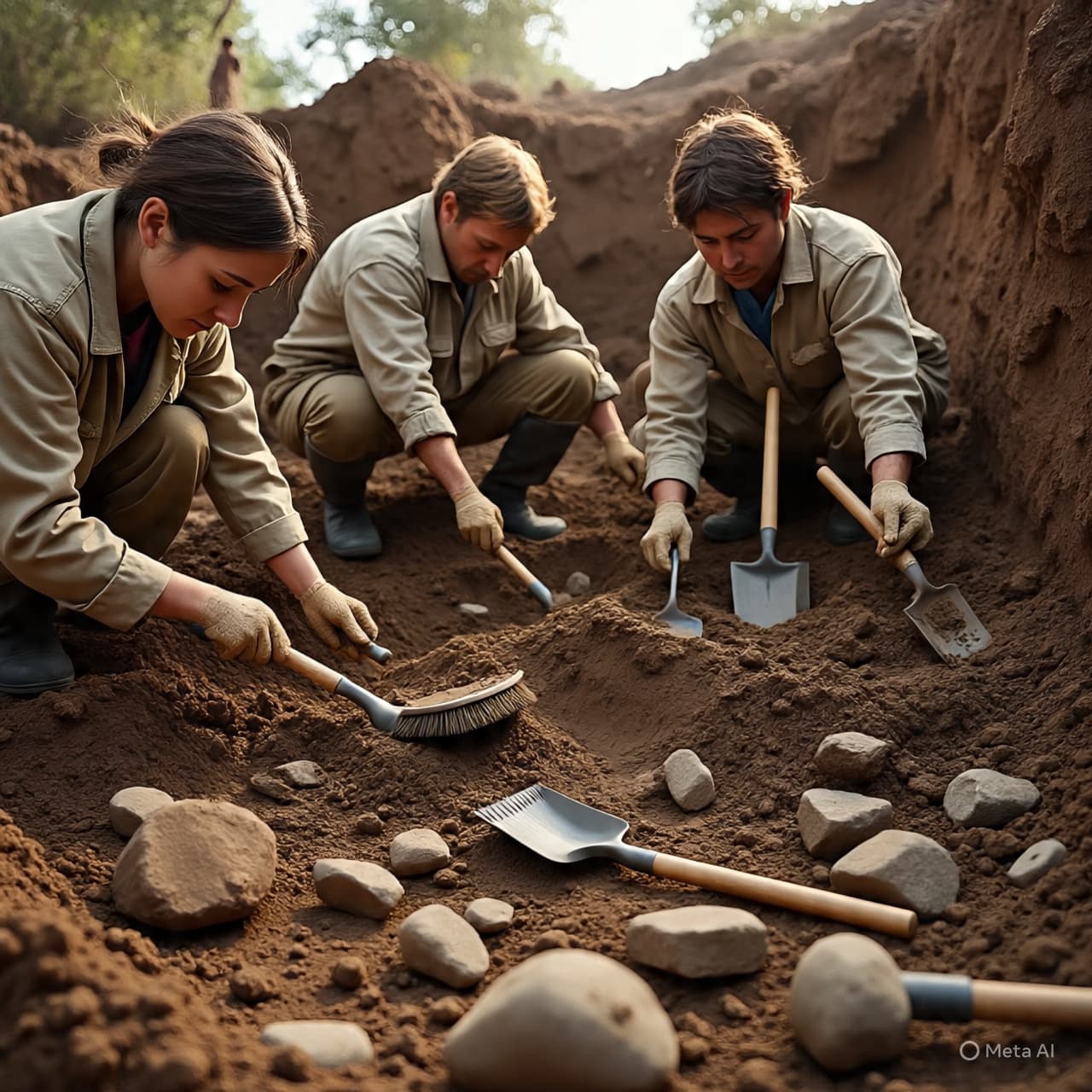
Time usually keeps its distance from us, layering the past so deeply that only fragments remain. Yet sometimes the earth loosens its grip. In sediments shaped by ancient water and volcanic ash, fossils nearly 773,000 years old have emerged, offering a rare and quiet conversation with a chapter of humanity that has long resisted clarity.
The remains are incomplete, as such discoveries almost always are. Bone fragments, teeth, subtle contours worn by age and pressure—nothing dramatic at first glance. But together, they form a pattern that researchers recognize as significant. The fossils appear to sit at a crossroads in human evolution, displaying a blend of traits seen in earlier hominins and later members of the human family. It is this in-between quality that has drawn careful attention.
For decades, scientists have searched for clearer evidence of a shared ancestor linking modern humans with Neanderthals and Denisovans. Genetic studies suggest such a population existed hundreds of thousands of years ago, yet the fossil record has remained frustratingly sparse. These newly studied remains, dated to around 773,000 years, may belong to that long-hypothesized group—or at least to a close relative that helps narrow the gap.
What stands out is not a single defining feature, but the combination. The teeth show proportions associated with later human species, while other skeletal elements retain more primitive characteristics. This mosaic hints at a population in transition, shaped by both inheritance and adaptation. Rather than a clean evolutionary break, the fossils suggest continuity, gradual change, and overlapping forms.
The location of the find adds another layer of meaning. Situated along ancient migration routes, the site may have served as a corridor where populations met, mixed, and moved onward. Over generations, such intersections could have produced the genetic foundations shared by multiple human lineages. The fossils do not announce a name or a final answer, but they offer a geographic and biological anchor for ideas that once rested mainly on DNA.
Caution remains central to the interpretation. Paleoanthropology advances slowly, built on comparison, context, and restraint. One discovery rarely rewrites the story on its own. Still, these fossils enrich the narrative, turning abstract ancestry into something tangible—bone shaped by muscle, teeth worn by meals long forgotten.
As researchers continue to analyze the remains, refine their dating, and compare them with other finds across Africa and Eurasia, the picture may sharpen. For now, the fossils rest in a space between certainty and possibility. They remind us that human origins are not a straight line, but a braided path—one that occasionally surfaces from deep time, allowing us a brief glimpse of where we came from, and how closely connected we have always been.
AI Image Disclaimer
Visuals are AI-generated and serve as conceptual representations.
Sources
Nature Science Smithsonian Institution Max Planck Institute for Evolutionary Anthropology National Geographic
Published by Banx Network. This article is part of the Banx decentralized media programme, powered by the BXE token on the XRP Ledger.