High above the restless blue of Earth, where the sun’s light softens into the quiet radiance of space, there is a slow, steady rhythm — the rhythm of human motion beyond the world that first cradled us. In these vast heights, travel feels measured not in haste but in arcs and orbits, in journeys that fold hours into the silent sweep of centuries. On this Valentine’s Day, that quiet rhythm met a gentle crescendo: a spacecraft, carrying four astronauts, glided toward the orbiting haven of the International Space Station, seeking not merely a port but a return to fullness, a restoration of company in a place often shaped by solitude and distance.
For more than a month, the station had felt the hush of quiet corridors, its population reduced to three after a previous crew made an early departure prompted by a medical issue. In a laboratory that had seen decades of continuous human presence — a testament to international cooperation and shared curiosity — the small team handled daily rhythms alone, performing maintenance and watching the slow passage of Earth below. In such a place, the arrival of companions carries its own kind of warmth: the echo of laughter, the soft choreography of shared tasks, and the resumption of a life lived together above the curve of the world.
The vessel that came to meet the station was SpaceX’s Crew Dragon, a streamlined craft borne aloft by a Falcon 9 rocket from Florida’s Cape Canaveral, its path traced by engineers and guided by instruments that think in pulses and precision. After about thirty‑four hours in transit, the capsule made its slow, calculated approach to the station’s forward Harmony module, docking in the calm light of one afternoon orbit. In those final meters before connection, motion and silence speak in unison, as though the spacecraft itself pauses to settle among its celestial peers.
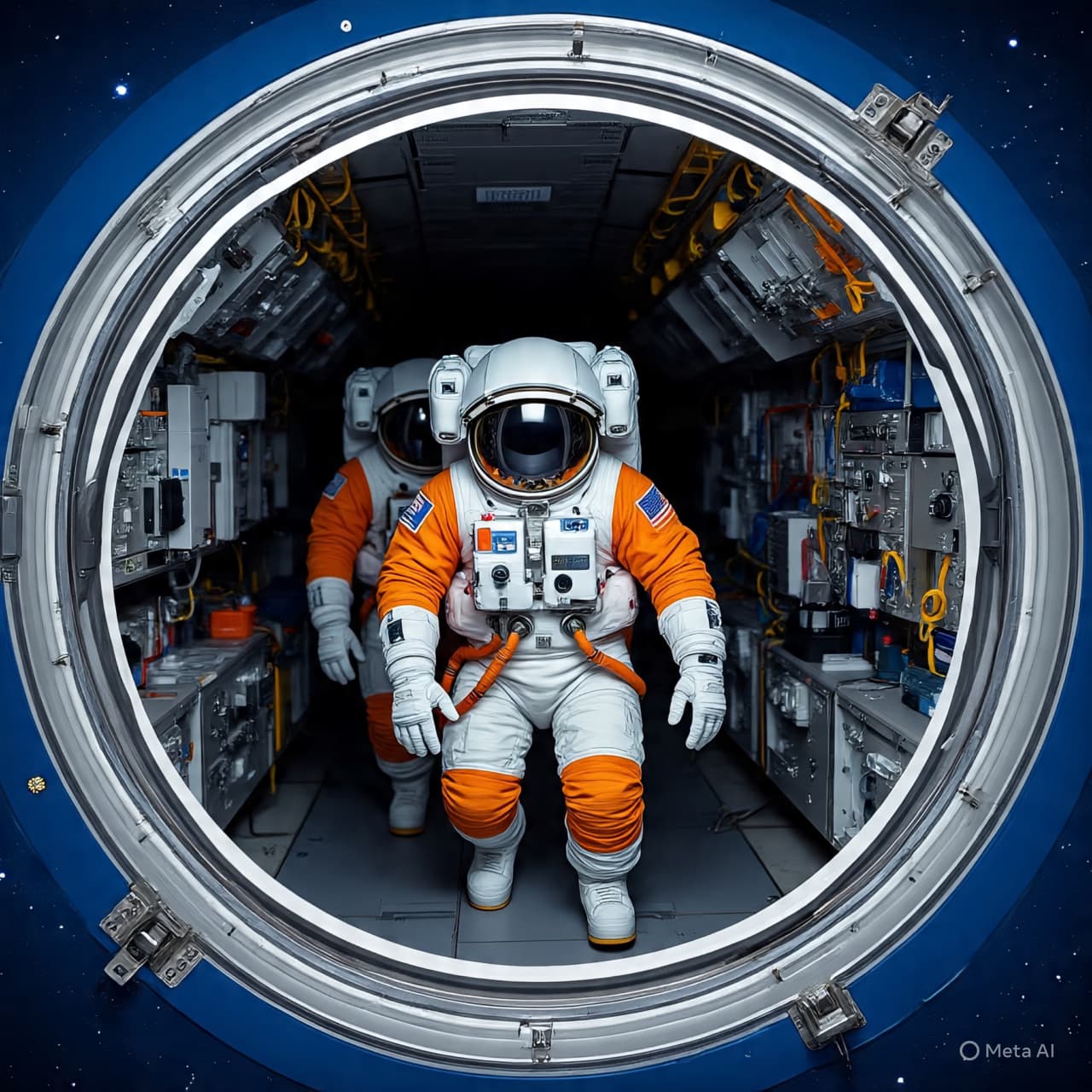
Inside that capsule were four people whose presence would shift the station’s quiet geometry. There was Jessica Meir, seasoned by previous expeditions and now commander once more; Jack Hathaway, whose pilot’s eyes have risen to meet Earth and sky; Sophie Adenot, a European Space Agency astronaut whose first glimpse of the planet in orbit was described as seeing a world without lines or borders; and Andrey Fedyaev, a Russian cosmonaut whose path through space now entwines with theirs. Together they crossed thresholds that few ever glimpse, and with a careful sequence of checks and balances, they brought the station’s crew back to its customary complement of seven.
The greeting that followed — quiet handshakes, smiles exchanged beneath the gentle hum of life‑support systems, and the shared embrace of colleagues long apart — was not a scene of spectacle but of simple reconnection. For those who have lived among the stars, such moments carry the weight of remembrance: that place is shaped not only by equipment and experiments but by the presence of people, by the shared laughter that floats with the hum of machinery. The station, for all its metal and modules, is a vessel of human story as much as it is a platform of science.
Under ordinary circumstances, a crew rotation brings fresh hands to orbit and relieves those who have spent their months within microgravity’s embrace. There are experiments to conduct — from biology that grows in weightless soil to technology demonstrations that may one day shepherd humans to Mars or the Moon — and routines to maintain in solar arrays and research racks. But this return to fullness carries more than pragmatic consequence; it marks a moment of return to shared endeavor, a quiet reaffirmation that even amid the vastness above, companionship and collaboration remain central to the human journey.
In straight news terms, a SpaceX Crew Dragon spacecraft carrying four astronauts docked with the International Space Station on February 14, 2026, restoring the station’s crew to its full complement of seven after it had operated with a reduced team for more than a month. The new arrivals — including NASA astronauts and international partners — will live and work aboard the station for the next eight to nine months, supporting research, maintenance, and operations.
All Illustrations were created using AI tools and serve as conceptual representations.
Sources (Media Names Only)
Space.com CBS News AINvest
Published by Banx Network. This article is part of the Banx decentralized media programme, powered by the BXE token on the XRP Ledger.