There are moments that arrive only after a long stillness—when time seems to stretch, not in urgency, but in anticipation. The sea holds its surface, the horizon draws a steady line, and the sky begins its slow, almost imperceptible shift. It is in these intervals, between expectation and appearance, that something rare begins to take shape.
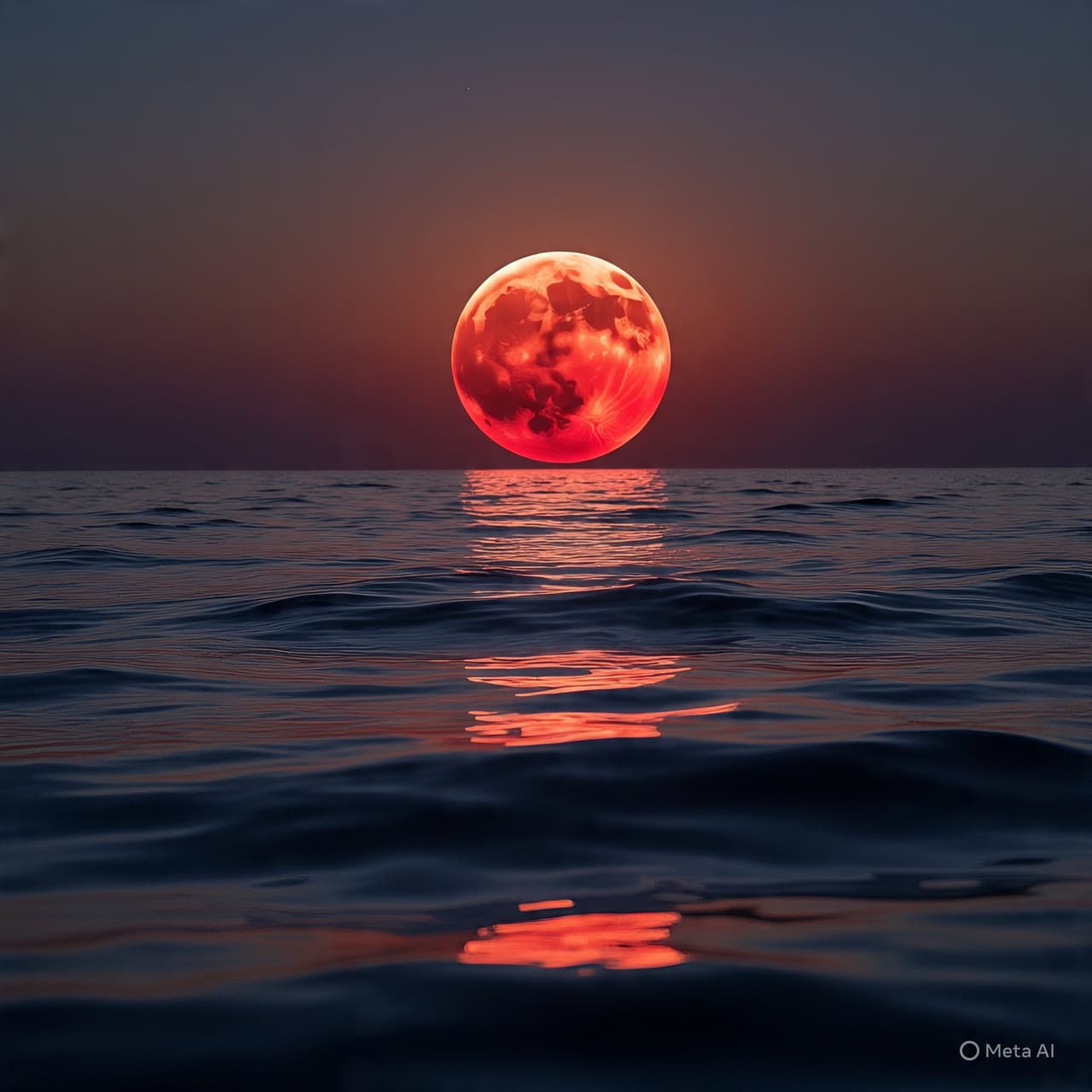
Out over the South China Sea, a photographer waited through such a passage of time, watching as night deepened and the conditions aligned. The goal was precise yet uncertain: to capture the rising of a blood moon, that brief transformation when the Earth passes between the sun and the moon, casting a shadow that softens its light into a muted red.
A lunar eclipse is, in one sense, predictable. Its timing can be calculated, its path charted. And yet, the act of witnessing it—especially from a specific place, framed against a particular horizon—remains subject to chance. Clouds gather or disperse, light shifts unexpectedly, and the moment itself is brief, easily missed.
For this photographer, the journey was as much about positioning as patience. Equipment was prepared, vantage points considered, and the coastline studied in advance. The sea, with its open expanse, offered a clear line of sight, but also introduced its own uncertainties—wind, moisture, and the quiet movement of the air that can soften or sharpen what the lens ultimately sees.
As the eclipse unfolded, the moon began its gradual ascent. What might normally appear bright and constant instead took on a deeper tone, its surface dimmed and colored by the Earth’s atmosphere. The red hue, often described as a “blood moon,” is the result of sunlight bending through the edges of the planet, scattering shorter wavelengths and allowing longer, redder light to reach the lunar surface.
In that moment, the ordinary familiarity of the moon gave way to something more distant, almost unfamiliar. Suspended above the water, it seemed less like a companion to the Earth and more like an object passing through a different kind of light.
The photograph, once captured, carries only a fraction of the experience. It holds the alignment, the color, the composition—but not the waiting, nor the subtle shifts that preceded it. Those remain with the observer, part of a longer narrative that extends beyond the frame.
Such images often suggest immediacy, as though the moment appeared fully formed. But behind them lies a quieter process, one defined by preparation, timing, and a willingness to remain still as the world changes slowly overhead.
The photographer described the event as “an incredible moment,” reflecting both the rarity of the alignment and the conditions that allowed it to be seen clearly over the open sea. The image captures a total lunar eclipse rising above the South China Sea, with the moon appearing in its characteristic red hue during the event.
AI Image Disclaimer
Visuals are AI-generated and serve as conceptual representations.
Source Check: BBC; The Guardian; National Geographic; CNN; Reuters
Published by Banx Network. This article is part of the Banx decentralized media programme, powered by the BXE token on the XRP Ledger.