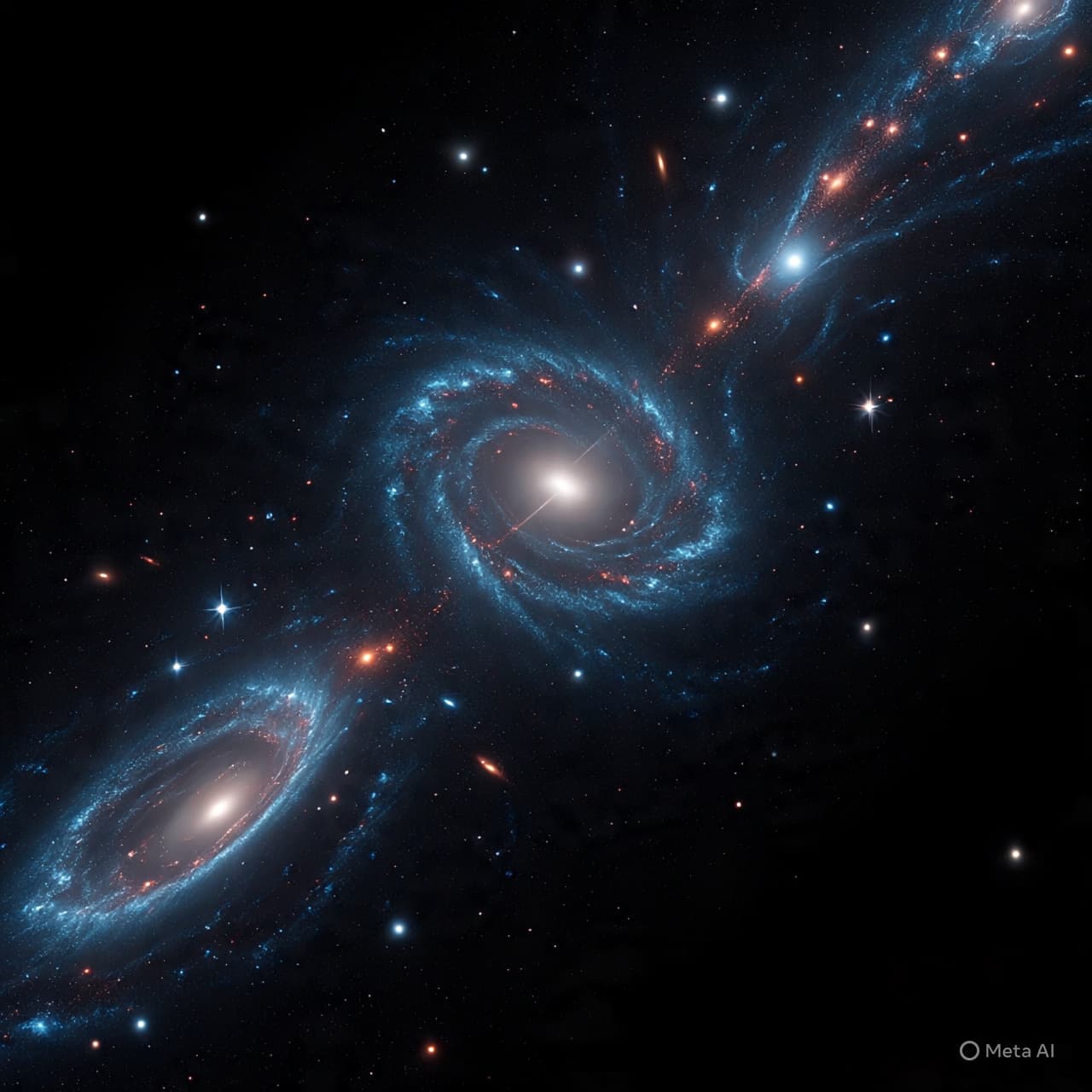
For generations, the space between galaxies has been treated as a kind of pause in the universe’s sentence — an emptiness separating the brighter nouns of stars and spirals. Telescopes lingered on luminous islands of matter, while the stretches between them were assumed to be thin, cold, and largely uneventful. Yet absence, it turns out, was only an illusion shaped by the limits of observation.
That assumption has begun to soften with the detection of vast reservoirs of hot gas threading the space between galaxies, a finding that has drawn particular excitement among Canadian researchers. What was once thought to be missing matter appears instead to be quietly glowing, heated to millions of degrees, stretched across the cosmic web that binds galaxies together.
For decades, astronomers have faced a persistent puzzle known as the “missing baryon” problem. Measurements of the early universe suggest that ordinary matter — the kind that makes up stars, planets, and people — should be more abundant than what telescopes could account for nearby. Galaxies alone did not add up. Something was unaccounted for, dispersed rather than condensed, difficult to see and harder still to measure.
The newly observed hot gas offers a compelling answer. Detected through faint X-ray emissions and subtle absorption signatures, this material occupies the vast filaments between galaxies, warmed by gravitational forces as structures formed over cosmic time. Canadian teams, contributing both observational analysis and theoretical modeling, have helped confirm that this diffuse gas may contain a significant fraction of the universe’s ordinary matter.
The excitement lies not only in solving an accounting problem, but in what this gas reveals about how galaxies live and evolve. Galaxies are not closed systems. They draw material in, push energy out, and interact constantly with their surroundings. The hot intergalactic gas acts as both reservoir and record, preserving evidence of ancient explosions, galactic winds, and the slow choreography of cosmic growth.
For Canadian researchers, the discovery reinforces a long-standing strength in cosmology and astrophysics. By combining international telescope data with homegrown expertise in simulation and data interpretation, they are helping to turn what was once theoretical scaffolding into observed structure. The universe, in this view, becomes less a collection of isolated objects and more a connected, breathing system.
The work is still unfolding. Measuring the temperature, density, and motion of this gas remains difficult, and future observatories are expected to sharpen the picture. But the direction is clear. The space between galaxies is no longer a void to be skipped over; it is an active participant in the universe’s story.
In straightforward terms, scientists have identified extensive hot gas between galaxies that likely accounts for long-missing ordinary matter, offering new insight into how galaxies form, interact, and evolve. For Canadian researchers involved in this work, it marks a rare moment when a quiet part of the universe finally speaks.
AI Image Disclaimer Illustrations were created using AI tools and are not real photographs.
Published by Banx Network. This article is part of the Banx decentralized media programme, powered by the BXE token on the XRP Ledger.