Just after launch, long before the Red Planet hung large in the sky and long before the first whispers of Martian dawn would brush its dusty plains, a pair of slender spacecraft began a quiet odyssey — not just across space but through the unseen tapestry woven from the Sun’s breath. In the soft expanse between Earth and Mars, where particles drift like forgotten snowflakes and magnetic fields murmur beneath the sweep of solar winds, a mission called ESCAPADE has begun to turn its instruments toward a question both subtle and profound: how does space weather — the invisible gusts and storms of energetic particles from our star — shape the very nature of a planet’s atmosphere and environment?
In mid‑November 2025, two nearly identical probes — given the names Blue and Gold — lifted skyward aboard a New Glenn rocket, carrying with them instruments designed to feel the imperceptible, to measure fields and flows that no human eye could see. These twin spacecraft form NASA’s Escape and Plasma Acceleration and Dynamics Explorers, a mission conceived not simply to reach Mars but to listen to the rhythms of space itself, to follow the trail of the solar wind as it squeezes and strips, buffets and shapes the tenuous atmosphere of the Red Planet.
As the probes make their long, winding trajectory — at times lingering near Earth’s distant magnetic tail, at others arcing toward the deep spaces between worlds — they are doing something larger than a solitary journey. They are tracing the story of how a world once wrapped in warmth and water became a place of thin air and bright, cold horizons. Mars, too small and too still now to hold onto its magnetic cloak, could once resist the solar wind’s relentless tide; today, its sheath of gas is but a whisper of what it was. By observing how charged particles from the Sun mingle with Martian magnetic fields and peal away constituents of its atmosphere, ESCAPADE seeks to decipher the processes that sculpted this transformation over billions of years.
Yet the mission’s poetry lies not only in its destination but also in its passage. While Earth’s magnetic field wraps us in a protective embrace, shielding much of our atmosphere and blunting the Sun’s fiercest winds, Mars stands exposed, its upper reaches a theatre of collisions between particles and fields. ESCAPADE’s twin eyes will take in the same space from two vantage points — a first for Martian science — allowing scientists to see cause and effect unfurl in real time as the Sun breathes outward and the planet responds. Such measurements, once they begin in earnest after a planned 2027 arrival, promise to fill large gaps in our understanding of space weather and its implications for planetary environments.
In thoughtful cadence, this mission will help guide not just scholarly curiosity but practical foresight. For future voyagers bound for Mars, understanding the cosmic winds that batter their path — and how those winds ebb and surge in the vacuum between worlds — is not merely academic. It is part of the larger preparation for journeys that will carry human hearts and frail skins through those same silent streams of particles, toward a horizon both vivid and vulnerable.
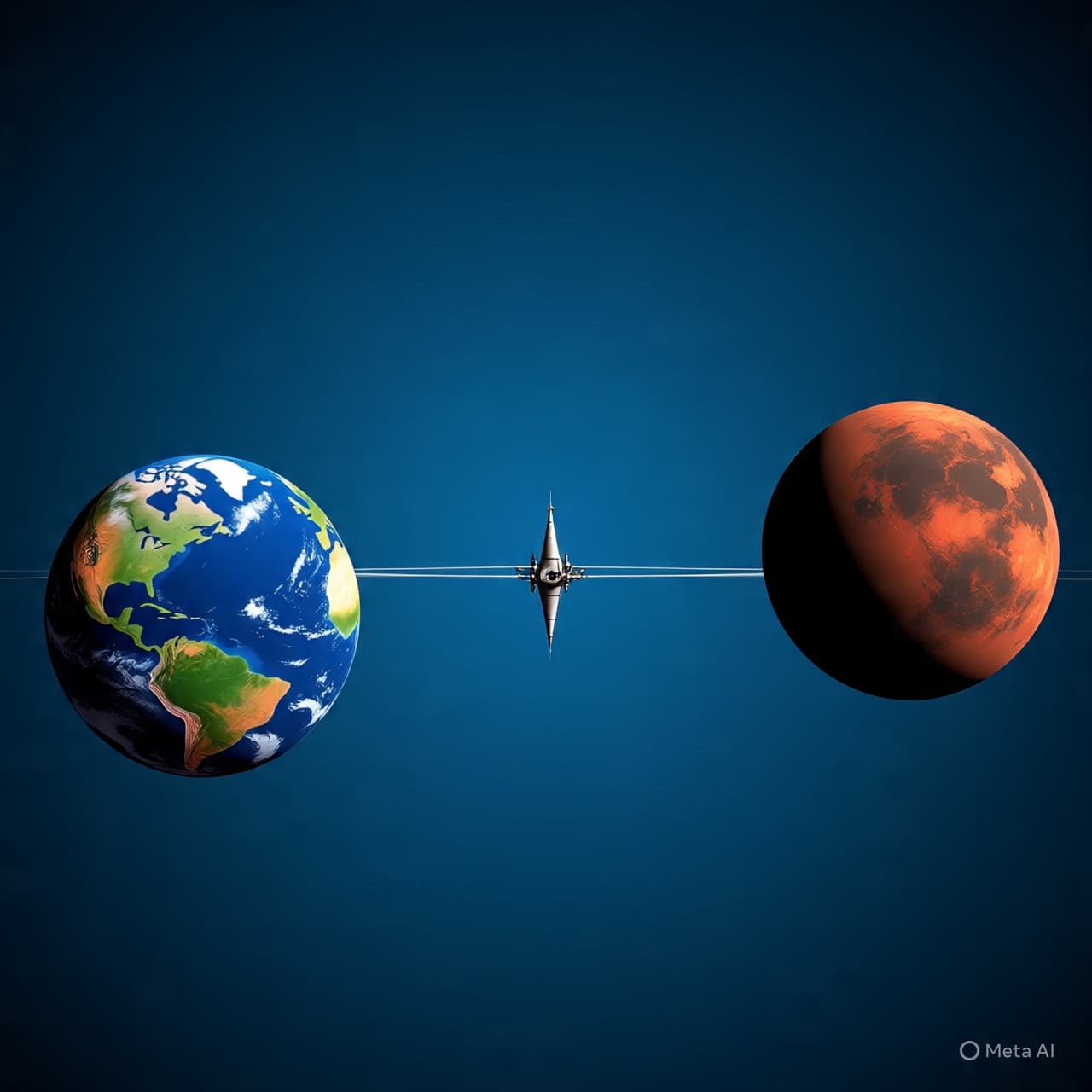
In straightforward terms, NASA’s ESCAPADE (Escape and Plasma Acceleration and Dynamics Explorers) mission, launched in November 2025, consists of two nearly identical spacecraft designed to study space weather — the stream of particles and magnetic energy from the Sun — as it travels from Earth toward Mars and interacts with the Martian environment. By using twin probes in coordinated orbits around Mars, the mission will provide new insights into how solar wind influences atmospheric loss and Mars’ magnetic environment, helping prepare for future human exploration.
AI Image Disclaimer
Illustrations were created using AI tools and serve as conceptual representations.
Sources (Media Names Only)
NASA Innovation News Network Reuters
Published by Banx Network. This article is part of the Banx decentralized media programme, powered by the BXE token on the XRP Ledger.