Some roads cannot be seen from the ground. They travel beneath the sea, carrying streams of information between continents before emerging quietly at coastal landing stations. Egypt sits along several of these invisible routes, and the country is now looking to turn that geographical position into a broader digital opportunity.
Egypt is preparing a national strategy for its data-center industry, with the aim of developing the country into a regional and international hub for data centers, artificial intelligence, cloud computing, and digital services. The strategy is expected to address investment incentives, energy availability, licensing, and infrastructure readiness.
The period from 2027 to 2030 has been identified as an important stage in this transition. Egypt has traditionally been known as a major transit route for international telecommunications cables, but officials are now looking toward a model in which more data is stored, processed, and managed within the country.
The scale of the ambition is visible in private-sector projects. Africa Data Centres Egypt, a joint venture involving Vodafone Business, Elsewedy Electric, and Cassava Technologies, has announced plans for data-center and sovereign AI infrastructure. The project could eventually reach 200 megawatts of capacity, with the initial phase potentially attracting up to $200 million in foreign investment.
Egypt’s geographical position is one of the central elements behind the strategy. Around 20 international submarine cables pass through the country, carrying a substantial share of internet traffic between Europe and Asia. That network creates a natural connection between Egypt and the wider digital economy.
But cables alone are not enough. Data centers require reliable electricity, cooling systems, high-speed networks, cybersecurity, skilled workers, and clear regulatory frameworks. Officials and industry executives have therefore emphasized infrastructure, energy, and human resources as interconnected foundations for the sector.
Clean energy is also becoming part of the discussion. As computing requirements grow, data centers consume significant amounts of electricity. Industry representatives have pointed toward solar power and other renewable sources as potential components of a more sustainable infrastructure ecosystem.
Human talent forms another part of the equation. Egypt’s large young population offers a pool of potential engineers, developers, technicians, and digital specialists. Training and specialized education could determine how much of the value created by new infrastructure remains within the local economy.
There are also questions surrounding data protection, cybersecurity, and digital identity. The more information that moves through a country’s infrastructure, the greater the importance of protecting that information and ensuring that digital systems can operate reliably.
Egypt’s emerging data-center strategy therefore reaches beyond rows of servers inside large buildings. It connects geography, energy, telecommunications, investment, artificial intelligence, and human skills. Somewhere between the submarine cables beneath the Mediterranean and the growing digital skyline of Cairo, Egypt is attempting to redefine its place in the global flow of information.
SEO SLUG
egypt-regional-data-center-digital-hub-ai-2026
HASHTAGS
#Egypt #DataCenters #ArtificialIntelligence #CloudComputing #DigitalInfrastructure #Technology #DigitalEconomy #AI
IMAGE DISCLAIMER
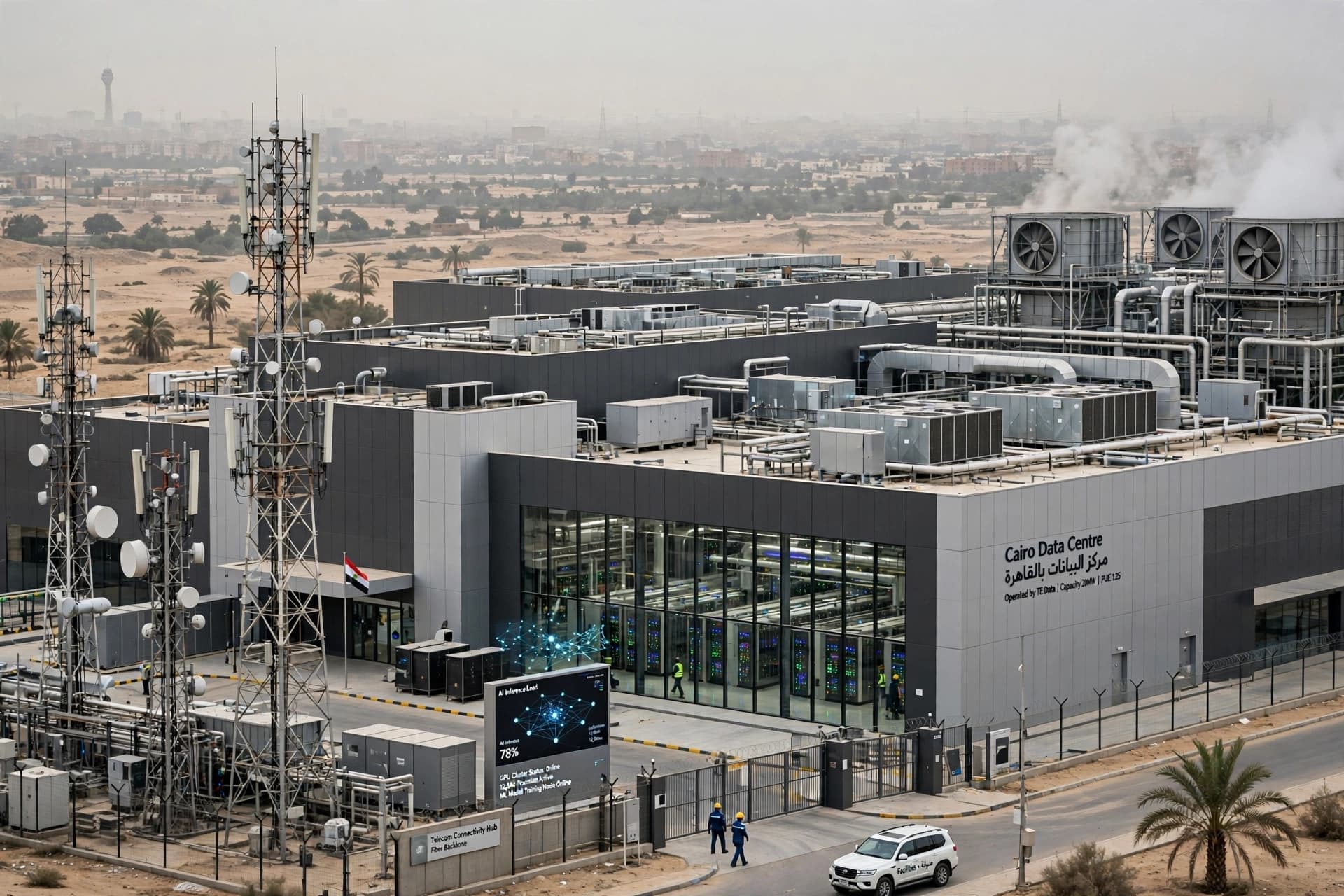
The accompanying AI-generated image is a conceptual visualization created for editorial purposes and should not be interpreted as a photograph of an actual facility or project.
SOURCES
Ahram Online Al-Ahram Weekly National Telecom Regulatory Authority
Published by Banx Network. This article is part of the Banx decentralized media programme, powered by the BXE token on the XRP Ledger.