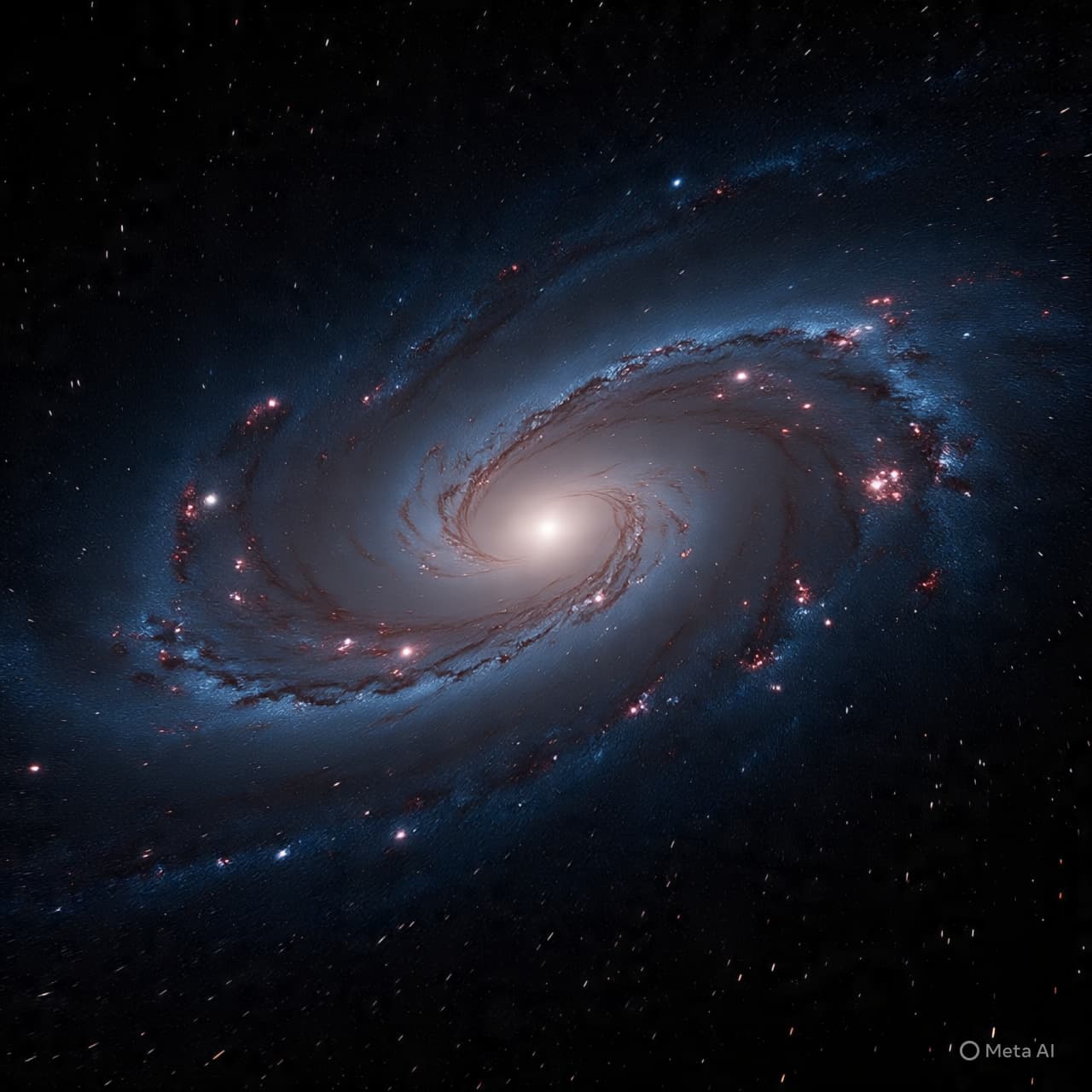
On clear nights in the southern hemisphere, observatories watch the sky with a patience that spans decades. The stars appear steady to the eye, but through powerful instruments they reveal quiet motions—galaxies turning, clouds of gas drifting, clusters of stars slowly rearranging themselves across the vast architecture of space.
Among those distant structures lies a galaxy whose shape has recently drawn renewed attention.
Astronomers using the Dark Energy Camera (DECam), mounted on the Víctor M. Blanco Telescope at the Cerro Tololo Inter-American Observatory in Chile, have captured a striking image of the galaxy NGC 1269. In the resulting observations, the galaxy reveals a shape that astronomers describe as resembling a cosmic steering wheel—a circular arrangement of stars and gas with delicate arms extending outward from a central hub.
Galaxies often form spirals, bars, or elliptical shapes, but each system carries its own variations in structure. In the case of NGC 1269, the distribution of stars creates a nearly ringlike configuration, giving the impression of spokes radiating through the disk. This pattern is thought to arise from gravitational dynamics within the galaxy—forces that guide the movement of stars and interstellar gas over millions of years.
The image captured by DECam offers remarkable clarity. With its wide field of view and sensitive detectors, the camera is designed to record faint light from distant objects across enormous regions of sky. Originally built to help scientists study the nature of dark energy, the instrument has also become a powerful tool for exploring galaxies and cosmic structures in detail.
Within NGC 1269, the image reveals bright regions where young stars are forming, scattered along the galaxy’s arms and ringlike features. These luminous knots mark areas where clouds of gas collapse under gravity, igniting new generations of stars that shine against the darker background of space.
Surrounding the galaxy is a quieter halo of older stars, remnants of earlier epochs of star formation. Together, these populations trace the slow evolution of the system—how matter gathers, rotates, and gradually reshapes itself under the influence of gravity.
Galaxies such as NGC 1269 remind astronomers that cosmic structures often develop through long sequences of interaction and change. Collisions with neighboring galaxies, internal gravitational resonances, and the flow of interstellar gas can all influence the patterns that emerge.
In this case, the circular “steering wheel” appearance may reflect waves of density moving through the galaxy’s disk, organizing stars and gas into repeating patterns that persist for millions of years.
For observers on Earth, such structures appear frozen in time, but the reality is more dynamic. Each star continues its orbit around the galaxy’s center, contributing to a slow and constant rearrangement of the stellar landscape.
The new DECam observations highlight the detailed structure of NGC 1269, offering astronomers a clearer view of how stars and gas are arranged within the galaxy and how gravitational forces shape its distinctive wheel-like form.
Researchers say the image demonstrates the capability of DECam to capture intricate galactic structures while contributing to ongoing studies of galaxy formation and evolution.
AI Image Disclaimer
This visual material was generated with AI to illustrate the scientific concept and does not represent an actual telescope photograph.
Source Check
Credible coverage and/or primary reporting exist from: NOIRLab ScienceDaily Phys.org Space.com Universe Today
Published by Banx Network. This article is part of the Banx decentralized media programme, powered by the BXE token on the XRP Ledger.