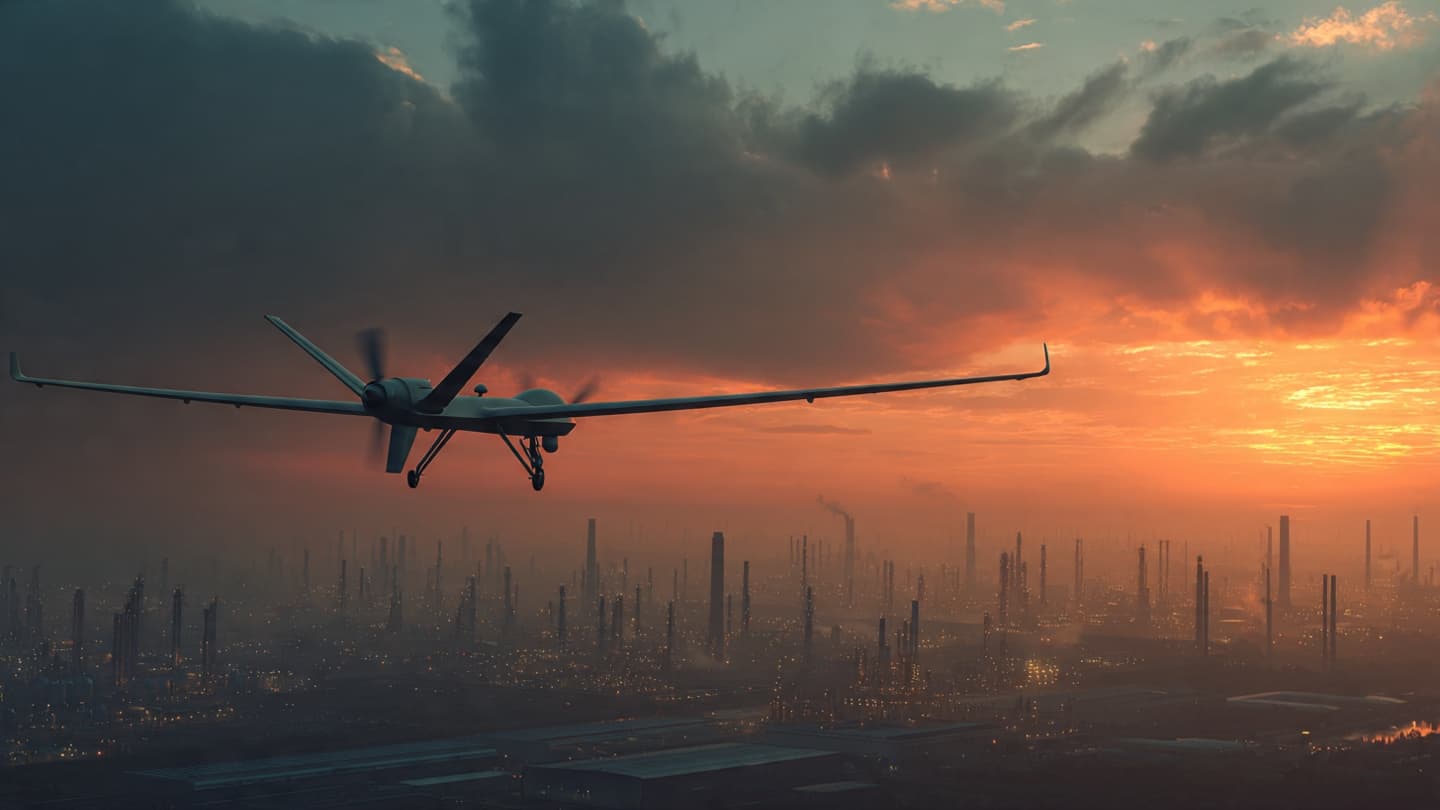
Before sunrise, the vast landscapes stretching across western Russia often rest beneath a quiet sky. Rail lines disappear into forests, rivers follow familiar courses toward distant seas, and industrial terminals begin another day of routine movement. Yet in modern conflict, distance no longer guarantees silence. The sky itself has become a pathway through which events unfold far from the front lines, connecting places once thought safely beyond the immediate reach of war.
During the latest wave of long-range operations, Ukrainian drones targeted energy infrastructure deep inside Russian territory, including an oil export terminal and other fuel-related facilities. Regional authorities acknowledged attacks in several locations, while emergency crews responded to fires and damage reported at energy sites. Ukrainian officials described the operation as part of an ongoing effort to reduce Russia's logistical and military capabilities by disrupting infrastructure that supports fuel supplies and exports.
Long-range drone strikes have become one of the defining features of the conflict. What began with relatively modest unmanned aircraft has evolved into increasingly sophisticated systems capable of traveling hundreds of kilometers with improved navigation and precision. These operations illustrate how technological innovation has gradually reshaped military strategy, allowing infrastructure well beyond traditional battlefields to become part of the wider contest.
Energy facilities occupy a particularly significant place within that strategy. Oil terminals, storage depots, and refinery networks serve both civilian economies and military logistics. Disruptions at these locations can affect fuel distribution, export capacity, and transportation networks, even when production itself continues elsewhere. Such facilities therefore represent strategic objectives whose importance extends beyond their physical structures.
The broader implications also reach international markets. Russia remains one of the world's major energy exporters, and incidents involving export infrastructure are closely monitored by traders, shipping companies, and governments. While individual attacks do not necessarily produce lasting supply disruptions, recurring strikes contribute to uncertainty surrounding transportation routes, insurance costs, and future market expectations.
For communities living near industrial facilities, however, these developments are experienced less through global economic analysis than through the sounds of emergency sirens, temporary evacuations, and the sight of firefighters working against flames before dawn. The industrial landscapes that normally symbolize routine production can, in moments such as these, become reminders that modern conflicts increasingly extend beyond conventional front lines.
Military analysts have observed that both Ukraine and Russia continue to adapt rapidly as drone technology evolves. Improvements in electronic warfare, air-defense systems, autonomous navigation, and long-range strike capabilities have created a conflict in which innovation moves almost as quickly as military operations themselves. Each side seeks not only to defend territory but also to influence the other's ability to sustain prolonged campaigns.
At the same time, diplomatic efforts aimed at reducing tensions continue alongside military developments. International partners remain engaged in discussions concerning security, humanitarian issues, and prospects for future negotiations, even as hostilities persist. The coexistence of dialogue and continued military operations reflects the complexity of a conflict in which political and battlefield dynamics unfold simultaneously.
As investigations assess the full extent of the reported damage, Ukraine's latest deep-strike operation underscores how the geography of war continues to expand. The conflict is increasingly defined not only by movements along the front but also by technological reach, strategic infrastructure, and decisions made far beyond the battlefield itself. Like the distant echoes that travel across open landscapes before sunrise, the consequences of these operations extend well beyond the places where they first begin.
AI Image Disclaimer
The visuals accompanying this article were generated using AI to illustrate the subject matter and are intended as conceptual representations rather than authentic photographs.
Sources
Reuters Associated Press BBC News Ukrainian General Staff Russian regional authorities
Published by Banx Network. This article is part of the Banx decentralized media programme, powered by the BXE token on the XRP Ledger.