Sometimes the echoes of the distant past can feel almost like whispers — a reminder that the deep history of life on Earth is written in stones and bone, waiting for our curiosity to unfold the stories they hold. In a remarkable moment of scientific exploration, researchers have now turned their attention to one such whisper: a 250-million-year-old fossil that may hold the key to understanding how early ancestors of mammals began to hear the world around them. In the quiet halls of a laboratory, where CT scans light up three-dimensional models and computers simulate the flow of sound through ancient bone, a new chapter in the story of hearing has begun.
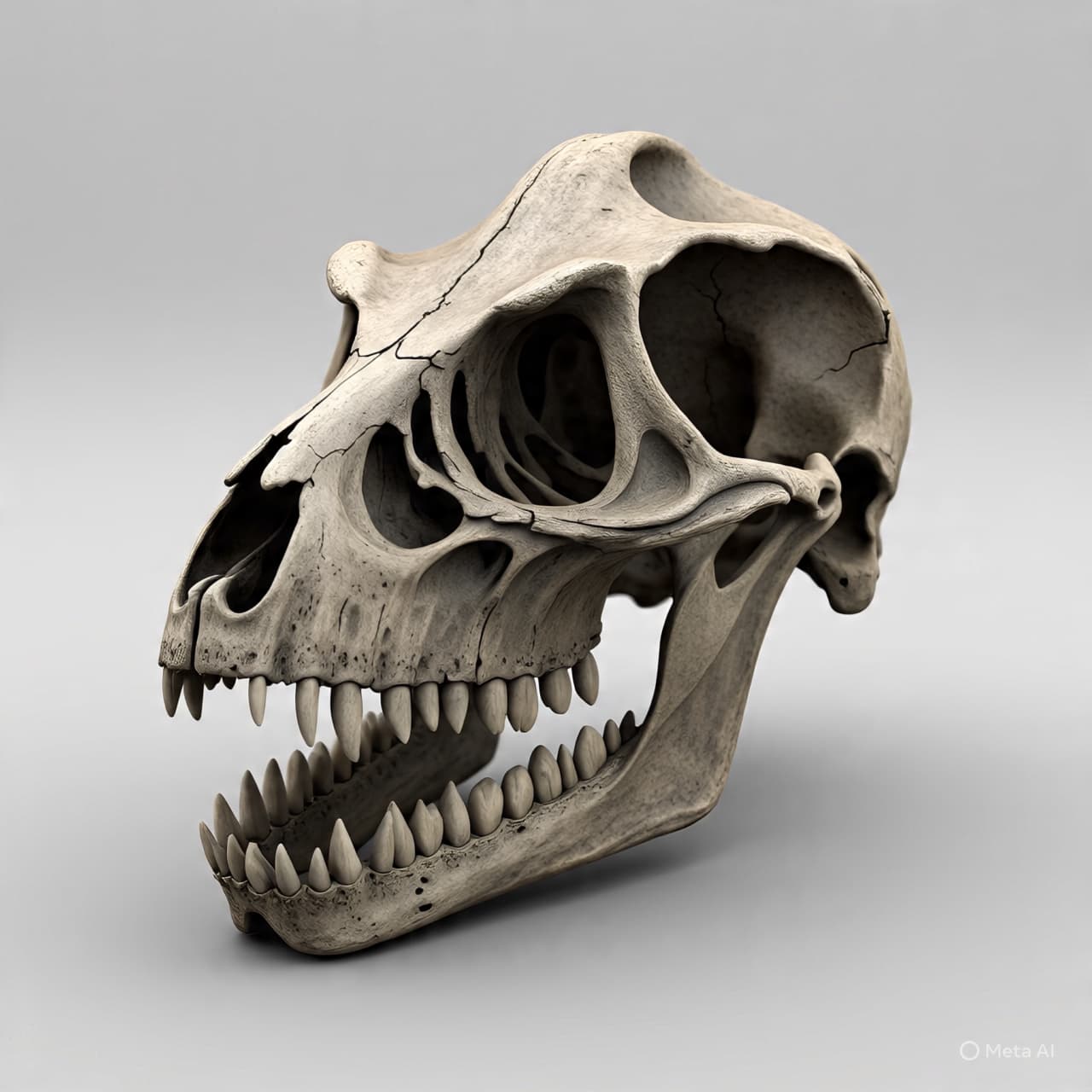
The fossil at the center of this discovery belongs to Thrinaxodon liorhinus, a creature that lived in the early Triassic period and walked the Earth long before the age of dinosaurs reached its peak. Though it bore traits that linked it to both reptilian ancestors and the earliest mammals, Thrinaxodon has long puzzled scientists when it came to its ability to perceive sound. Conventional wisdom held that such ancient animals could mainly detect vibrations through bone — a method very different from the sensitive airborne hearing that more advanced mammals use today. However, advances in imaging and engineering have given researchers a fresh perspective.
By using high-resolution CT scans of the fossil’s skull and jaw, paleontologists and biomechanical engineers created a detailed digital model of Thrinaxodon’s anatomy. They were then able to simulate how sound would travel through the creature’s jaw and middle ear structures — a technique that marries paleontology with modern computational tools. What emerged from this work suggests that an early eardrum was already in place in this ancient animal, capable of detecting airborne sound far more effectively than previously thought.
This finding gently pushes back the timeline for the evolution of sophisticated hearing by nearly 50 million years, suggesting that key elements of what we recognize today as “mammal-like” hearing were already beginning to take shape deep in prehistory. In a sense, Thrinaxodon may have heard the world in ways not unlike its distant descendants, navigating a Triassic landscape rich with sound and shadow.
For almost a century, scientists have debated how these early mammal relatives sensed their acoustic environment. The idea that they might have used an early membrane-like structure in their jaws as a precursor to a true eardrum was proposed decades ago but lacked strong biomechanical evidence — until now. By framing this ancient puzzle in terms of engineering and anatomy, researchers have effectively brought a long-standing hypothesis into sharper focus.
In these moments where the ancient past intersects with cutting-edge science, we are reminded that evolution is not a story of sudden leaps but of subtle shifts unfolding over vast spans of time. With each new fossil revelation, we gain not only technical insight, but also a deeper sense of continuity with the living world around us — a world that, in its very capacity to listen and adapt, reflects its long journey through Earth’s history.
In factual terms, a study led by researchers at the University of Chicago using CT imaging and biomechanical modeling indicates that Thrinaxodon liorhinus, a 250-million-year-old cynodont (early mammal ancestor), likely possessed a membrane capable of detecting airborne sound. This finding suggests that aspects of mammal-like hearing evolved significantly earlier than previous estimates, according to results published in the Proceedings of the National Academy of Sciences.
AI Image Disclaimer “Visuals are created with AI tools and are not real photographs.”
Sources ScienceDaily (University of Chicago study), SciTechDaily (biomechanical modeling), Phys.org (engineering analysis), DetikEdu (Indonesian science reporting), Live Science background context.
Published by Banx Network. This article is part of the Banx decentralized media programme, powered by the BXE token on the XRP Ledger.