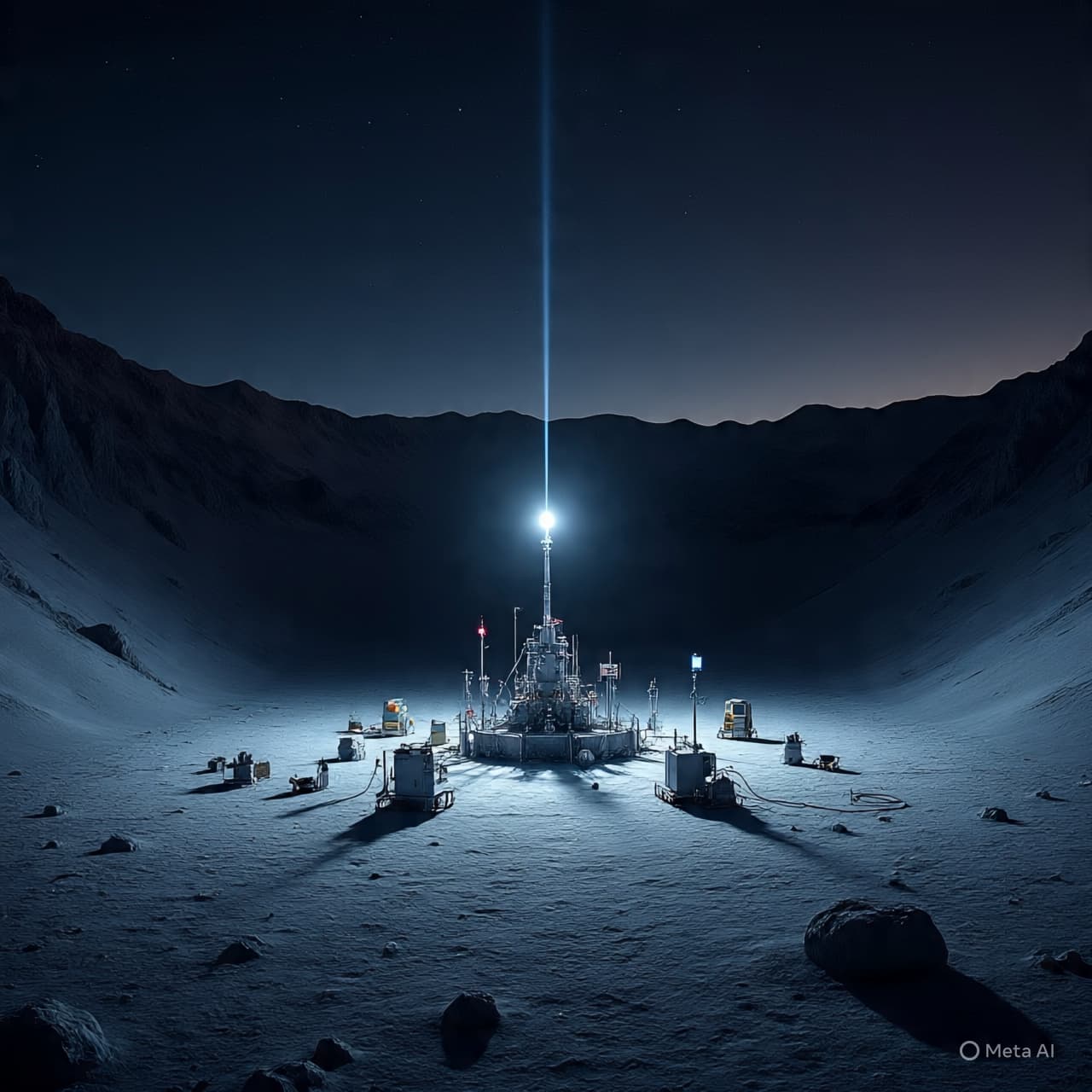
At the Moon’s poles, in the silent embrace of craters that never see the dawn, there is a kind of stillness that speaks not of emptiness but of possibility. Here, in the deep cold and near‑perfect quiet, light and time might find a home more stable than any on Earth — a place where a beam of laser light could be as steady as the heartbeat of a planet.
Scientists and engineers are now dreaming of such a place: to position an ultra‑stable laser system within one of these permanently shadowed regions, where the frigid, gentle darkness can serve as a cradle for new kinds of measurement and guidance. In this vision, a laser held in place by the lunar night could send out a rhythm of light both steady and pure, a beacon for spacecraft wandering in the deep shadows and a reference for clocks on Earth that seek ever greater precision.
On Earth, lasers are precious tools for navigation and timekeeping, but their stability is always at the mercy of an active world: the heartbeat of traffic, the rising and falling of heat, the capricious dance of air and vibration. On the Moon, in a crater untouched by sunlight, these disturbances are nearly absent. A block of cryogenic silicon suspended in these frigid depths could hold light so steady that it scarcely changes at all, the distance that light travels held constant to a degree Earthbound systems can only imagine. Such consistency — the product of temperature and silence — might allow the lunar laser to serve as a master clock, a timekeeper whose ticking would ripple outward, guiding satellites, rovers, and even clocks across continents.
But the potential goes beyond keeping better time. Future explorers, whether robotic scouts or astronauts in bulky suits, need more than instinct and star charts to find their way under the long shadows. A moon‑anchored laser could broadcast a steady signal to orbiting spacecraft and surface networks, a kind of lunar GPS that works where Earth’s systems cannot. In the darkness of the poles, where sunlight never reaches, such a guiding light could be as essential as the poles themselves are cold, offering a map of precision where none existed before.
In this unfolding story of light and motion, the Moon becomes not merely a destination but a partner in measurement. The same system that could help astronauts and rovers traverse silent craters might also refine our understanding of time’s passage back on Earth, helping synchronize atomic clocks with a steadiness once thought out of reach. And in doing so, it echoes an older practice — the lunar laser ranging experiments that have measured the distance between worlds for decades — but with a new, dynamic role that reflects the ambitions of an age moving beyond mere observation to presence and permanence.
As these ideas take shape on paper and in preprints, they remind us that the act of exploration is not only about movement through space but about the calibration of our instruments and our sense of place. A laser held in lunar cold, marking time with its steadfast glow, could help usher in missions that land in darkness with confidence and mark the seconds of both world and lunar days with uncommon clarity.
In straightforward terms, researchers from institutions including the National Institute of Standards and Technology and NASA’s Jet Propulsion Laboratory have proposed a conceptual lunar laser system placed in a permanently shadowed crater at one of the Moon’s poles. This ultra‑stable cryogenic silicon cavity laser could broadcast precise signals to aid navigation for spacecraft and surface explorers and improve global timekeeping by serving as an exceptionally stable reference. The concept remains theoretical but highlights potential advances in lunar mission support and timing infrastructure.
AI Image Disclaimer
Visuals are AI‑generated and serve as conceptual representations.
Sources (Media Names Only)
AzerNEWS Phys.org News Minimalist
Published by Banx Network. This article is part of the Banx decentralized media programme, powered by the BXE token on the XRP Ledger.