There are moments in exploration when patience gives way to boldness. For decades, humanity has sent spacecraft outward in careful arcs, tracing predictable paths around familiar worlds. But every so often, the cosmos offers a fleeting visitor—an object not born in our solar system, not bound by our Sun, merely passing through. And in that brief window, scientists must decide: observe from afar, or dare to chase.
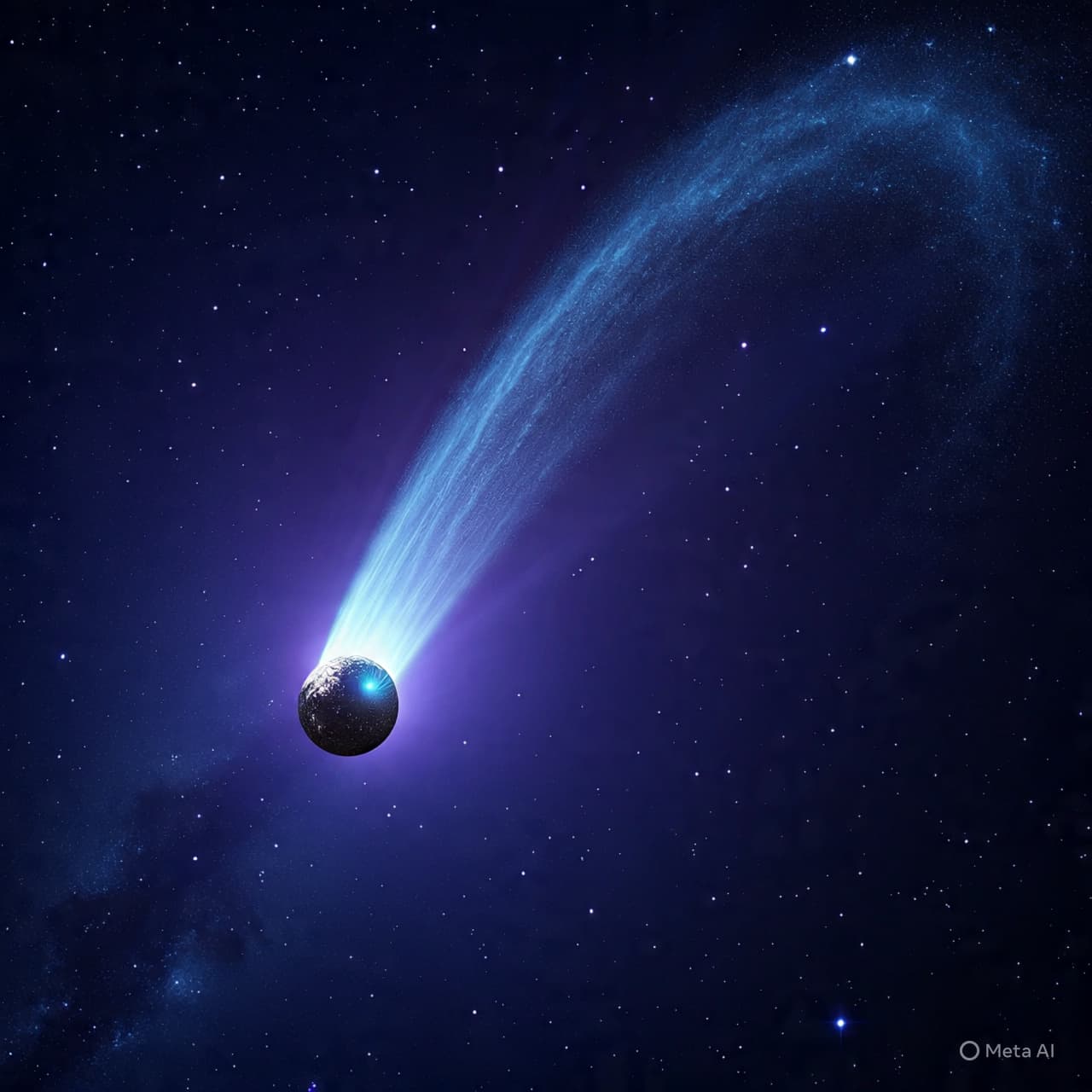
The newly identified interstellar comet 3I/ATLAS is one such traveler. Like its predecessors ‘Oumuamua and 2I/Borisov, it does not belong to our celestial neighborhood. It entered from the deep dark between stars, carrying with it material forged in another planetary system. To study such an object up close would be to examine a fragment of another star’s history. But time is the great constraint. Interstellar visitors do not linger.
Now, researchers are outlining a bold and technically demanding plan: a risky orbital maneuver that could redirect an existing or newly launched spacecraft toward 3I/ATLAS. The proposal hinges on precision timing and gravitational mechanics, a choreography of speed and alignment measured in kilometers per second.
Interstellar objects travel extraordinarily fast relative to the Sun. By the time astronomers detect them, they are often already moving at velocities that challenge pursuit. To intercept 3I/ATLAS, a spacecraft would need to dramatically increase its heliocentric speed. Traditional propulsion alone may not suffice. Instead, mission planners are considering gravitational assists—using close flybys of planets such as Earth, Venus, or Jupiter to slingshot a spacecraft onto a faster trajectory.
This maneuver is not without risk. Gravity assists require exact timing and razor-thin margins of error. A slight miscalculation could send a spacecraft off course, wasting fuel or missing the comet entirely. Moreover, the window for launch or redirection may be narrow, closing as the comet speeds away from the Sun and back toward interstellar space.
One concept under discussion involves leveraging spacecraft already in development, modifying their mission profiles to allow a rapid-response intercept. Another possibility includes designing a dedicated probe capable of high-speed travel, perhaps using advanced propulsion methods or staged gravity assists to build velocity. In either case, the engineering challenge is considerable.
Why take such a gamble? Because interstellar comets are scientific treasures. Unlike comets formed within our solar system, 3I/ATLAS originated around another star. Its composition—ices, dust, organic molecules—may reflect the chemistry of distant planetary nurseries. Studying it up close could provide rare insight into how other solar systems form and evolve. It would be, in essence, a sample return mission without the return.
Past encounters have been limited. ‘Oumuamua was detected too late for interception, leaving astronomers to study it remotely as it faded from view. 2I/Borisov allowed more detailed telescopic observations, revealing a composition somewhat familiar yet distinctly alien. But no spacecraft has yet visited an interstellar object directly. 3I/ATLAS may offer that opportunity—if the risks can be managed.
There is also a philosophical dimension to the pursuit. For centuries, comets were seen as omens, then as icy remnants of our own system’s birth. Now, some are emissaries from elsewhere. To chase one is to reach beyond the Sun’s influence, to briefly touch something shaped by another star’s light.
Engineers and mission planners are currently evaluating feasibility, fuel requirements, trajectory windows, and potential spacecraft candidates. The proposed maneuver would demand careful coordination and swift decision-making. Funding, technical readiness, and international collaboration will also play roles in determining whether the mission proceeds.
For now, 3I/ATLAS continues its passage, indifferent to the calculations unfolding on Earth. Whether a spacecraft ultimately meets it will depend on engineering precision and strategic timing. Scientists note that even if interception proves impossible this time, the planning effort strengthens preparedness for future interstellar visitors. Each passing comet reminds us that the galaxy is not distant—it occasionally drifts straight through our sky.
AI Image Disclaimer: Illustrations were produced with AI and serve as conceptual depictions.
Sources: NASA Space.com Scientific American Nature The Planetary Society
Published by Banx Network. This article is part of the Banx decentralized media programme, powered by the BXE token on the XRP Ledger.